Hair grows roughly half an inch each month, and no product or treatment has been shown to push past that rate. What you can control is breakage.
Split ends travel up the strand, and friction from heat tools, tight styles and rough handling snaps off length before you notice it. A dusting removes an eighth of an inch of damage without costing you progress.
1. Eat a Balanced, Nutrient-Rich Diet

Your hair is made of protein, so getting enough of it at every meal matters. Each strand builds from keratin, and when protein runs short, your body redirects what it has to organs that need it more.
Hair growth slows or stalls. I aim for a palm-sized portion with breakfast and lunch, the amount trichologists recommend for keeping follicles supplied.
Iron, zinc, and B vitamins show up in most of the foods already worth eating: eggs, beans, spinach, lean beef, and fish. Vitamin C from bell peppers and berries helps produce collagen, which strengthens strands so they break less often.
Vitamin E in avocados protects the scalp from oxidative stress. Healthy fats from salmon, nuts, and olive oil carry nutrients to the follicle.
Restrictive eating hits hair hard.
Hair cells divide fast, making them sensitive to skipped meals or inadequate nutrition. A balanced diet with whole grains, vegetables, lean proteins, and unsaturated fats supports growth better than any one supplement alone.
2. Use Supplements Only When Appropriate

Supplements can help when a genuine deficiency is holding growth back, but they are not a shortcut to faster growth.
If you suspect low iron or another nutritional gap, talk to your healthcare provider before starting anything. Self-diagnosing a deficiency often misses the full picture, and iron deficiency rarely travels alone.
Biotin, collagen, vitamins A, C, D and E, zinc, and amino acids all support the follicle, but no pill makes hair grow faster than your genetics allow.
What supplements can do is reduce breakage and keep existing strands from snapping off, which preserves length over time.
That takes patience. Results, when they come, may not show up for one to five years.
Hair grows half an inch a month no matter what you take, so a strand reaching shoulder length from the scalp needs five to six years even under ideal conditions.
If your diet already covers these nutrients, a supplement adds little. The best route is a balanced plate, and a multivitamin only when blood work shows a real gap.
3. Care for the Scalp

Care for the Scalp
A healthy scalp supports stronger hair as it grows, while inflammation and buildup can slow things down or weaken strands as they emerge.
Shampoo two to three times a week to keep the scalp clean without stripping natural oils, and add a clarifying shampoo about once a week or every other week to lift away product residue, sebum and pollutants that regular shampoo leaves behind.
That buildup can block serums and treatments from reaching the follicle, so clearing it off matters more than it sounds.
If your scalp is itchy or flaky, treat the irritation first. Anti-dandruff formulas or fragrance-free options help calm sensitivity, and a flaky scalp has been linked to thinner hair and loss in several studies.
I apply conditioner from mid-length down and rinse it completely to avoid weighing down the roots or adding more buildup where I just cleaned.
4. Massage the Scalp
Massage the Scalp
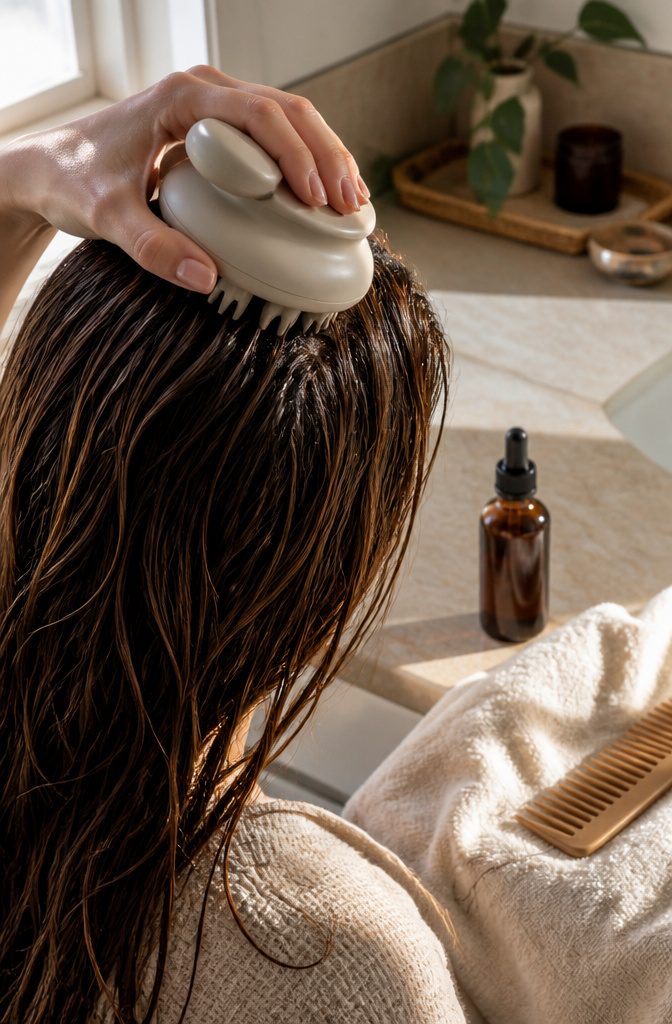
A scalp massage may help support thicker hair, though the evidence remains limited.
One study found that men who massaged their scalps for four minutes every day had thicker hair after 24 weeks. Some participants experienced temporary shedding around the 12-week mark before growth resumed.
The men in that study used a massage device rather than their fingers. Rubbing with your fingertips may actually contribute to hair loss, so a tool is the safer route.
I would massage while applying a scalp scrub or serum, which gives you a reason to be thorough and helps remove product buildup and dead skin at the same time.
Consistency matters more than perfect timing, so daily is ideal but as often as you can manage still counts.
5. Get Regular Trims or Dustings
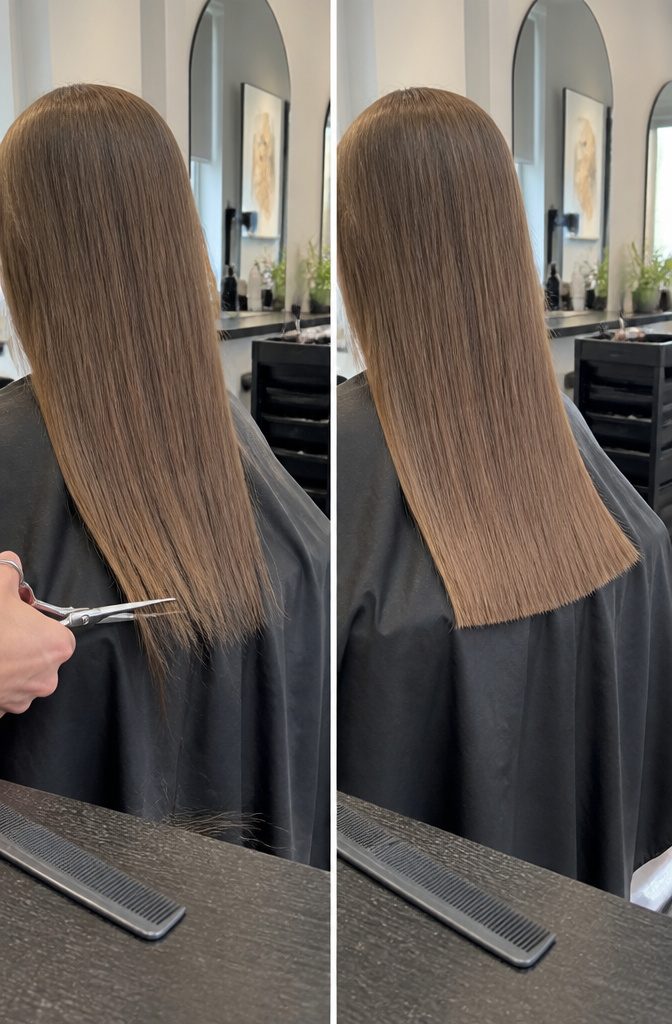
Trims do not make hair grow faster at the scalp, but they stop split ends from traveling up the strand and costing you the length you already gained.
A split left alone works its way higher, turning a quarter inch of damage into several inches you have to cut later.
The question is how often to go in. Intervals depend on how quickly your ends fray: every 6–8 weeks if breakage is frequent, or stretch it to 3 months if your hair holds up better.
For serious length retention, ask for a dusting instead of a standard trim. That eighth of an inch barely shows on the floor but removes the damaged tips without sacrificing progress.
Hair grows about half an inch a month, so a quarter-inch trim every 3 months keeps you ahead. I treat the appointment as insurance, not as the thing that makes growth happen.
6. Limit Heat Styling and Use Heat Protection
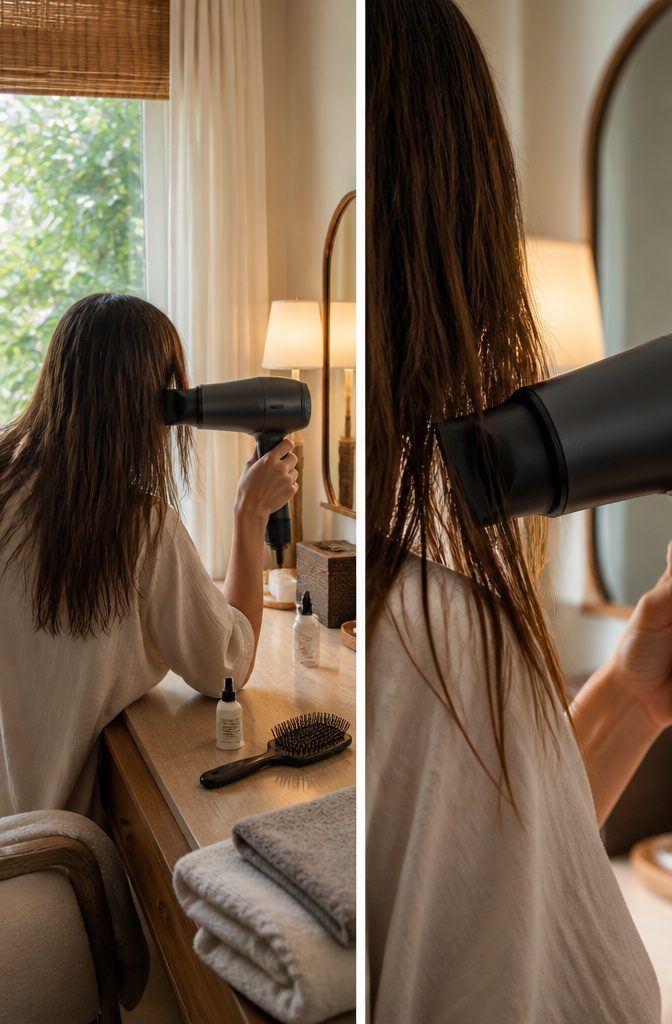
Frequent heat styling weakens hair and makes it prone to snapping before it reaches the length you want.
If you blow-dry, straighten or curl your hair regularly, turn the temperature to the lowest setting and work quickly so the heat touches each section as briefly as possible.
Stopping when your hair is about 80 percent dry and letting the rest air-dry helps, too.
A heat protectant is not optional if you use hot tools. I always apply one before any styling, and Kérastase’s L’Incroyable Blowdry Lotion offers protection up to 450°F, which covers the range of most flat irons and curling wands.
Spray it on damp hair before blow-drying, or on dry sections before using a straightener or curling iron.
Giving your hair a break from heat a few days a week lets it recover.
Air-drying and working with your natural texture saves time in the morning and keeps breakage in check, which makes a noticeable difference when you are trying to keep every inch you grow.
7. Be Gentle with Wet Hair and Detangle Carefully
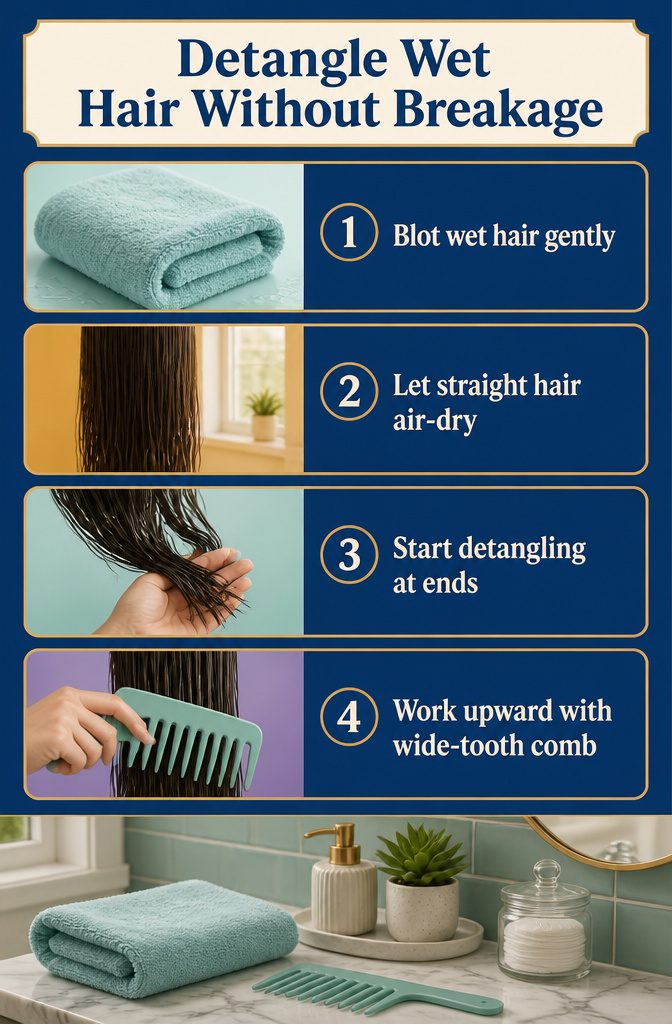
Wet hair stretches far more than dry hair, and that makes it vulnerable to breakage when you brush or tug at it.
If you comb through from the roots down, every knot has to travel the full length of the strand.
Start at the ends instead and work upward. The tangle clears with less distance to pull through, and you put less strain on the shaft.
For straight hair, let it air-dry first, then use a wide-tooth comb. Textured and curly hair can be detangled while damp, but you still need a wide-tooth comb or a tool built for wet detangling.
After washing, wrap your hair in a microfibre towel or blot it gently rather than rubbing. Heat tools on soaking-wet hair create steam bubbles inside the strand, weakening it where you cannot see the damage until it snaps.
8. Limit Damaging Chemical Treatments
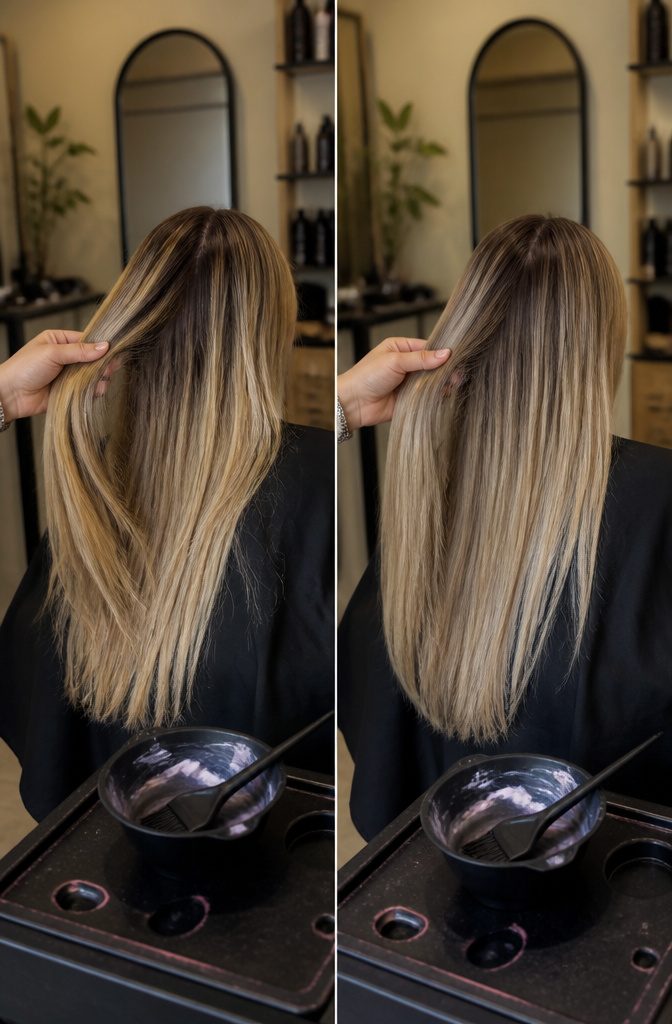
Limit Damaging Chemical Treatments
Bleach and relaxers weaken the hair shaft, and the damage adds up with each service. A single bleach appointment can compromise the cuticle enough that ends snap off before they reach the length you’re trying to hold onto.
Relaxers work the same way: they break protein bonds to straighten the texture, and that leaves hair more fragile.
If you’re relaxing, touch-ups should land about every two to three months rather than sooner.
Overlapping chemical treatments onto previously processed hair is where the worst breakage happens. I’d rather stretch the interval and keep the length than chase a crisp line at the scalp and lose inches at the ends.
Coloring, especially anything that requires lifting your natural pigment, falls into the same category. The more you lift, the more porous the strand becomes, and porous hair breaks.
If you’re committed to color or texture services, a stylist who knows your hair history will get you closer to the result without the cost that home kits often extract.
9. Use Conditioning Treatments and Suitable Hair Products
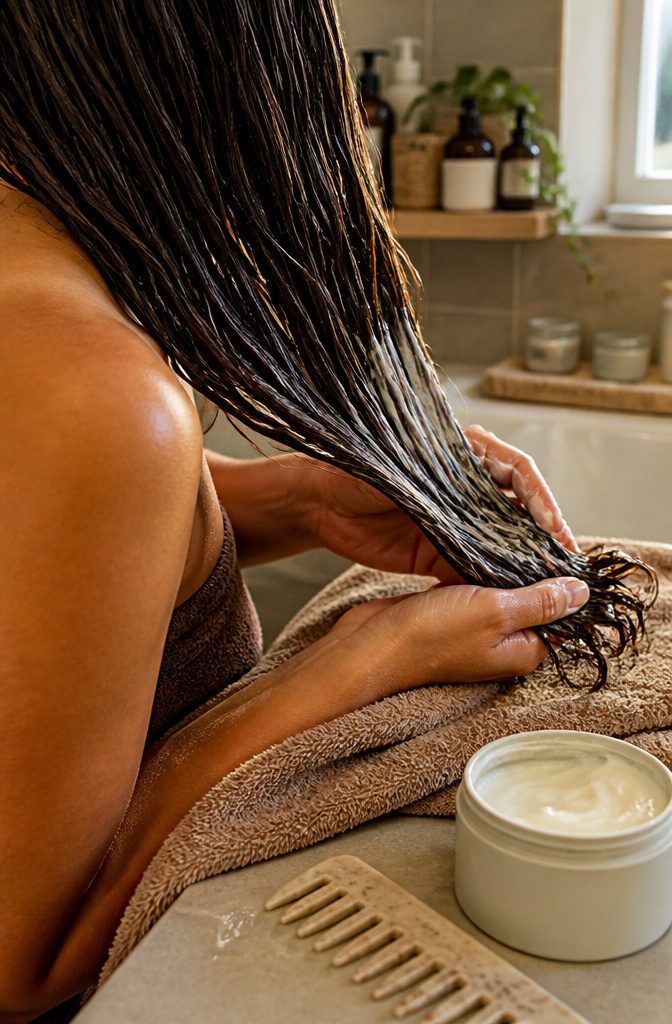
Conditioners and masks do more than soften hair.
A weekly deep-conditioning treatment keeps strands strong enough to hold onto the length you already have. Dry, brittle hair snaps easily, and every break is length you lose before you notice it.
I apply a mask once or twice a week to damp hair, wrap it in a warm towel for five minutes, and let the heat push moisture in.
The ends need the most attention. They are the oldest part of your hair, thinner and more fragile than anything near the scalp, and they have taken the most damage from sun, brushing and styling.
When I deep condition, I work most of the product into the last few inches.
A molecular treatment with five amino acids can make hair up to 82 percent stronger. The Kérastase Resistance Extentioniste collection claims 99 percent less breakage and 78 percent fewer split ends when you use the full system.
10. Manage Stress

Manage Stress
Stress disrupts the hair growth cycle by pushing follicles out of the active growth phase and into a resting stage where they shed more easily.
High cortisol levels from chronic stress can also inflame the scalp, which interferes with how well your body absorbs nutrients your hair needs.
I have seen people lose noticeably more hair during stressful stretches, and it grows back once they bring stress levels down.
Activities like exercise, time outdoors, deep breathing and meditation help lower cortisol and keep follicles in the growth phase longer.
If you are pulling or scratching at your hair when anxious, that is worth flagging separately, since the mechanical damage compounds the hormonal effect. Stress management is not optional for length retention.
11. Protect Hair During Sleep

Protect Hair During Sleep
Your hair tangles and snags against a cotton pillowcase as you move at night, and that friction breaks strands before they reach any useful length.
Silk or satin pillowcases cut that friction down—your hair glides instead of catching, and you wake up with fewer knots and less breakage. Cotton pulls moisture out overnight; silk and satin keep it in.
If you don’t want to swap pillowcases, a silk hair wrap does the same job.
A loose top knot works too, keeping hair in place without the tension that causes its own kind of damage. The knot should sit high and loose enough that it doesn’t pull.
Before bed, a few strokes with a brush move natural oils through your lengths and prevent knots from forming while you sleep.
A few strokes, not fifty. Over-brushing weakens hair, but a quick pass smooths things out and gets circulation going at the scalp.
12. Avoid Tight or Repetitive Hairstyles
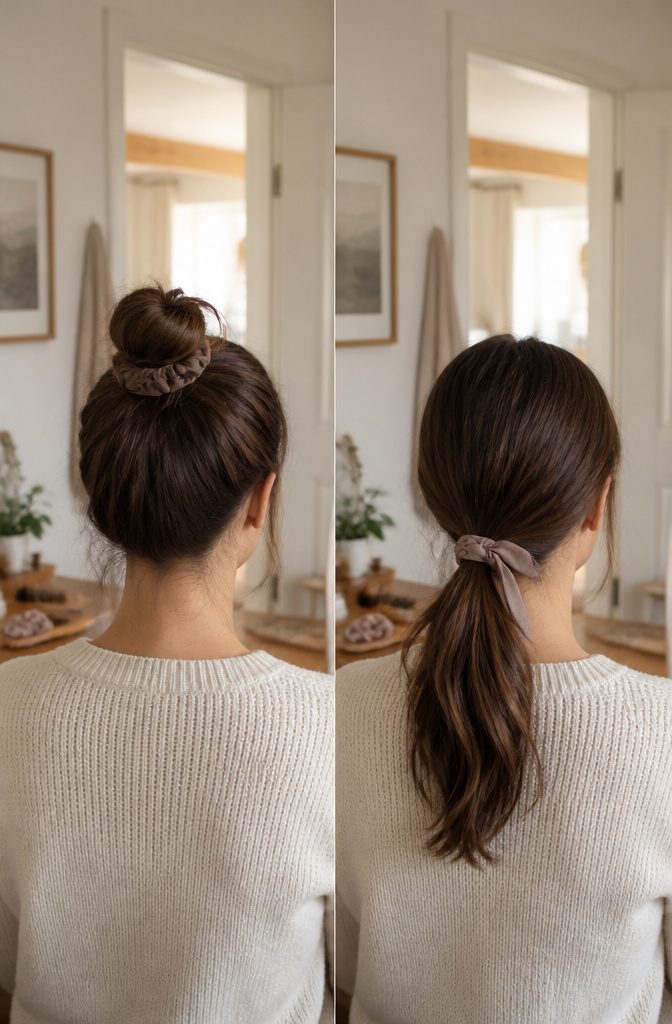
Tight ponytails, braids and cornrows can stress the hair shaft enough that it breaks before it reaches your shoulders.
The same goes for extensions and weaves: wear them for no more than 2–3 months at a time, then give your scalp and natural hair a rest.
The damage is slow and easy to miss until you notice your hairline pulling back or thinning at the temples.
Frequent twisting or pulling makes hair seem like it grows more slowly, because the length you gain gets lost to breakage.
If you usually wear your hair pulled back, try loosening the elastic or rotating styles so the tension moves around. On days you can skip the ponytail, skip it.
13. Consider Medical Evaluation or Treatment for Hair Loss
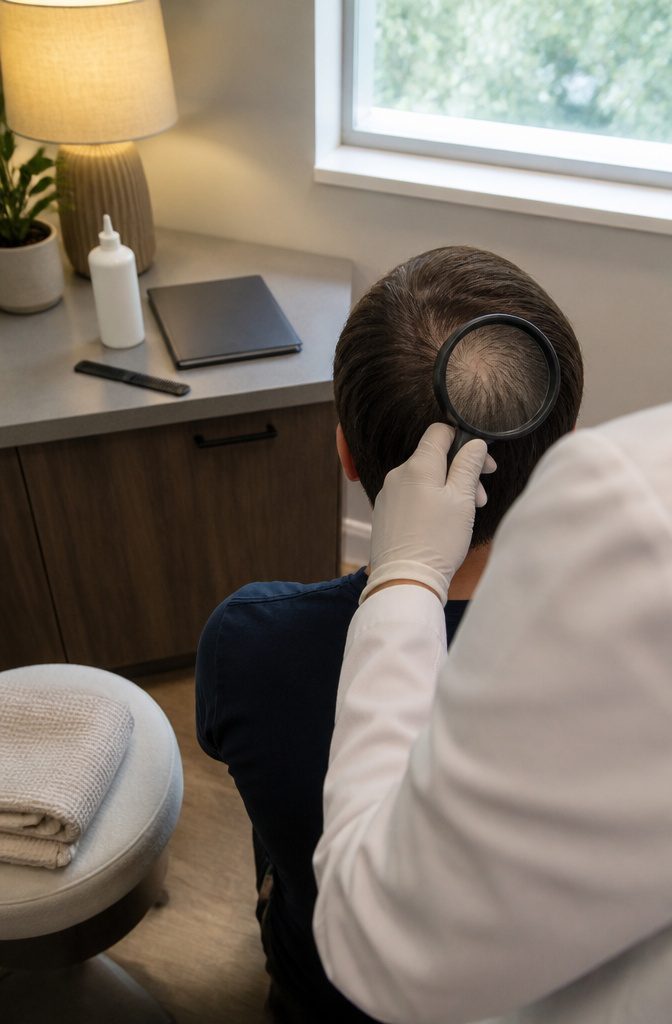
When hair loss or sudden thinning shows up, I recommend talking to a dermatologist who works in trichology.
That branch of medicine focuses on scalp and hair issues, and a specialist can identify what is causing the problem and whether any treatment might reverse it or encourage regrowth.
Minoxidil is the only over-the-counter option approved by the FDA for hair loss in both men and women. It comes as a 2% or 5% liquid or foam, sold under names like Rogaine or Theroxidil.
It stimulates growth and thickens existing hair, but it requires daily application to the scalp. If you stop using it, the hair loss returns, sometimes faster than before.
For male pattern baldness, which affects more than half of men over fifty, prescription options include finasteride taken orally or minoxidil applied topically.
These can slow the loss, but once a follicle shrivels completely, the hair will not grow back even with treatment.
14. Be Patient and Set Realistic Expectations
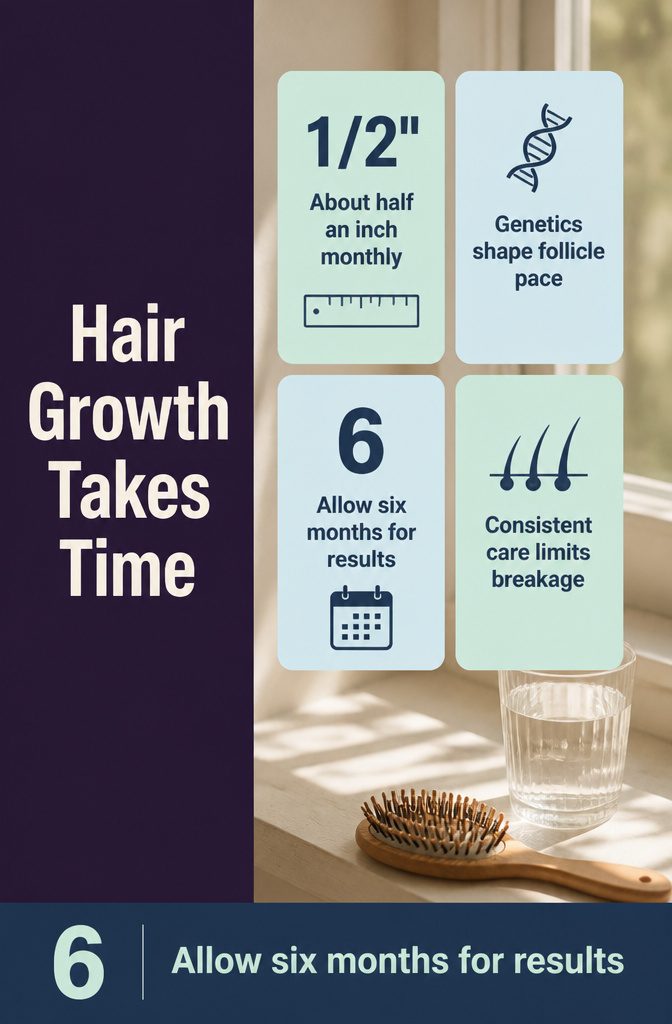
There is no reliable way to exceed your natural growth rate. Hair grows at roughly half an inch per month, and that pace is determined by genetics and the health of the follicle.
The real work is supporting what you already grow and keeping it from breaking off before you notice the length.
If you start a serum or a new routine, give it a solid six months before you expect visible results. Growth happens slowly, and anything promising faster gains is overselling what the biology allows.
The patience is not optional. You are protecting strands that take months to reach your shoulders, and the difference between keeping them and losing them to breakage is often just consistent care over time rather than one dramatic fix.
Hair Cannot Usually Be Made to Grow Dramatically Faster
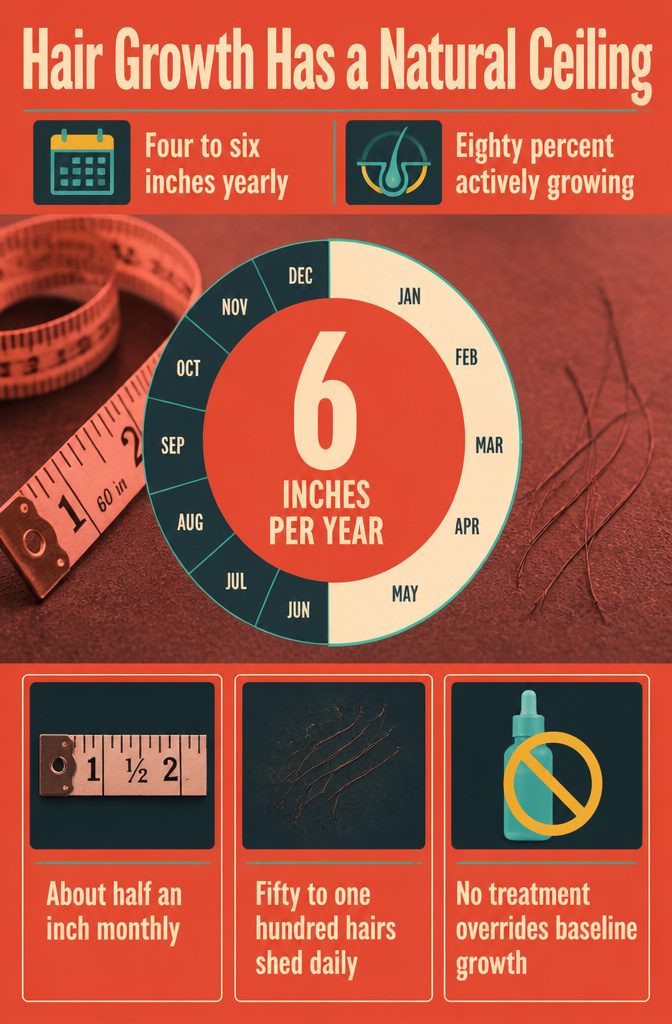
Hair grows around half an inch per month, which works out to roughly six inches over a year.
Cleveland Clinic puts the yearly range at four to six inches and notes that about 80 percent of your hair is actively growing at any given time.
The rest is either resting or shedding, which is why fifty to a hundred hairs falling out each day is normal and not a sign something is wrong.
There is no method that forces hair to grow faster than that baseline rate.
The growth phase is set by genetics, and no product or treatment has been shown to extend it. What you can control is how much of that length you keep.
If hair breaks off at the same rate it grows, the tape measure never moves. Focus on reducing breakage and shedding so more of what grows stays on your head, rather than trying to speed up growth itself.
Why Breakage and Split Ends Make Growth Seem Slower
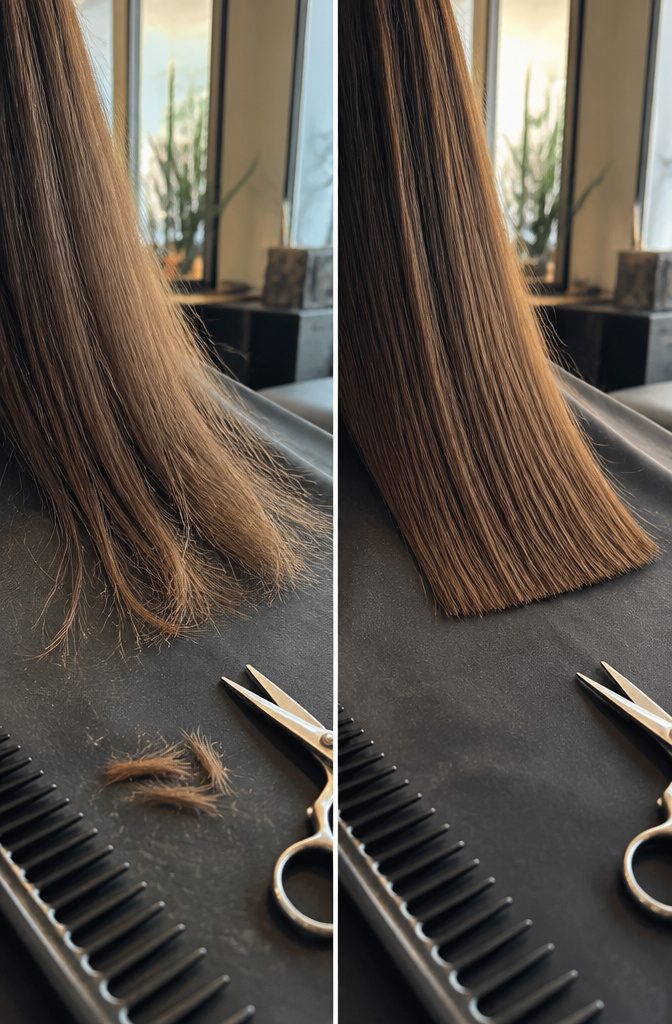
Hair grows about half an inch each month from the scalp, but split ends and breakage can steal that length from the other end.
A split travels up the hair shaft the way a run climbs a stocking, and if you leave it alone, you lose more length than the trim would have taken.
The dusting technique removes just an eighth of an inch, enough to cut off the damaged tip without sacrificing the progress you made.
Gentle handling matters just as much. Frequent twisting, tight braids, hot tools and chemical treatments all weaken strands, and once the hair breaks, it looks like growth stalled.
Conditioner minimizes tangles and prevents the kind of snapping that happens when you work through knots, so the length you grow from the root actually stays on your head.
Hair-Growth Cycle Stages
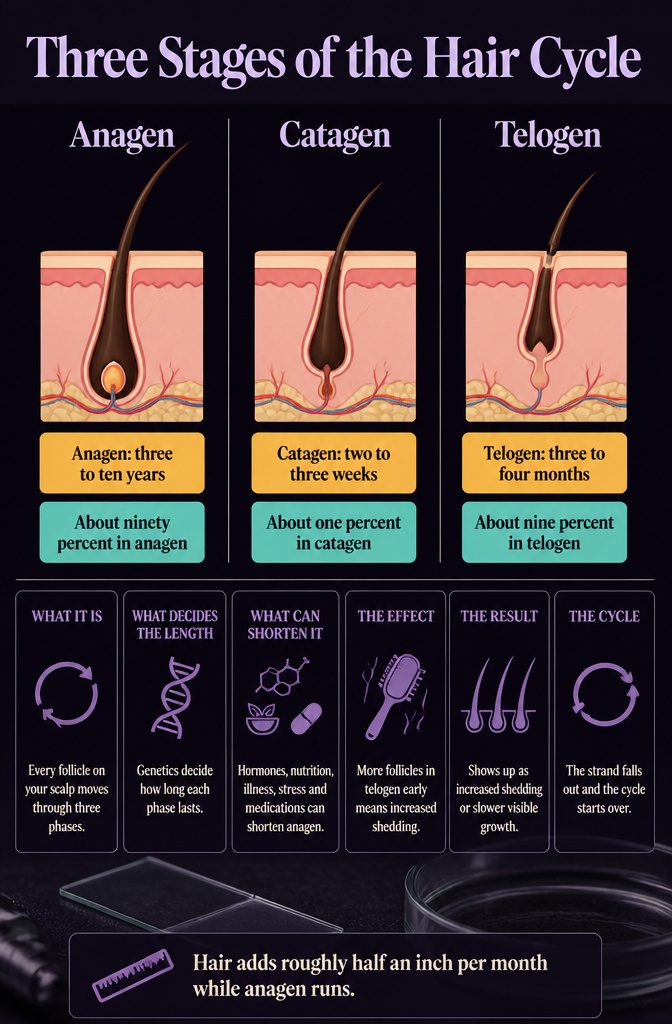
Every follicle on your scalp moves through three phases. The anagen phase is active growth and lasts anywhere from three to ten years, with about ninety percent of follicles in this stage at any given time.
Hair adds roughly half an inch per month while anagen runs. Catagen follows next, a brief transition lasting two to three weeks where growth stops and only about one percent of follicles sit in this window.
Then telogen arrives, the resting phase that holds around nine percent of your follicles for three to four months before the strand falls out and the cycle starts over.
Genetics decide how long each phase lasts, which explains why some people grow waist-length hair while others plateau at shoulder length.
Hormones, nutrition, illness, stress and medications can all shorten anagen or push more follicles into telogen early, showing up as increased shedding or slower visible growth.
Frequently Asked Questions
How long does it take for your hair to grow?
Hair grows about half an inch per month, which works out to roughly 6 inches per year. The active growth phase (anagen) lasts 3 to 10 years for most people, with genetics determining how long each follicle stays in that phase.
That explains why some people can grow waist-length hair while others reach a natural stopping point at shoulder length.
What affects hair growth?
Genetics, age, hormones, nutrition, overall health, stress, medications, and the condition of your scalp and hair all influence how fast your hair grows and how much length you keep.
Hormonal changes, nutritional deficiencies, illness, significant stress, and certain medications can push more follicles into the shedding phase early.
Breakage from heat, chemicals, tight hairstyles, or friction can also make hair appear to grow more slowly even when the follicle is producing strands at a normal rate.
Can you grow hair faster and thicker naturally?
Natural remedies and supplements may help when hair loss or damage stems from a nutritional deficiency, but they do not produce results overnight.
It usually takes 1 to 5 years to see meaningful changes, since hair grows only half an inch per month and a strand reaching shoulder length from the scalp needs 5 to 6 years under ideal conditions.
A balanced diet with adequate protein, iron, zinc, B vitamins, and healthy fats supports the follicle better than any single supplement.
Can I grow 1 inch of hair in a month?
No. Hair grows at roughly half an inch per month on average, and there is no method that forces it to exceed that rate.
The growth phase is set by genetics, and no product or treatment has been shown to extend it.
Can hair grow 2 inches in 2 weeks?
No.
Hair grows about half an inch per month, which works out to roughly a quarter inch over 2 weeks. No supplement, serum, or routine can push hair to grow faster than your genetics allow.