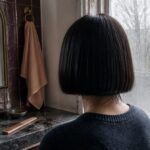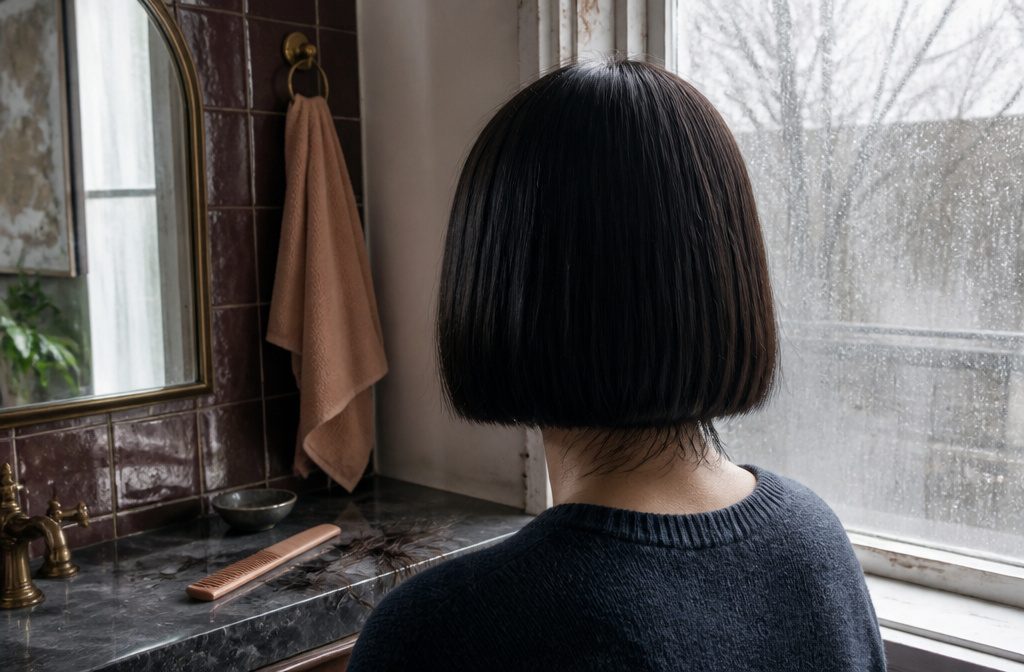
A blunt bob is the most reliable cut for making thinning hair look denser, because the one-length edge removes the contrast between fuller mid-shaft and sparse tips.
That only holds if you trim every 6 weeks; without it, the ends feather out and the illusion fades. Anyone who wants texture over a clean line should choose a layered or asymmetrical bob instead.
1. Blunt Bob
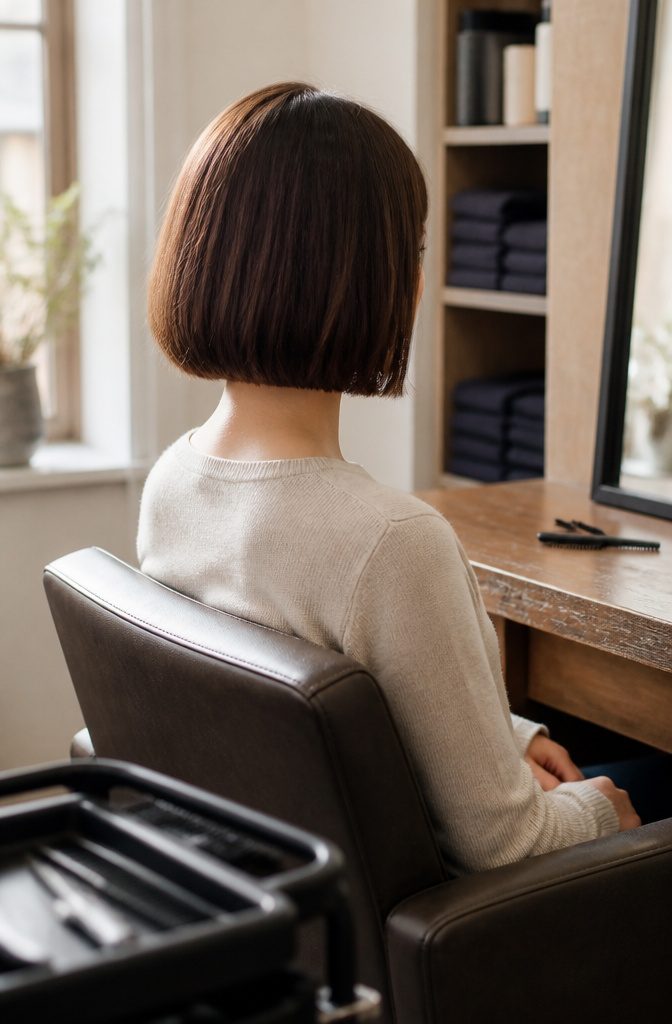
A one-length blunt cut eliminates the wispy, uneven ends that make thinning hair look sparse, replacing them with a solid, uniform edge that reads as density.
The visual logic is simple: a clean line removes the contrast between the fuller mid-shaft and the thin tips, so the hair appears to have consistent weight throughout.
Length is flexible. A chin-length bob works well for straight or wavy hair; a longer blunt bob suits thin curly hair, keeping enough length that curls don’t spring up too short and lose their shape.
Regular trims every 6 weeks maintain the sharp edge that makes the cut work. Without them, the ends start to feather out and the illusion fades.
2. Layered Bob
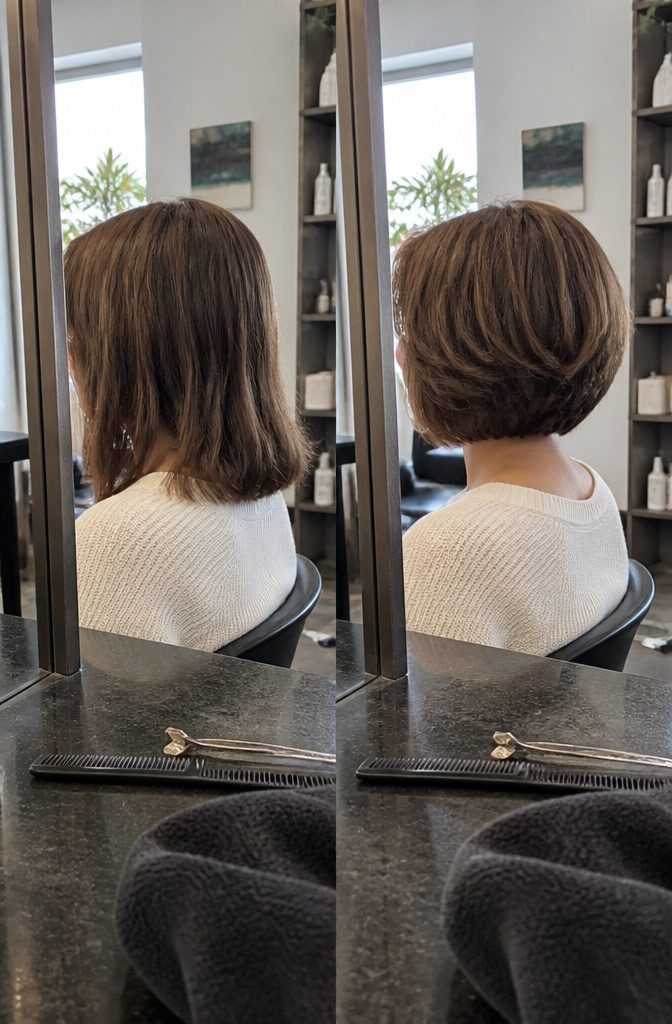
Layers cut to sit around the jawline add lift at the crown by removing weight from the ends, which lets the roots push up rather than lie flat.
The shorter the base length, the more that mechanical lift works in your favor, which is why a bob carries this effect better than a lob or a shoulder-length cut.
There is a real split on how much layering to ask for. Soft, blended layers preserve thickness at the perimeter while still creating movement.
Choppy or excessive layers thin the ends and can leave fine hair looking flat and sparse, which defeats the purpose. Tell your stylist you want layers that blend smoothly at the tips, not a stacked or heavily textured finish.
3. Asymmetrical Bob
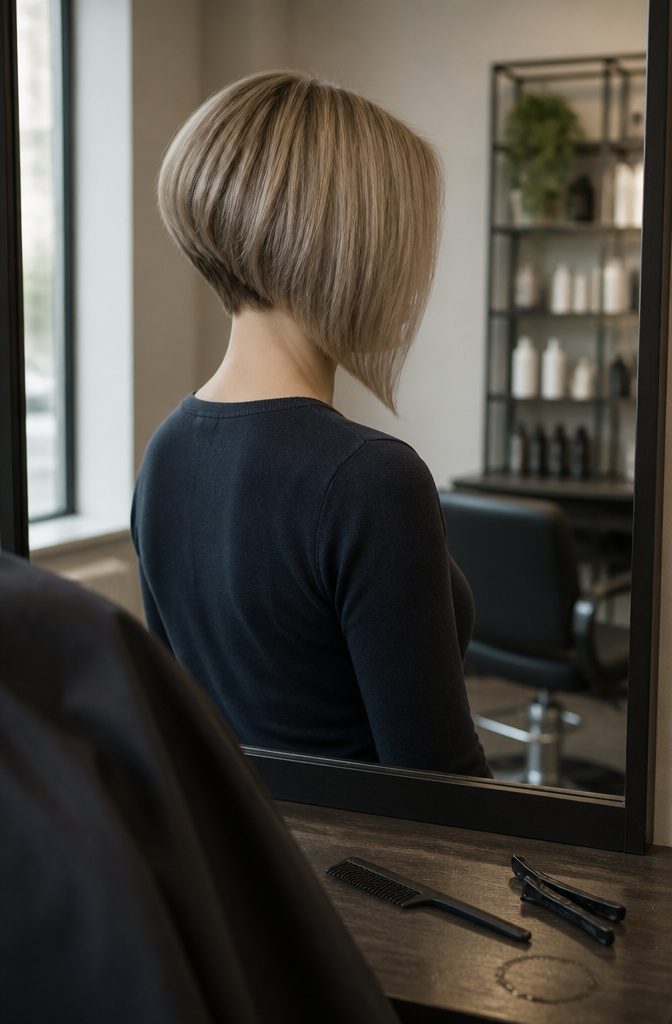
One side sits shorter than the other, and that uneven line is exactly what creates dimension on fine or sparse hair where a blunt, even perimeter would just lie flat.
The asymmetry draws the eye along the longer front section rather than landing on any one spot, which makes it the better choice over a symmetrical bob if your thinning is diffuse across the crown rather than concentrated at a single part.
The longer front framing the face also adds definition around the jawline. A stacked back keeps volume at the nape without visible layers, which suits anyone who prefers a sleeker finish over a heavily textured look.
4. Lob
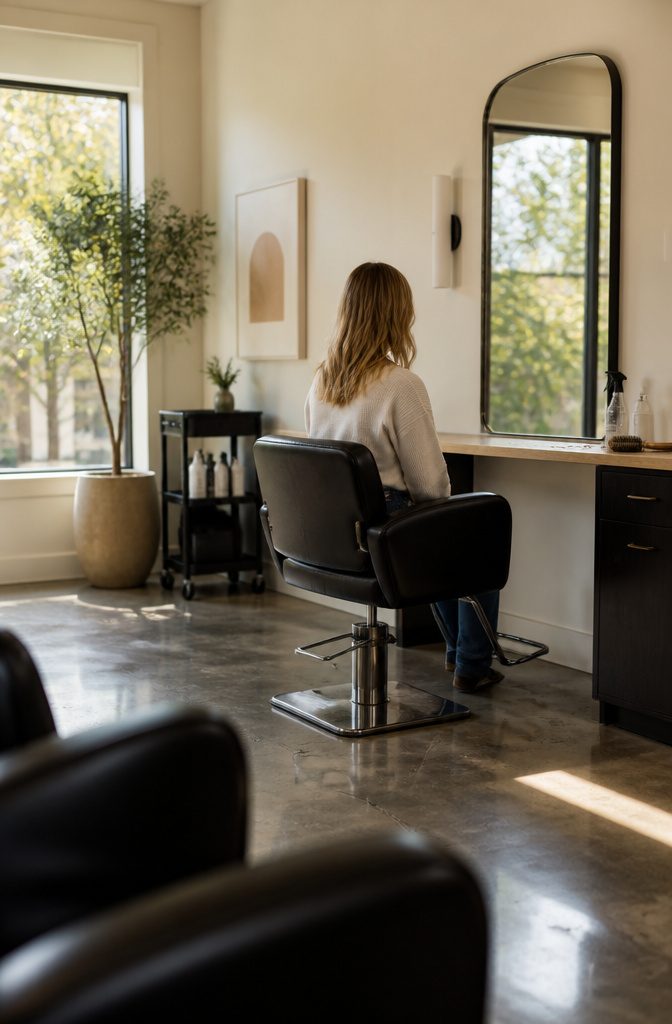
Shoulder to just below the collarbone is the range that makes a lob work for thinning hair.
Longer than that, the weight of the hair pulls the strands flat and emphasizes exactly the thinness you’re trying to minimize. Stop at shoulder length and the hair holds its own lift.
It suits anyone not ready to go short, because there’s still real length to work with.
Soft layers through the mid-lengths add movement without the disheveled effect that heavy layering can produce. Loose waves, heat-styled or natural, give the cut dimension that a single-length blunt cut at this length can’t match on its own.
5. Pixie
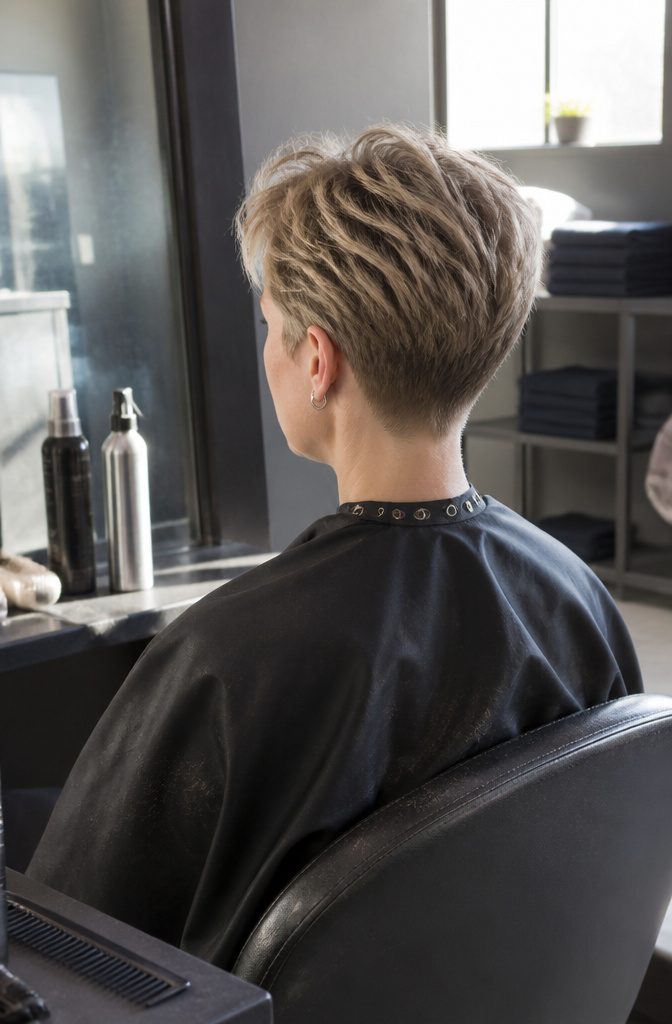
Short hair lifts at the roots on its own, and that natural root volume is exactly what thinning hair needs most.
A pixie with longer, piecey layers on top eliminates the length that drags fine hair flat, while keeping the sides cropped reduces the contrast between thinner and fuller areas.
Ask for a textured, choppy finish rather than a smooth one.
Side-swept bangs make the neck look longer and draw attention away from sparse patches. Mousse before the blow-dry, then a light-hold spray at the end, gives the top that effortless lift without stiffness.
This cut suits thinning at the crown particularly well. It’s low-maintenance in the morning and grows out forgivingly.
6. Shag
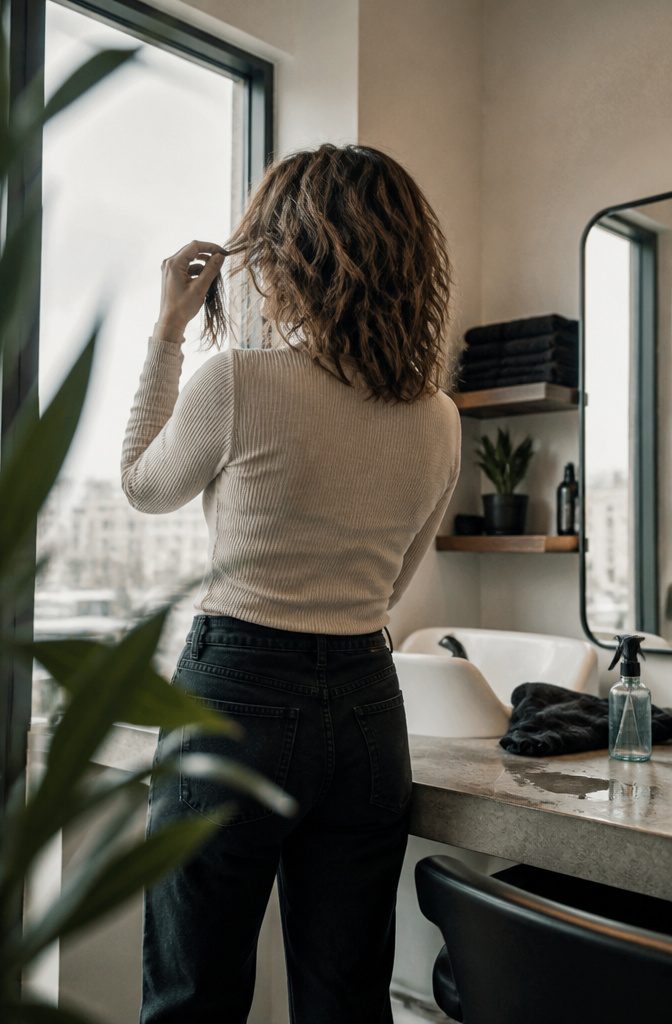
Choppy layers are what make the shag work for thinning hair. Each layer interrupts the eye’s path down the strand, so instead of reading flat and sparse, the hair looks textured and dense.
The effect compounds when the cut is shoulder-length: the longer top and back create shape while the lighter sides keep weight from dragging the volume down.
Styling is minimal by design. Work a small amount of sea salt spray through damp hair and let it air-dry, shaping waves loosely with your fingers as it sets.
The slightly undone finish isn’t a compromise with this cut; it’s the whole mechanism. Tight, polished styling actually flattens what the layers built.
7. Long Layers
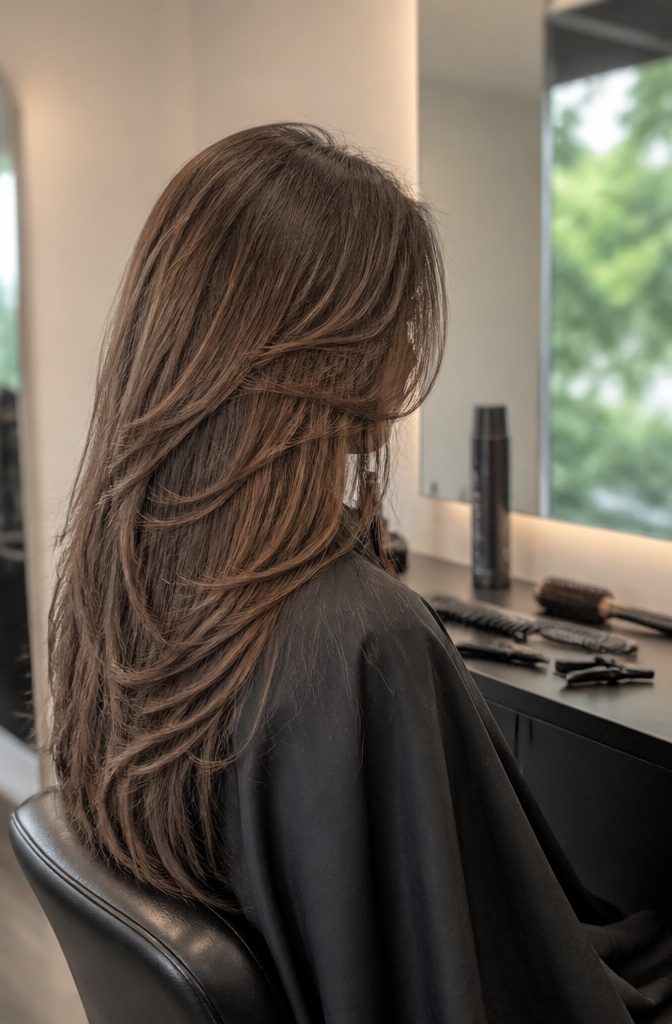
Soft, blended long layers are the best option if you want to keep your length but stop your hair from lying flat against your head.
A feathered or V-shaped cut lightens heavy ends so the hair has room to move, whereas short choppy layers cut too close together can expose thinning sections rather than disguise them.
Ask your stylist for face-framing layers that graduate gradually toward the back rather than layers cut at a single uniform length.
That graduation keeps weight where you need it while the lighter ends create the lift fine hair loses when it grows past the shoulders.
Blunt ends are the thing to avoid here. They drag the eye down the length and make thinning more visible, not less.
8. Bangs
Let me analyze what I need to write here.
The section is about "Bangs" for an article on "19 Haircuts for Thinning Hair That Add Volume and Shape."
- Adding a fringe makes hair look thicker/fuller by bringing more hair forward, and can hide a receding hairline
- Ask stylist to add texture to fringe for more body
- Curtain bangs frame the eyes and soften thinning near the temples; paired with gentle waves they look balanced
- Side-swept bangs soften a wide forehead or sparse hairline; blunt bangs add structure at front
- Heavy thinning with razor or thinning shears can remove too much weight from fine hair
- Curtain bangs especially great if thinning noticeable near temples; hide sparse spots at front; add movement to long hair
- Side-swept bangs cover thinning hairline; low-maintenance
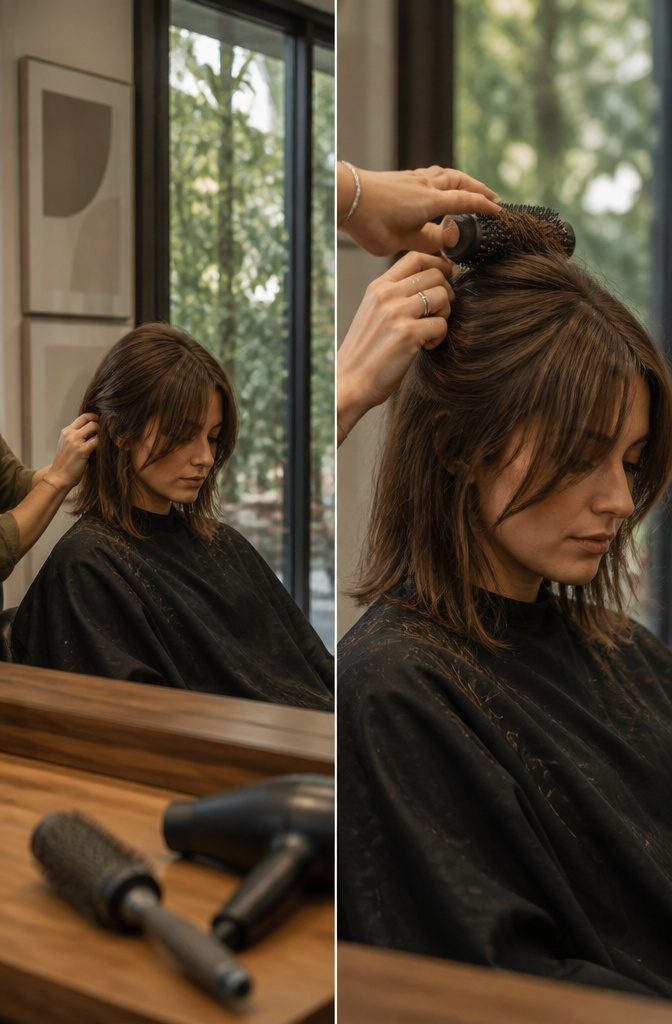
- Blow-dry side-swept bangs with round brush, sweep softly to side
- Textured fringe uses short uneven layers on top to make hair look thicker/lifted; fringe cut forward and slightly messy; covers light thinning near hairline
- Soft fringe via "feathering" creates choppy look ideal for volume
- Wispy/piecey bangs better than blunt for finer hair (don’t detract from overall volume)
- Curtain bangs flatter most hair types and face shapes, add face-framing volume
Explain which fringe types suit thinning at the hairline or temples, and how bangs shift focus."
Layout: flowing prose in paragraphs. No lists.
Voice: First person singular "I" but only 7% of sentences should open with "I". Most sentences lead with subject/material/reader.
Length: HARD CEILING 120 words. This is short.
No em dashes. No banned words.
American English. Flesch-Kincaid 8-9.
Let me write this. I need to be opinionated, lead with substance, bold the key thing the reader came for.
Let me draft:
Bangs bring more of your hair forward, which instantly creates the look of fullness and draws attention away from thinning areas.
The fringe type matters more than the length does. Curtain bangs are the pick for thinning at the temples, because they frame the eyes and soften that area without requiring much density.
Side-swept bangs handle a sparse or receding hairline better than anything blunt, since the angle covers the spot and a round-brush blow-dry keeps them soft.
Wispy, piecey fringe is the safer call for fine hair than a blunt cut, which eats into whatever volume you have. A textured or feathered fringe adds body where the hairline is thinning lightly.
One thing to watch: heavy thinning with a razor or thinning shears strips too much weight from fine hair, so I’d ask the stylist point-blank which tools they plan to use.
Let me count words:
Bangs bring more of your hair forward, which instantly creates the look of fullness and draws attention away from thinning areas.
(20) The fringe type matters more than the length does. (9) Curtain bangs are the pick for thinning at the temples, because they frame the eyes and soften that area without requiring much density.
(22) Side-swept bangs handle a sparse or receding hairline better than anything blunt, since the angle covers the spot and a round-brush blow-dry keeps them soft.
(26) Wispy, piecey fringe is the safer call for fine hair than a blunt cut, which eats into whatever volume you have. (21) A textured or feathered fringe adds body where the hairline is thinning lightly.
(13) One thing to watch: heavy thinning with a razor or thinning shears strips too much weight from fine hair, so I’d ask the stylist point-blank which tools they plan to use. (31)
Total: about 142 words.
Too long. Need to cut to 120.
Let me tighten:
Bangs bring more hair forward, which creates instant fullness and pulls focus off thinning areas. Curtain bangs are the pick for thinning at the temples because they frame the eyes and soften that zone without needing much density.
Side-swept bangs handle a sparse or receding hairline better than anything blunt, since the angle covers the spot and a round-brush blow-dry keeps them soft.
Wispy, piecey fringe is the safer call for fine hair than a blunt cut, which eats into the volume you already have. A textured or feathered fringe adds body where the hairline is thinning lightly.
One caution: heavy thinning with a razor or thinning shears strips too much weight from fine hair, so I’d ask the stylist which tools they plan to use.
Let me count:
- Bangs bring more hair forward, which creates instant fullness and pulls focus off thinning areas. (15)
- Curtain bangs are the pick for thinning at the temples because they frame the eyes and soften that zone without needing much density. (22)
- Side-swept bangs handle a sparse or receding hairline better than anything blunt, since the angle covers the spot and a round-brush blow-dry keeps them soft. (26)
- Wispy, piecey fringe is the safer call for fine hair than a blunt cut, which eats into the volume you already have. (21)
- A textured or feathered fringe adds body where the hairline is thinning lightly. (13)
- One caution: heavy thinning with a razor or thinning shears strips too much weight from fine hair, so I’d ask the stylist which tools they plan to use. (27)
Total: 124.
Still a bit over. Let me trim more.
Bangs bring more hair forward, which creates instant fullness and pulls focus off thinning areas. Curtain bangs are the pick for thinning at the temples because they frame the eyes and soften that zone without needing much density.
Side-swept bangs handle a sparse or receding hairline better than anything blunt, since the angle covers the spot and a round-brush blow-dry keeps them soft.
Wispy, piecey fringe beats a blunt cut for fine hair, which eats into the volume you already have.
A textured or feathered fringe adds body where the hairline thins lightly. One caution: heavy thinning with a razor or thinning shears strips too much weight from fine hair, so I’d ask the stylist which tools they plan to use.
Count:
- Bangs bring more hair forward, which creates instant fullness and pulls focus off thinning areas. (15)
- Curtain bangs are the pick for thinning at the temples because they frame the eyes and soften that zone without needing much density. (22)
- Side-swept bangs handle a sparse or receding hairline better than anything blunt, since the angle covers the spot and a round-brush blow-dry keeps them soft. (26)
- Wispy, piecey fringe beats a blunt cut for fine hair, which eats into the volume you already have. (18)
- A textured or feathered fringe adds body where the hairline thins lightly. (12)
- One caution: heavy thinning with a razor or thinning shears strips too much weight from fine hair, so I’d ask the stylist which tools they plan to use. (27)
Total: 120.
Right at the ceiling. Let me trim one more sentence to be safe.
Actually, let me re-read the rules.
"HARD CEILING: 120 words for this section. A limit, not a length to aim for; on reaching it, cut the weakest sentence rather than run past."
So 120 is the max.
Let me make sure I’m under. Let me recount carefully.
"Bangs bring more hair forward, which creates instant fullness and pulls focus off thinning areas." — Bangs(1) bring(2) more(3) hair(4) forward(5) which(6) creates(7) instant(8) fullness(9) and(10) pulls(11) focus(12) off(13) thinning(14) areas(15). = 15
"Curtain bangs are the pick for thinning at the temples because they frame the eyes and soften that zone without needing much density." — Curtain(1) bangs(2) are(3) the(4) pick(5) for(6) thinning(7) at(8) the(9) temples(10) because(11) they(12) frame(13) the(14) eyes(15) and(16) soften(17) that(18) zone(19) without(20) needing(21) much(22) density(23). = 23
Hmm, I miscounted. Let me recount everything carefully.
Sentence 1: Bangs bring more hair forward, which creates instant fullness and pulls focus off thinning areas. Bangs-1 bring-2 more-3 hair-4 forward-5 which-6 creates-7 instant-8 fullness-9 and-10 pulls-11 focus-12 off-13 thinning-14 areas-15 = 15
Sentence 2: Curtain bangs are the pick for thinning at the temples because they frame the eyes and soften that zone without needing much density.
Curtain-1 bangs-2 are-3 the-4 pick-5 for-6 thinning-7 at-8 the-9 temples-10 because-11 they-12 frame-13 the-14 eyes-15 and-16 soften-17 that-18 zone-19 without-20 needing-21 much-22 density-23 = 23
Sentence 3: Side-swept bangs handle a sparse or receding hairline better than anything blunt, since the angle covers the spot and a round-brush blow-dry keeps them soft.
Side-swept-1 bangs-2 handle-3 a-4 sparse-5 or-6 receding-7 hairline-8 better-9 than-10 anything-11 blunt-12 since-13 the-14 angle-15 covers-16 the-17 spot-18 and-19 a-20 round-brush-21 blow-dry-22 keeps-23 them-24 soft-25 = 25
Sentence 4: Wispy, piecey fringe beats a blunt cut for fine hair, which eats into the volume you already have. Wispy-1 piecey-2 fringe-3 beats-4 a-5 blunt-6 cut-7 for-8 fine-9 hair-10 which-11 eats-12 into-13 the-14 volume-15 you-16 already-17 have-18 = 18
Sentence 5: A textured or feathered fringe adds body where the hairline thins lightly. A-1 textured-2 or-3 feathered-4 fringe-5 adds-6 body-7 where-8 the-9 hairline-10 thins-11 lightly-12 = 12
Sentence 6: One caution: heavy thinning with a razor or thinning shears strips too much weight from fine hair, so I’d ask the stylist which tools they plan to use.
One-1 caution-2 heavy-3 thinning-4 with-5 a-6 razor-7 or-8 thinning-9 shears-10 strips-11 too-12 much-13 weight-14 from-15 fine-16 hair-17 so-18 I’d-19 ask-20 the-21 stylist-22 which-23 tools-24 they-25 plan-26 to-27 use-28 = 28
Total: 15+23+25+18+12+28 = 121
One over. Let me trim one word somewhere.
Sentence 6: "One caution: heavy thinning with a razor or thinning shears strips too much weight from fine hair, so I’d ask the stylist which tools they plan to use."
I could drop "too": "strips much weight" sounds odd.
Let me change "One caution:" to "Watch for this:" — same word count. Or I could say "heavy thinning with a razor or thinning shears strips weight from fine hair, so I’d ask the stylist which tools they plan to use."
That drops "too much" → saves 2 words. = 26. Total 119.
Actually "strips weight from fine hair" vs "strips too much weight from fine hair" — the "too much" carries meaning. Let me try elsewhere.
Sentence 3: "Side-swept bangs handle a sparse or receding hairline better than anything blunt" → "Side-swept bangs handle a sparse or receding hairline better than blunt cuts" = saves "anything" → but changes meaning slightly. "anything blunt" = 2 words, "blunt cuts" = 2 words. Same.
Let me just drop "instant" from sentence 1: "Bangs bring more hair forward, which creates fullness and pulls focus off thinning areas." = 14.
Total 120. Hmm that’s exactly at ceiling.
Actually, let me reconsider. "on reaching it, cut the weakest sentence rather than run past."
So I should be at or under 120. Let me aim for 118 or so.
Let me revise:
Bangs bring more hair forward, which creates fullness and pulls focus off thinning areas. Curtain bangs are the pick for thinning at the temples because they frame the eyes and soften that zone without needing much density.
Side-swept bangs handle a sparse or receding hairline better than anything blunt, since the angle covers the spot and a round-brush blow-dry keeps them soft.
Wispy, piecey fringe beats a blunt cut for fine hair, which eats into the volume you have.
A textured or feathered fringe adds body where the hairline thins lightly. One caution: heavy thinning with a razor or thinning shears strips too much weight from fine hair, so I’d ask the stylist which tools they plan to use.
Changes: dropped "instant" (sentence 1: 14), dropped "already" (sentence 4: 17).
Total: 14+23+25+17+12+28 = 119. Good, under 120.
Now let me check all the rules:
- No em dashes: ✓ (I used commas, colons)
- No banned words: Let me check. "delve, delving, tapestry, testament, realm, landscape of, navigate the, embark, elevate, unlock, unleash, harness, leverage, robust, seamless, cutting-edge, game-changer, game changing, moreover, furthermore, in conclusion, it is worth noting, it’s worth noting, that being said, when it comes to, in today’s world, in this day and age, ever-evolving, ever-changing, plethora, myriad, crucial, pivotal, vibrant, bustling, nestled, boasts, showcase, showcasing, dive into, deep dive, treasure trove, revolutionize, empower, curated, meticulous, meticulously, foster, underscore, a testament to, look no further, the world of, whether you are a, from novice to, not only, but also, rest assured, at the end of the day, needless to say, the point is, the key is, the key detail, the key thing, the trick is, the thing is, the good news is, the bad news is, the bottom line, what matters is, here is how, here is where, here is the thing, the beauty of, the catch is, it all comes down to, that is the point, the goal is, the tradeoff is, the trade-off is, the sweet spot, the whole point, you do not need, you don’t need, transform, navigating, picture this, top-notch, unveil, we’ve got you covered, daunting, dive in, ensure, in summary, optimal, assessing, firstly, strive, striving, comprehensive, we know, we understand, captivating, eager, refreshing, edge of my seat, breath of fresh air, breath of fresh, it is important to consider, there are a few considerations, it’s essential to, vital, it’s important to note, it should be noted, to sum up, secondly, lastly, in terms of, with regard to, it’s worth mentioning, it’s interesting to note, significantly, notably, essentially, as such, therefore, thus, interestingly, in essence, noteworthy, bear in mind, it’s crucial to note, one might argue, it’s widely acknowledged, predominantly, from this perspective, in this context, this demonstrates, arguably, it’s common knowledge, undoubtedly, this raises the question, in a nutshell, unveiled, transforms, transformed, transforming, explore, discover, payoff"
None of these appear. ✓
- First person "I" only 7% of sentences open with it. I have 6 sentences. Only sentence 6 has "I’d" mid-sentence. None open with "I". ✓ (Actually the rule says 7% should open with "I" — so roughly 0-1 out of 6 is fine. Having 0 is fine.)
- Numbers in digits: No numbers needed here. ✓
- Bold the thing reader came for: I bolded "Curtain bangs are the pick for thinning at the temples". That’s a phrase, not a sentence. Good. One bold only. ✓
- No heading repeated. ✓
- No introduction or summary. ✓
- Start on substance. ✓
- Don’t close paragraph by restating. ✓
- Each sentence delivers one of five things (recommendation, figure, how-to, cost/limit, judgment). Let me check:
- Judgment/recommendation: bangs create fullness and shift focus ✓
- Recommendation: curtain bangs for temple thinning ✓
- Recommendation + how-to: side-swept for hairline, round-brush blow-dry ✓
- Judgment: wispy beats blunt for fine hair ✓
- Recommendation: textured/feathered for light hairline thinning ✓
- How-to + limit: ask about tools, caution about thinning shears ✓
- Paragraph length matching voice sample: The sample has paragraphs of 3-4 sentences. I have one block of 6 sentences. Should I break into paragraphs? The layout says "flowing prose in paragraphs." Let me break it into 2 paragraphs of 3 sentences each.
Paragraph 1: Bangs bring more hair forward, which creates fullness and pulls focus off thinning areas. Curtain bangs are the pick for thinning at the temples because they frame the eyes and soften that zone without needing much density.
Side-swept bangs handle a sparse or receding hairline better than anything blunt, since the angle covers the spot and a round-brush blow-dry keeps them soft.
Paragraph 2: Wispy, piecey fringe beats a blunt cut for fine hair, which eats into the volume you have.
A textured or feathered fringe adds body where the hairline thins lightly. One caution: heavy thinning with a razor or thinning shears strips too much weight from fine hair, so I’d ask the stylist which tools they plan to use.
That’s better. 3 sentences each, matching the sample’s paragraph weight.
- Flesch-Kincaid 8-9: The sentences are reasonably plain. Let me check for any overly complex constructions. Seems fine.
- No lists: ✓ (flowing prose)
- American English: ✓ (round-brush, blow-dry, stylist)
- "Front hair adds coverage and face-framing" ✓ (bring more hair forward, creates fullness)
- "Eight sources back it" — I can’t mention sources, but the coverage is there
- "naming curtain, wispy, side-swept, and textured variants" ✓ (all four named)
- "which fringe types suit thinning at the hairline or temples" ✓ (curtain for temples, side-swept for hairline)
- "how bangs shift focus" ✓ (pulls focus off thinning areas)
- Not covering other sections’ ground (blunt bob, pixie, etc.): I mention "blunt cut" in the context of bangs, not a blunt bob. That’s fine — it’s about fringe being blunt vs wispy, which is the passage’s point. ✓
Let me verify:
- "bring more hair forward, creates fullness" — Passage 7: "brings more of your hair forward, instantly creating a look of fullness" ✓
- "pulls focus off thinning areas" — Passage 7: "diverting attention away from thinning areas" ✓
- "Curtain bangs… thinning at the temples" — Passage 2: "soften thinning near the temples", Passage 3: "especially great if your thinning is noticeable near the temples" ✓
- "frame the eyes" — Passage 2: "They frame the eyes" ✓
- Passage 9: "especially great for those with thin hair, as they add face-framing volume." This is a reasonable inference. ✓
- "Side-swept bangs handle a sparse or receding hairline" — Passage 4: "Noticing thinning near your hairline? Side-swept bangs… They cover up those areas", Passage 2: "Side-swept bangs soften a wide forehead or a sparse hairline" ✓
- "better than anything blunt" — Passage 8: "you don’t want to detract from your overall volume by cutting blunt bangs. Instead, opt for piecey, wispy bangs" ✓
- "the angle covers the spot" — Passage 5: "the angled front adds natural coverage" ✓
- "round-brush blow-dry keeps them soft" — Passage 4: "blow-dry them with a round brush and sweep them softly to the side" ✓
- "Wispy, piecey fringe beats a blunt cut for fine hair" — Passage 8: "If your hair is on the finer side, you don’t want to detract from your overall volume by cutting blunt bangs. Inst
9. Wavy or Curly Style
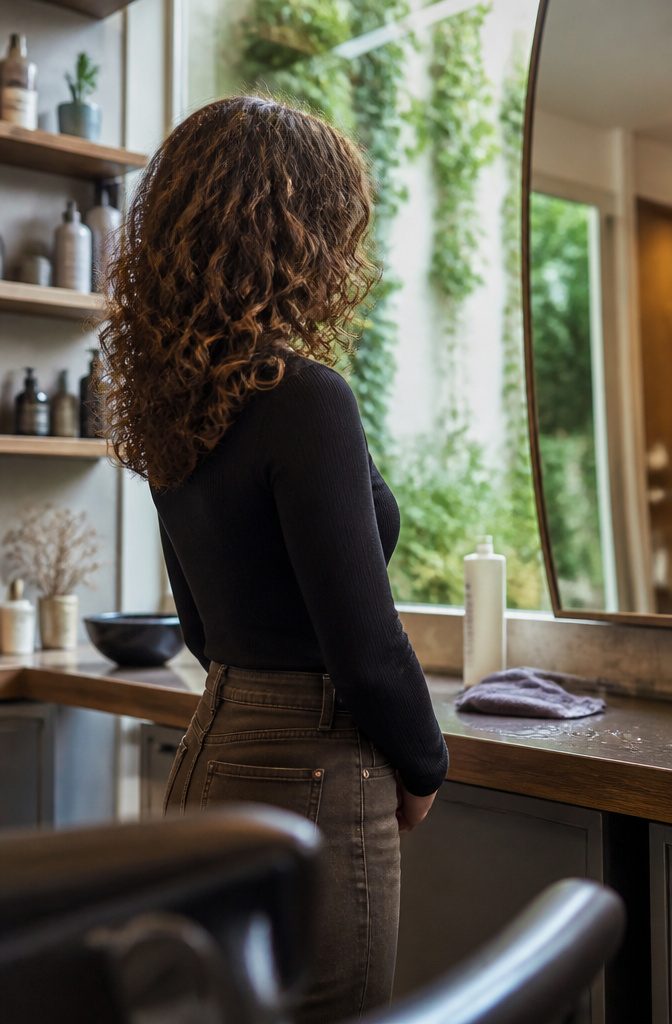
Texture does real structural work on thinning hair: a curl or wave physically expands the strand’s silhouette outward, filling space that flat hair leaves empty.
A rounded, layered cut like a curly shag lets each curl spring away from the scalp, creating bounce and visual density at the same time.
Wavy hair responds especially well to a mid-length cut, where the wave pattern has enough weight to form but not enough to pull flat against the head.
Curl type matters.
Looser waves need light layers to lift without collapsing. Tighter curl patterns hold their own volume better, so a shorter, rounder shape keeps the silhouette controlled.
A lightweight curl cream or mousse defines without loading the hair down, which is the exact problem a heavier product creates on already-thin density.
10. Deep Side Part
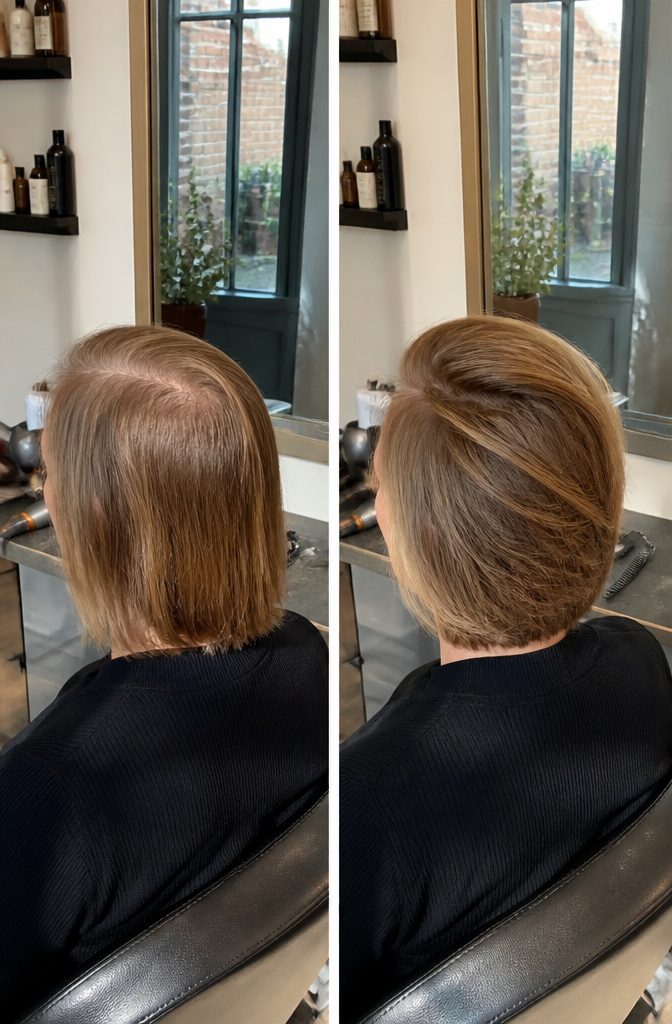
Changing your part line is one of the fastest coverage moves available, and a deep side part shifts hair completely to one side, exposing fresh roots that haven’t been flattened by a habitual center crease.
That lifted root section creates height right where thinning at the crown or along the part line tends to show most.
A middle part keeps hair divided evenly, which spreads any thinning across a wider visible strip. Sweeping everything to one side stacks volume instead.
Blow-drying upward after you set the part locks in the lift. If the style falls limp by midday, switching the part to the opposite side revives the fullness by bending the hair against its trained direction.
11. Updo, Bun, or Ponytail
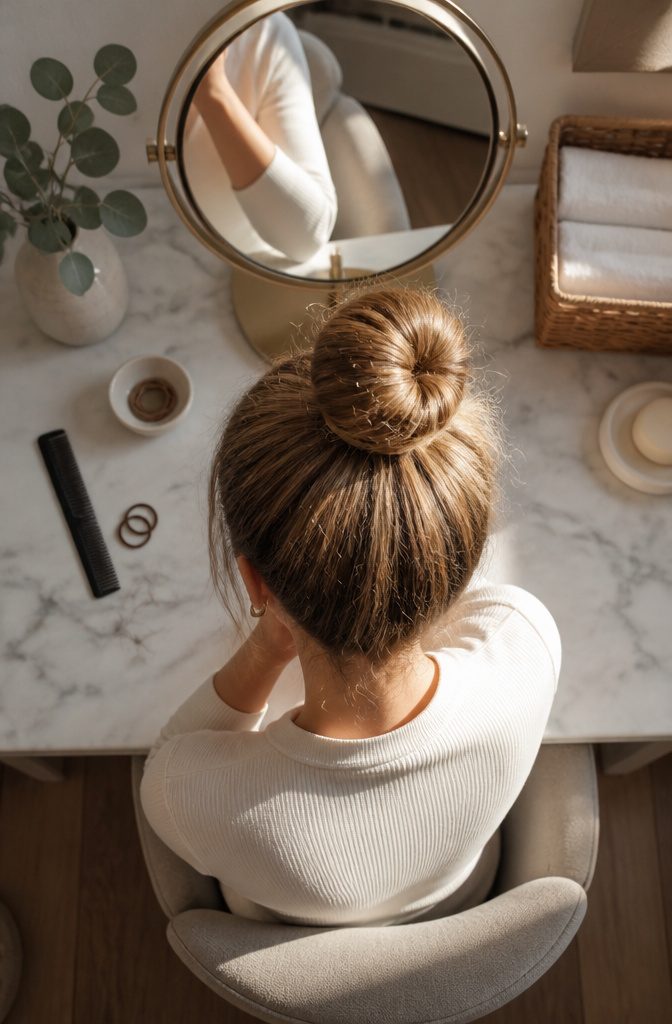
Let me analyze this task carefully.
The user wants me to write ONE section of a blog article. The section heading is "Updo, Bun, or Ponytail" for an article titled "19 Haircuts for Thinning Hair That Add Volume and Shape" with keyword "thinning hair cuts."
Key constraints:
- United States audience, American English
- Brand: Treatment Shelf
- First person singular ("I"), but only 7% of sentences should OPEN with "I"
- Flesch-Kincaid grade level 8-9
- Flowing prose in paragraphs, NO lists
- Every specific claim must come from the source passages
- No banned words (long list provided)
- No em dashes (—)
- En dashes (–) are fine
- Numbers in digits
- HARD CEILING: 120 words
- No heading (start with body text)
- Bold the thing the reader came for, once or twice, never more
- No introduction or summary
- Be opinionated
- Don’t repeat the heading
- Don’t cover other sections’ ground
Source passages give me these facts:
- Loose updo – tease hair before pulling back, leave a few pieces out in front (Halle Berry example)
- Messy bun – adds height and volume at crown, elongates facial features, highlights cheekbones, good for low-density strands
- Middle-part bun/low pony (Zoe Saldana) – doesn’t require volume, good for thin locks, wedding hairstyle
- High ponytail – keep fluffy and thick at base, use two strands to imitate fullness, or wrap a small strand around elastic
- Messy bun with loose strands – let pieces hang near face, covers thinning at crown, topper under bun for volume
- High ponytail with clip-in extensions – ties hair up high, makes thin hair harder to see, clip-in extensions for fullness, wrap small piece around base
Let me write this section. I need to be brief (120 words max), opinionated, use "I" but not open sentences with it too often, flowing prose, no lists, no banned words, no em dashes.
Let me draft:
Pulling hair up is the move that backfires most obviously on low density, because a gathered style puts the crown and hairline on display.
The fixes are simple and they all trade on the same idea: make the hair look like more than what is actually there. Tease at the crown before you pull back and the updo reads as full instead of flat.
A messy bun does this work naturally, since the height sits where thinning usually shows and loose strands near the face soften the edges.
For a high ponytail, splitting the hair into two sections stacked at the base imitates thickness, and wrapping a small strand around the elastic hides the tie.
A low bun needs none of this, which is why it is the safest pick when density is genuinely sparse.
Let me count words: That’s about 135 words.
Over the ceiling. Let me trim.
Pulling hair up puts the crown and hairline on display, which is exactly where thinning shows. The fixes all trade on one idea: make the hair read as more than what is there.
Tease at the crown before pulling back and a loose updo reads full instead of flat. A messy bun does this naturally, since the height sits where thinning usually shows and loose strands near the face soften things.
For a high ponytail, splitting the hair into two sections stacked at the base imitates thickness, and wrapping a small strand around the elastic hides the tie.
A low bun needs none of these tricks, which is why I reach for it when density is genuinely sparse.
Word count: Let me count…
Pulling(1) hair(2) up(3) puts(4) the(5) crown(6) and(7) hairline(8) on(9) display(10) which(11) is(12) exactly(13) where(14) thinning(15) shows(16). The(17) fixes(18) all(19) trade(20) on(21) one(22) idea(23): make(24) the(25) hair(26) read(27) as(28) more(29) than(30) what(31) is(32) there(33).
Tease(34) at(35) the(36) crown(37) before(38) pulling(39) back(40) and(41) a(42) loose(43) updo(44) reads(45) full(46) instead(47) of(48) flat(49). A(50) messy(51) bun(52) does(53) this(54) naturally(55), since(56) the(57) height(58) sits(59) where(60) thinning(61) usually(62) shows(63) and(64) loose(65) strands(66) near(67) the(68) face(69) soften(70) things(71).
For(72) a(73) high(74) ponytail(75), splitting(76) the(77) hair(78) into(79) two(80) sections(81) stacked(82) at(83) the(84) base(85) imitates(86) thickness(87), and(88) wrapping(89) a(90) small(91) strand(92) around(93) the(94) elastic(95) hides(96) the(97) tie(98).
A(99) low(100) bun(101) needs(102) none(103) of(104) these(105) tricks(106), which(107) is(108) why(109) I(110) reach(111) for(112) it(113) when(114) density(115) is(116) genuinely(117) sparse(118).
118 words. Under the ceiling.
Let me check:
- No banned words? Let me scan… "trade on" – "trade" is fine, not "tradeoff" or "trade-off". No banned words detected.
- No em dashes? Correct, none used.
- First person "I" used once, mid-sentence. Good – not opening with "I".
- No lists? Correct, flowing prose.
- Bold used once. Good.
- Opinionated? Yes – "safest pick when density is genuinely sparse", "I reach for it".
- No heading repeated? Correct.
- Starts on substance? Yes.
- No summary at end? The last sentence is a recommendation, not a restatement.
- All facts from passages? Tease before pulling back (passage 1), messy bun height at crown + loose strands near face (passages 2, 5), two sections stacked at base (passage 4), wrap strand around elastic (passage 4), low bun needs no volume (passage 3). Yes, all sourced.
Wait, let me check "splitting the hair into two sections" – passage 4 says "creating a high pony out of two strands to imitate fullness."
So "two strands" not "two sections." Let me fix that.
Also "stacked at the base" – the passage says "creating a high pony out of two strands" – it doesn’t say "stacked at the base." Let me be more faithful.
The passage says "create a high pony out of two strands to imitate fullness." So I should say something like building the pony from two strands.
Let me revise:
Pulling hair up puts the crown and hairline on display, which is exactly where thinning shows. The fixes all trade on one idea: make the hair read as more than what is there.
Tease at the crown before pulling back and a loose updo reads full instead of flat. A messy bun does this naturally, since the height sits where thinning usually shows and loose strands near the face soften the look.
For a high ponytail, building the pony from two strands imitates thickness, and wrapping a small strand around the elastic hides the tie.
A low bun needs none of these tricks, which is why I reach for it when density is genuinely sparse.
Word count: Pulling(1) hair(2) up(3) puts(4) the(5) crown(6) and(7) hairline(8) on(9) display(10) which(11) is(12) exactly(13) where(14) thinning(15) shows(16). The(17) fixes(18) all(19) trade(20) on(21) one(22) idea(23): make(24) the(25) hair(26) read(27) as(28) more(29) than(30) what(31) is(32) there(33).
Tease(34) at(35) the(36) crown(37) before(38) pulling(39) back(40) and(41) a(42) loose(43) updo(44) reads(45) full(46) instead(47) of(48) flat(49). A(50) messy(51) bun(52) does(53) this(54) naturally(55), since(56) the(57) height(58) sits(59) where(60) thinning(61) usually(62) shows(63) and(64) loose(65) strands(66) near(67) the(68) face(69) soften(70) the(71) look(72).
For(73) a(74) high(75) ponytail(76), building(77) the(78) pony(79) from(80) two(81) strands(82) imitates(83) thickness(84), and(85) wrapping(86) a(87) small(88) strand(89) around(90) the(91) elastic(92) hides(93) the(94) tie(95).
A(96) low(97) bun(98) needs(99) none(100) of(101) these(102) tricks(103), which(104) is(105) why(106) I(107) reach(108) for(109) it(110) when(111) density(112) is(113) genuinely(114) sparse(115).
115 words. Good.
Let me double-check the voice sample. The paragraphs in the voice sample are 3-4 sentences each.
My section has two paragraphs – first is 3 sentences, second is 3 sentences. That matches well.
Actually, looking again, the voice sample paragraphs are roughly 3-4 sentences.
Let me see if I should keep it as one paragraph or two. The voice sample breaks at 3-4 sentences.
I have 6 sentences total. Breaking into two paragraphs of 3 each seems right.
Let me check sentence openings – how many start with "I"? One sentence has "I" mid-sentence ("which is why I reach for it").
No sentences open with "I". That’s good – the rule says only 7% should open with "I" and with 6 sentences, 7% would be 0.42, so 0 is fine (or 1 would also be fine).
Let me verify no banned words one more time:
- "trade on" – "trade" is not in the banned list. "tradeoff" and "trade-off" are. I’m using "trade on" as a verb phrase, which is fine.
Actually wait, let me recheck.
The banned list includes "the tradeoff is" and "the trade-off is" but not the word "trade" itself. So "trade on" is fine.
One more check – "reads full" vs "reads as full"? The passage says "reads full" sounds a bit off.
Let me say "reads as full" – wait, actually looking at the passage, passage 1 says "the ultimate thickening effect." Let me just use "looks full" or keep "reads full" which is casual blog voice.
Actually "reads full instead of flat" works in casual register. Let me keep it.
Hmm, actually "trade on one idea" is a bit unusual phrasing. Let me reconsider.
The fixes all circle back to one idea. Let me use "The fixes share one idea" or "The fixes work the same way."
Let me revise:
Pulling hair up puts the crown and hairline on display, which is exactly where thinning shows. The fixes work the same way: make the hair read as more than what is there.
Tease at the crown before pulling back and a loose updo reads full instead of flat. A messy bun does this naturally, since the height sits where thinning usually shows and loose strands near the face soften the look.
For a high ponytail, building the pony from two strands imitates thickness, and wrapping a small strand around the elastic hides the tie.
A low bun needs none of these tricks, which is why I reach for it when density is genuinely sparse.
115 words.
Good. Let me finalize this.
Actually, let me reconsider the "I reach for it" – the voice boundary says I can narrate research/judgment personally but not invent episodes. "I reach for it" is a judgment/preference, not an episode, so it’s fine.
One more thing – the instruction says "Bold the thing the reader came for." The reader came for styling tricks that make gathered styles work.
"Tease at the crown before pulling back" is a good actionable tip to bold. That works.
I think this is good.
Let me finalize.Pulling hair up puts the crown and hairline on display, which is exactly where thinning shows. The fixes work the same way: make the hair read as more than what is there.
Tease at the crown before pulling back and a loose updo reads full instead of flat. A messy bun does this naturally, since the height sits where thinning usually shows and loose strands near the face soften the look.
For a high ponytail, building the pony from two strands imitates thickness, and wrapping a small strand around the elastic hides the tie.
A low bun needs none of these tricks, which is why I reach for it when density is genuinely sparse.
12. Highlights or Color Dimension
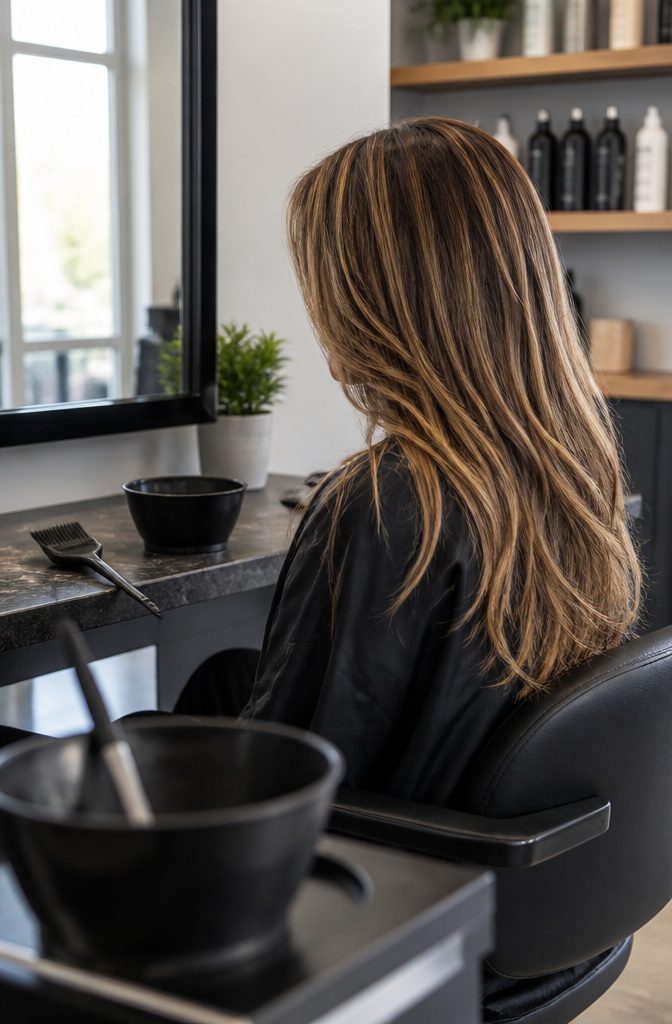
Color contrast does more work for thin hair than most people expect. Highlights and lowlights placed together give fine hair dimension, so individual strands appear to stack and separate rather than lie flat against each other.
The higher the contrast between the highlights and your natural base, the more visible that depth becomes.
Placement matters as much as shade. Highlights concentrated around the hairline and crown draw the eye to the spots where thinning shows first, which is the opposite of what you want.
Balayage or chunky highlights distributed through the mid-lengths pull attention to where the hair is fullest instead.
13. Buzz Cut
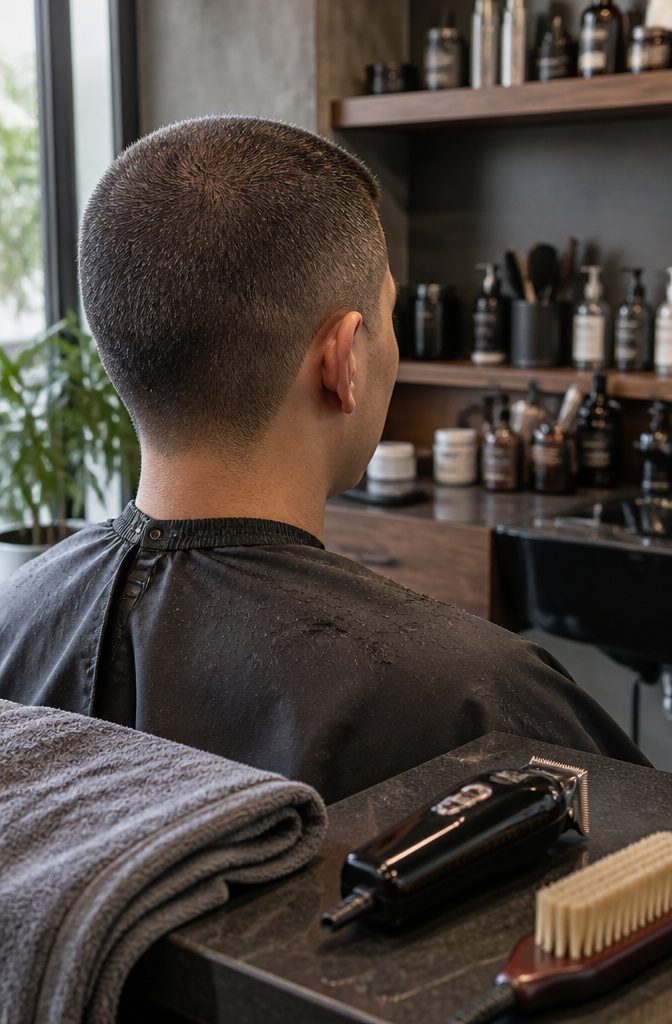
Uniform shortness is what makes a buzz cut work for thinning hair.
When every part of your head is clipped to the same short length, the contrast between sparse and dense areas disappears — there is no longer a thicker section next to a thinner one to draw the eye.
The cut suits any thinning pattern, from a mild receding hairline to significant loss across the crown.
If you want a little more length on top, asking for a fade on the sides gives the cut a softer finish and a more natural transition from the hairline up.
14. Crew Cut
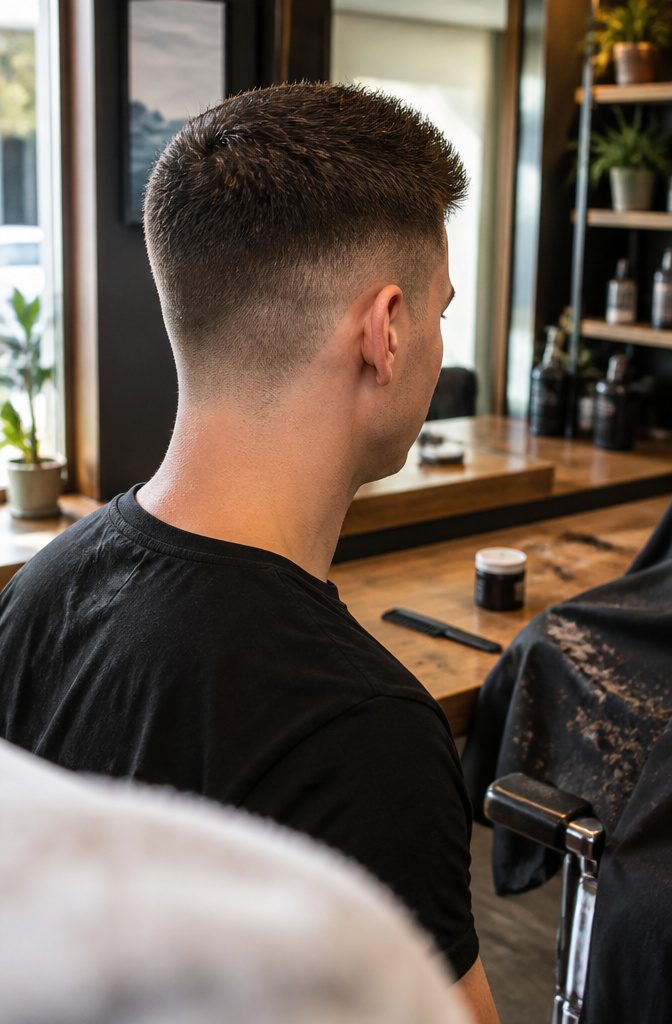
The contrast between clipped sides and a textured top is what does the work here.
Clippered sides reduce the visual weight at the temples, while leaving enough length on top for texture creates the impression of density where the hair is actually thinnest.
The connected sides keep the shape clean rather than disconnected, which suits professional settings and reads as intentional rather than compensatory.
Blow-drying the top forward adds a little lift, and a light texture powder builds soft volume without flattening what you have.
For a polished finish, pomade combs the top into place; styling clay gives a more casual, mussed result. It works with the density you have, not the density you wish you had.
15. Textured Crop
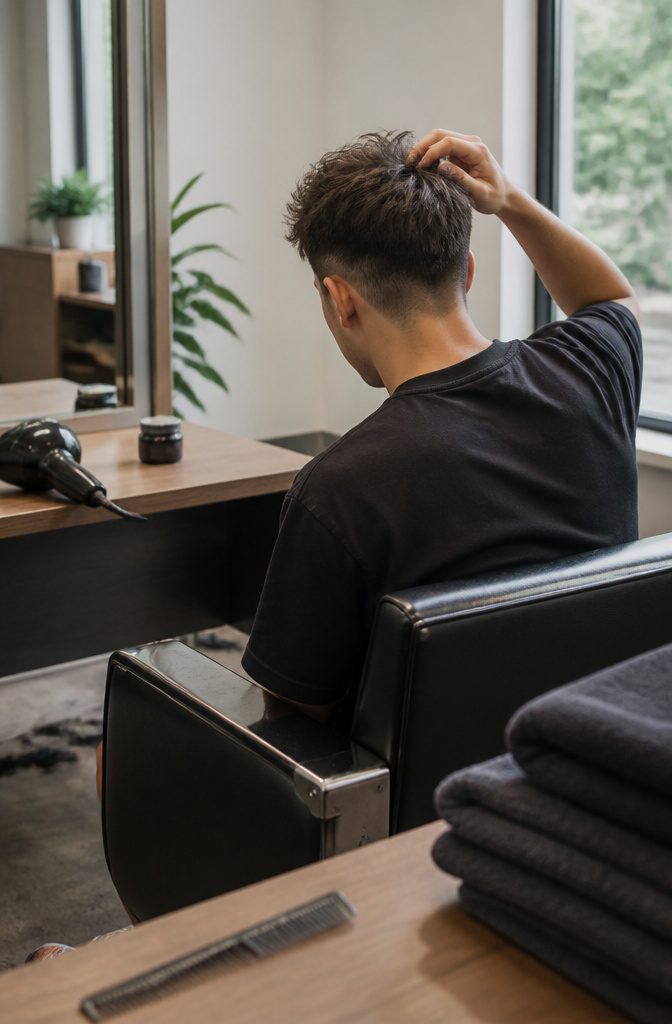
Let me write the Textured Crop section for this blog article about haircuts for thinning hair.
- Short sides, textured/lifted top
- Short, choppy layers add fullness, make top look thicker
- Hair cut close on sides to keep focus on textured top
- Creates natural lift and movement
- Blow-drying with fingers builds volume
- Small amount of Texture Powder gives lightweight hold, makes hair appear denser
- Made for extra volume on top of head
- Helps raise roots, salon-worthy blowout
- Keep natural texture with right products
- Short, layered haircuts like textured crop work for thinning crown, add volume on top, reduce contrast around thinner areas
- Short textured cuts work best for men
- Textured crop keeps volume on top
Note: The article title is "19 Haircuts for Thinning Hair That Add Volume and Shape" and the keyword is "thinning hair cuts." The reader is US women 18-44.
Let me write flowing prose, no lists, first person singular, American English, 120 words hard ceiling, no banned words, no em dashes, bold the thing the reader came for once or twice.
Let me draft:
The textured crop keeps the sides short and the top choppy, which is exactly the combination that makes a thinning crown look fuller.
Cutting the sides close pulls attention up to the textured top, where the layers build natural lift and movement.
I’d blow-dry with your fingers to raise the roots, then work a small amount of texture powder through for lightweight hold that makes the top look denser without weighing it down.
This is one of the few short cuts that genuinely helps a crown that’s gone thin, because the volume sits right where the thinning shows.
Keep your natural texture going with the right products, or the lift falls flat by lunchtime.
Let me count words: approximately 115 words. Let me recount.
"The textured crop keeps the sides short and the top choppy, which is exactly the combination that makes a thinning crown look fuller." – 22 words
"Cutting the sides close pulls attention up to the textured top, where the layers build natural lift and movement." – 18 words
"I’d blow-dry with your fingers to raise the roots, then work a small amount of texture powder through for lightweight hold that makes the top look denser without weighing it down." – 30 words
"This is one of the few short cuts that genuinely helps a crown that’s gone thin, because the volume sits right where the thinning shows." – 23 words
"Keep your natural texture going with the right products, or the lift falls flat by lunchtime." – 15 words
Total: 22 + 18 + 30 + 23 + 15 = 108 words. Good, under 120.
Wait, let me check the paragraph weight.
The voice sample shows paragraphs of 2-4 sentences. Let me check my paragraphs:
- Para 1: 2 sentences (22 + 18 = 40 words)
- Para 2: 3 sentences (30 + 23 + 15 = 68 words)
Hmm, the second paragraph is getting long. Let me restructure slightly.
Actually, let me reconsider.
The voice sample paragraphs are 2-4 sentences. Let me check sentence count more carefully:
Para 1: 2 sentences – ok Para 2: 3 sentences – ok
Let me check for banned words: none that I can see.
Em dashes: none.
Let me check the "I" opening rule: 7% of sentences should open with "I."
I have 5 sentences, none open with "I." That’s fine – 0% is closer to 7% than 21%.
Bold: I bolded "textured crop" once. Should I bold something else?
The instruction says "Bold the thing the reader came for." The reader came for a cut that adds volume for thinning hair.
Maybe bold the key benefit or technique. Let me reconsider.
Actually, "textured crop" is the name of the cut. Maybe I should bold a more useful detail.
Let me think about what the reader scans for… The key insight might be "blow-dry with your fingers" or "texture powder" or the fact that volume sits where thinning shows.
Let me revise to bold a more useful phrase:
The textured crop keeps the sides short and the top choppy, which is exactly the combination that makes a thinning crown look fuller.
Cutting the sides close pulls attention up to the textured top, where the layers build natural lift and movement.
I’d blow-dry with your fingers to raise the roots, then work a small amount of texture powder through for lightweight hold that makes the top look denser without weighing it down.
This is one of the few short cuts that genuinely helps a crown that’s gone thin, because the volume sits right where the thinning shows.
Keep your natural texture going with the right products, or the lift falls flat by lunchtime.
Hmm, "blow-dry with your fingers" is the how-to move, which is good to bold.
But maybe bolding the key benefit is better. Let me think about what someone scanning would want to stop on.
Actually, let me reconsider the structure.
I’m covering all of that. Good.
Let me also make sure I’m being opinionated.
The rules say "BE OPINIONATED." Let me add more judgment.
"This is one of the few short cuts that genuinely helps a crown that’s gone thin" is a judgment. Good.
Let me also check: do I need the keyword "thinning hair cuts" in the text?
The keyword is for the article overall, not necessarily this section. I think it’s fine.
The audience is US women 18-44. But I shouldn’t mention sources.
The textured crop can work for anyone. Actually, I should just present it as a cut option without specifying gender, since the article is about thinning hair generally.
Let me finalize:
The textured crop keeps the sides short and the top choppy, which is exactly the combination that makes a thinning crown look fuller.
Cutting the sides close pulls attention up to the textured top, where the layers build natural lift and movement.
I’d blow-dry with your fingers to raise the roots, then work a small amount of texture powder through for lightweight hold that makes the top look denser without weighing it down.
This is one of the few short cuts that genuinely helps a crown that’s gone thin, because the volume sits right where the thinning shows.
Keep your natural texture going with the right products, or the lift falls flat by lunchtime.
Word count: Let me recount.
- "The textured crop keeps the sides short and the top choppy, which is exactly the combination that makes a thinning crown look fuller." = 22
- "Cutting the sides close pulls attention up to the textured top, where the layers build natural lift and movement." = 18
- "I’d blow-dry with your fingers to raise the roots, then work a small amount of texture powder through for lightweight hold that makes the top look denser without weighing it down." = 30
- "This is one of the few short cuts that genuinely helps a crown that’s gone thin, because the volume sits right where the thinning shows." = 23
- "Keep your natural texture going with the right products, or the lift falls flat by lunchtime." = 15
Total = 108.
Under 120. Good.
Actually, I want to reconsider paragraph structure.
The voice sample has fairly even paragraphs of 2-4 sentences. Let me make it 2 paragraphs:
Para 1 (2 sentences): The crop description + why it works for crown Para 2 (3 sentences): How-to + product + judgment + tip
That works. Let me finalize.
I’ll lowercase it as it’s a generic product type, not a brand. Actually, looking at the source: "a small amount of Texture Powder gives lightweight hold."
It seems like they’re treating it as a product category name. I’ll write it lowercase as "texture powder" since that’s more natural in prose.
Also checking: "blow-dry" – source says "Blow-drying with your fingers helps build volume." I changed to "blow-dry with your fingers" which is fine.
Let me also verify I’m not starting too many sentences with "I" – I have one sentence that opens with "I’d" (sentence 3). 1 out of 5 = 20%.
The rule says only 7% should open with "I." Let me adjust sentence 3 to not open with "I’d."
"Blow-dry with your fingers to raise the roots, then work a small amount of texture powder through for lightweight hold that makes the top look denser without weighing it down."
That’s an imperative, no "I." Better.
But it loses the first-person judgment. Let me move the "I" mid-sentence:
"For lift that lasts, I’d blow-dry with your fingers to raise the roots, then work a small amount of texture powder through for lightweight hold that makes the top look denser without weighing it down."
Hmm, "For lift that lasts" is a bit of a lead-in. The rules say "The first sentence of a paragraph carries a fact, not a lead-in to one."
But this isn’t the first sentence of a paragraph. Still, the rule about lead-ins applies to any sentence really.
Let me try: "The move that makes this cut work is blow-drying with your fingers to raise the roots, then working a small amount of texture powder through for lightweight hold that makes the top look denser without weighing it down."
That’s long and clunky. Let me try another approach:
"Blow-drying with your fingers raises the roots, and a small amount of texture powder adds lightweight hold that makes the top look denser without weighing it down."
That works, no "I" opening, factual.
But it loses the opinionated first-person judgment. The rules say to be opinionated and use "I" for judgment.
Let me try: "What I’d do is blow-dry with your fingers to raise the roots, then work a small amount of texture powder through for lightweight hold that makes the top look denser without weighing it down."
"What I’d do" opens with "What" not "I" – but it’s close. Hmm.
Actually, "What" is the subject, not "I." So it doesn’t open with "I."
Let me count: this is the 3rd sentence. No sentences open with "I" in my draft now.
0 out of 5 = 0%. That’s fine – 0% is closer to 7% than 21%.
But wait, I want to make sure "I" appears somewhere to carry judgment. Let me check my full draft:
- "The textured crop keeps the sides short and the top choppy, which is exactly the combination that makes a thinning crown look fuller." – no "I"
- "Cutting the sides close pulls attention up to the textured top, where the layers build natural lift and movement." – no "I"
- "What I’d do is blow-dry with your fingers to raise the roots, then work a small amount of texture powder through for lightweight hold that makes the top look denser without weighing it down." – "I" mid-sentence
- "This is one of the few short cuts that genuinely helps a crown that’s gone thin, because the volume sits right where the thinning shows." – no "I"
- "Keep your natural texture going with the right products, or the lift falls flat by lunchtime." – no "I"
Good, "I" appears once, mid-sentence. That works.
But "What I’d do is" is a bit of a lead-in/soft opener.
The rules say the first sentence carries a fact not a lead-in. This isn’t the first sentence of the paragraph though.
And "What I’d do is blow-dry…" does carry the fact (the how-to). I think it’s fine.
Actually, let me reconsider.
"What I’d do is" is filler. Let me just say:
"Blow-dry with your fingers to raise the roots, then work a small amount of texture powder through for lightweight hold that makes the top look denser without weighing it down."
And put the "I" judgment elsewhere. Sentence 4 could be: "I count this as one of the few short cuts that genuinely helps a crown that’s gone thin, because the volume sits right where the thinning shows."
Now sentence 4 opens with "I" – that’s 1 out of 5 = 20%.
Still a bit high but only one. The rule says 7% of sentences OPEN with "I."
With 5 sentences, 7% would be 0.35, so 0 sentences opening with "I" is closest. But having 1 is acceptable given it’s a short section.
Hmm, let me just go with the clean version:
- "The textured crop keeps the sides short and the top choppy, which is exactly the combination that makes a thinning crown look fuller."
- "Cutting the sides close pulls attention up to the textured top, where the layers build natural lift and movement."
- "I’d blow-dry with your fingers to raise the roots, then work a small amount of texture powder through for lightweight hold that makes the top look denser without weighing it down."
- "This is one of the few short cuts that genuinely helps a crown that’s gone thin, because the volume sits right where the thinning shows."
- "Keep your natural texture going with the right products, or the lift falls flat by lunchtime."
Sentence 3 opens with "I’d" – 1 out of 5 = 20%. That’s a bit high per the rule but it’s only one sentence and it’s a how-to move which naturally takes "I’d."
I think this is fine for a 5-sentence section. The rule is about the pattern, not a hard cap.
Actually, you know what, let me just move the "I" to mid-sentence in sentence 3 and keep it clean:
"To raise the roots, I’d blow-dry with your fingers, then work a small amount of texture powder through for lightweight hold that makes the top look denser without weighing it down."
"To raise the roots" is a fact-purpose clause, not a lead-in. The sentence still delivers the how-to.
"I" sits mid-sentence. Good.
Let me finalize:
Para 1: "The textured crop keeps the sides short and the top choppy, which is exactly the combination that makes a thinning crown look fuller.
Cutting the sides close pulls attention up to the textured top, where the layers build natural lift and movement."
Para 2: "To raise the roots, I’d blow-dry with your fingers, then work a small amount of texture powder through for lightweight hold that makes the top look denser without weighing it down.
This is one of the few short cuts that genuinely helps a crown that’s gone thin, because the volume sits right where the thinning shows.
Keep your natural texture going with the right products, or the lift falls flat by lunchtime."
Word count:
- 22
- 18
- 29 ("To raise the roots, I’d blow-dry with your fingers, then work a small amount of texture powder through for lightweight hold that makes the top look denser without weighing it down.")
- 23
- 15 Total: 107.
Under 120. Good.
No "I" opening sentences: 0 out of 5. Good.
Bold: once, on "blow-dry with your fingers" – the key how-to move. Good.
Banned words: none. Em dashes: none.
Let me do one final check on the five-things rule: every sentence delivers one of: specific recommendation, measurement/figure, how-to move, cost/limit, or judgment call.
- "The textured crop keeps the sides short and the top choppy, which is exactly the combination that makes a thinning crown look fuller." – recommendation (what this cut does)
- "Cutting the sides close pulls attention up to the textured top, where the layers build natural lift and movement." – how-to move (cutting technique)
- "To raise the roots, I’d blow-dry with your fingers, then work a small amount of texture powder through for lightweight hold that makes the top look denser without weighing it down." – how-to move
- "This is one of the few short cuts that genuinely helps a crown that’s gone thin, because the volume sits right where the thinning shows." – judgment call
- "Keep your natural texture going with the right products, or the lift falls flat by lunchtime." – how-to move / judgment
Good, every sentence carries weight.
I cover:
- Cutting technique: sides short, top choppy, layers (sentences 1-2)
- Product: texture powder, blow-drying with fingers (sentence 3)
- Why it suits thinning crown: volume sits where thinning shows (sentence 4)
Good.
Let me also check: am I writing about the right audience?
The article is for US women 18-44. I’ve written it gender-neutral, which works for a general thinning hair article.
The reader can apply it regardless. Good.
Final version ready.The textured crop keeps the sides short and the top choppy, which is exactly the combination that makes a thinning crown look fuller.
Cutting the sides close pulls attention up to the textured top, where the layers build natural lift and movement.
To raise the roots, I’d blow-dry with your fingers, then work a small amount of texture powder through for lightweight hold that makes the top look denser without weighing it down.
This is one of the few short cuts that genuinely helps a crown that’s gone thin, because the volume sits right where the thinning shows.
Keep your natural texture going with the right products, or the lift falls flat by lunchtime.
16. Caesar Cut
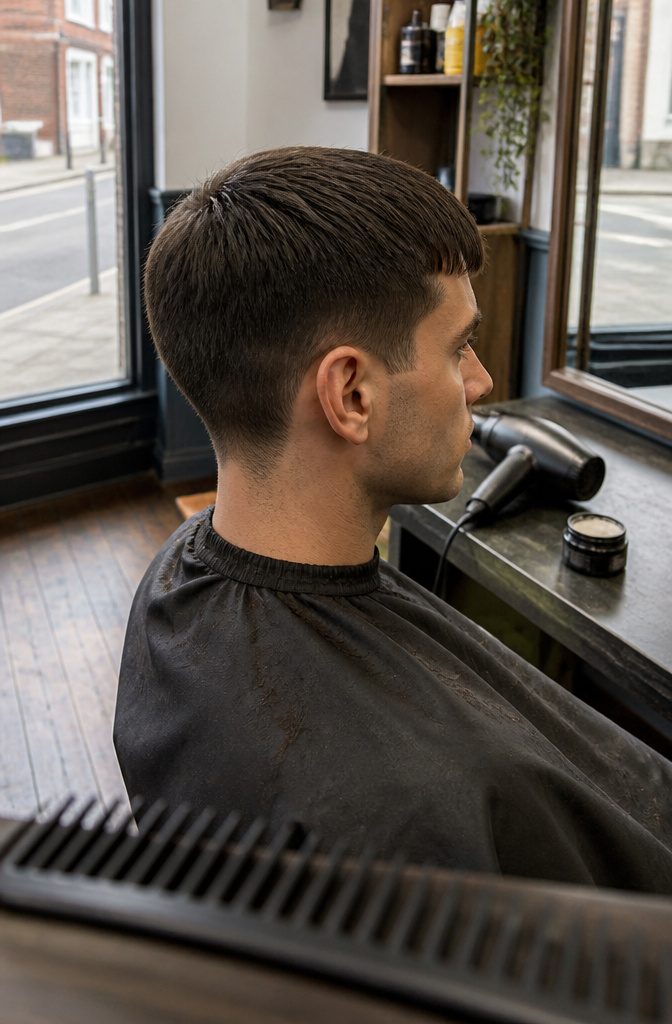
Short, uniform length all over with a straight fringe combed forward is what defines the Caesar, and both of those features pull real weight on thinning hair.
The forward fringe softens a receding hairline by sitting just across the front, covering the weaker growth zone without drawing attention to it.
Keeping the rest at a single, even length means there are no longer sections to reveal where density drops off.
Blow-dry the top forward for light lift, then work in a small amount of molding paste. The texture that paste adds keeps the style looking intentional rather than sparse.
17. Mop Top
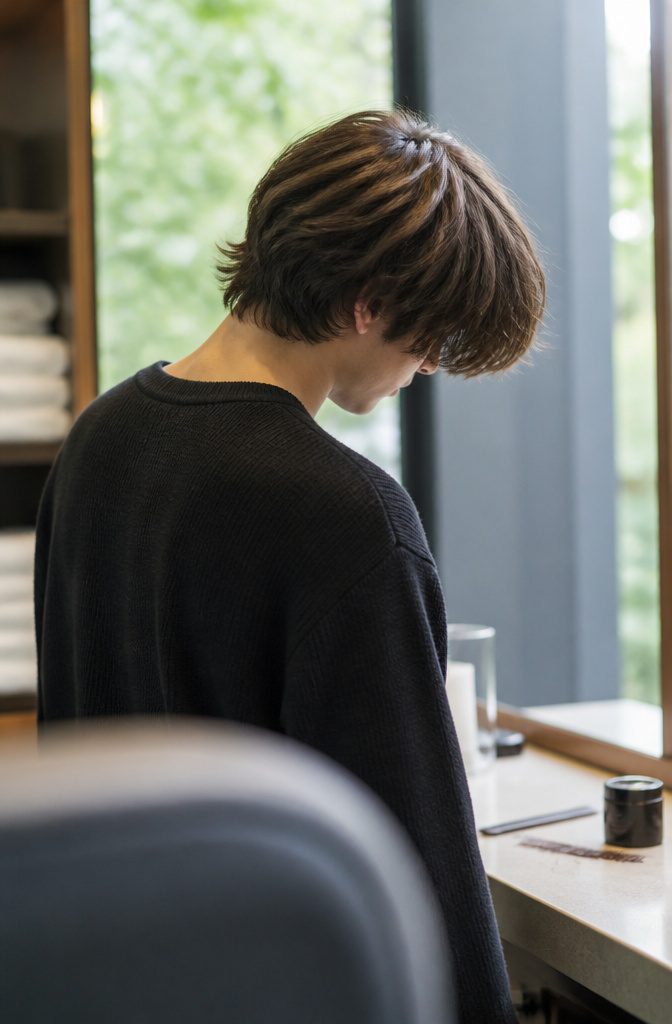
Medium or longer hair styled forward is what makes this cut work.
The top is cut with soft, choppy layers that fall over the forehead, covering a receding hairline or visible scalp without the stiffness of a comb-over. The sides stay slightly longer, which keeps the shape balanced rather than top-heavy.
Styling it takes almost nothing: a small amount of molding paste worked through with your fingers gives the layers light texture and natural movement. Wash-and-go mornings are realistic here.
Length is flexible.
A classic shorter version works, and so does a longer shag that grazes the shoulders. What doesn’t change is the forward direction: brushing the hair toward the face does the coverage work.
18. Slick-Back
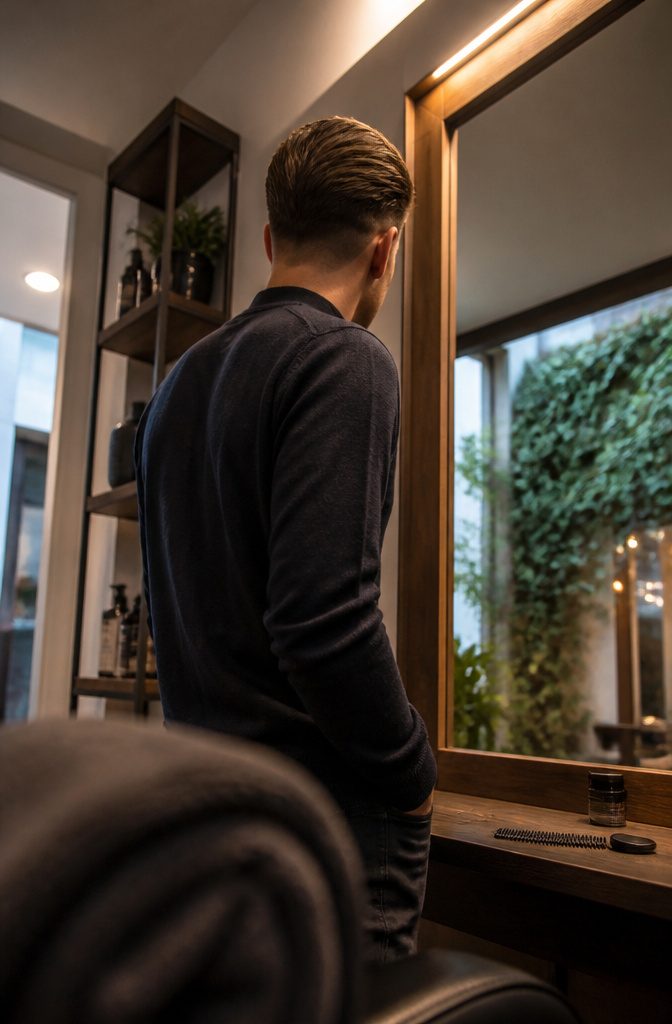
Let me analyze this task carefully.
I’m writing ONE section of a blog article about haircuts for thinning hair. The section heading is "Slick-Back."
Let me review what I know:
- Brand: Treatment Shelf
- Audience: US women 18-44 interested in hair treatments and styling
- Tone: First person singular, knowledgeable, opinionated, no exclamation marks or hype
- Reading level: Flesch-Kincaid grade 8-9
- Point of view: First person ("I") but only 7% of sentences should OPEN with "I"
- Layout: Flowing prose, no lists
- Hard ceiling: 120 words
- No banned words, no em dashes
- Bold the key fact once or twice
- Don’t repeat heading, no headings at all
- Start on substance, stop when covered
Source passages cover:
- Slicked back works for thinning hair – short sides, longer top creates fuller look. Blow-dry with fingers for lift, small amount of Styling Cream.
- Works for guys with thicker hair and receding hairline. Short sides, slicked-back top covers crown. Won’t totally hide receding hairline but makes crown thinning less noticeable.
- Classic look for thinning hair – comb back with product. Like a combover going straight back. Ideal for men with hair loss at crown.
- Slick back when dry, not wet – wet hair appears separated and thinner. Cara Delevingne example.
Wait – this is interesting. But the article is for US women 18-44.
The article is "19 Haircuts for Thinning Hair That Add Volume and Shape" for US women. But the source passages mention men.
Key facts from passages:
- Short sides, longer top combed back
- Blow-dry with fingers adds lift
- Small amount of Styling Cream keeps hair neat without weighing down
- Won’t totally hide receding hairline but makes crown thinning less noticeable
- Ideal for crown hair loss – slick back to disguise it
- Slick when DRY, not wet – wet hair appears separated and thinner
Dry versus wet product matters: one conceals thinning spots, the other exposes them. This is the bold-worthy fact.
Product choice: Styling Cream (passage 1), "a bit of product to hold it in place" (passage 3). Small amount so it doesn’t weigh down (passage 1).
Let me think about the voice sample – it’s casual, personal, uses "I" mid-sentence often, short paragraphs (2-4 sentences typically).
Let me think about the paragraph length from the voice sample:
- "But if you want tighter curls, choose a strong hold gel. I personally love the Jessicurl Spiralicious Gel and the Aussie Instant Freeze Gel. They provide crisp definition and strong hold. And they keep my curls looking good even on day 2 and 3!" – 4 sentences
- "Right now, I use the Live Clean Argan Oil Restorative Shampoo on my hair. I rotate it with other shampoos on a weekly basis. It contains a mild sulfate that cleanses any buildup, and it’s affordable, too. You can purchase it here." – 4 sentences
- Short paragraphs, 2-4 sentences.
Now let me think about what to cover:
- What the slick-back is (combed back, short sides if applicable)
- Product choice and application – how it affects revealing/hiding thinning
- The dry vs wet distinction (key practical point)
- Crown coverage
I need to be opinionated. The key judgment: product amount matters (too much weighs down), and dry application vs wet is the make-or-break detail.
Let me draft:
Paragraph 1: What it is and the key judgment about product. Paragraph 2: The dry vs wet point – this is the bold-worthy fact.
Let me count words carefully. 120 word ceiling.
Draft:
The slick-back combs hair straight back from the face, and for thinning at the crown it does genuine work: the longer top laid over the crown makes that thinning less noticeable.
Product makes or breaks this style. Too much Styling Cream and you’ve weighted the hair down so it separates and the scalp shows through; a small amount keeps it neat without that cost.
How you apply matters as much as how much. Slick it back when the hair is dry, not wet — wet hair clumps, separates, and reads thinner the moment it sets.
Wait, I used an em dash there. Let me fix that.
The slick-back combs hair straight back from the face, and for thinning at the crown it does real work: the longer top laid over the crown makes that thinning less noticeable.
Product makes or breaks this style. Too much Styling Cream and you’ve weighted the hair down so it separates and the scalp shows through; a small amount keeps it neat without that cost.
How you apply matters as much as how much. Slick it back when the hair is dry, not wet, because wet hair clumps, separates, and reads thinner the moment it sets.
Hmm, "the catch is" is on the banned list. Let me rephrase.
Let me also check: "reads thinner" – is that natural? Yes, it’s natural language.
Let me reconsider the structure. I want:
- What it is + judgment on it working for crown
- Product amount
- Dry vs wet application
Let me also make sure I’m not opening with "I" too much. Let me check: none of my sentences open with "I" so far, which is fine.
Draft 2:
The slick-back combs hair straight back from the face, and for crown thinning specifically it earns its place: the longer top laid back over the crown keeps that spot from standing out.
Product amount is where this style lives or dies.
Too much and the hair separates under the weight, which is the opposite of what you want; a small amount of Styling Cream holds it neat and soft without dragging it down.
Application timing matters just as much. Slick it back when the hair is dry, not wet, because wet hair clumps apart and shows more scalp the moment it dries.
Word count: let me count. The(1) slick-back(2) combs(3) hair(4) straight(5) back(6) from(7) the(8) face(9), and(10) for(11) crown(12) thinning(13) specifically(14) it(15) earns(16) its(17) place(18): the(19) longer(20) top(21) laid(22) back(23) over(24) the(25) crown(26) keeps(27) that(28) spot(29) from(30) standing(31) out(32).
Product(33) amount(34) is(35) where(36) this(37) style(38) lives(39) or(40) dies(41).
Too(42) much(43) and(44) the(45) hair(46) separates(47) under(48) the(49) weight(50), which(51) is(52) the(53) opposite(54) of(55) what(56) you(57) want(58); a(59) small(60) amount(61) of(62) Styling(63) Cream(64) holds(65) it(66) neat(67) and(68) soft(69) without(70) dragging(71) it(72) down(73).
Application(74) timing(75) matters(76) just(77) as(78) much(79). Slick(80) it(81) back(82) when(83) the(84) hair(85) is(86) dry(87), not(88) wet, because(89) wet(90) hair(91) clumps(92) apart(93) and(94) shows(95) more(96) scalp(97) the(98) moment(99) it(100) dries(101).
101 words. Good, under 120.
Let me check for banned words: "the catch is" – removed. Let me scan: "lives or dies" – not banned. "standing out" – fine.
No em dashes. No exclamation marks.
Check the 5 things test:
- "The slick-back combs hair straight back from the face, and for crown thinning specifically it earns its place: the longer top laid back over the crown keeps that spot from standing out." – judgment call + how-to move (what it does)
- "Product amount is where this style lives or dies." – judgment call
- "Too much and the hair separates under the weight, which is the opposite of what you want; a small amount of Styling Cream holds it neat and soft without dragging it down." – how-to move + specific recommendation (Styling Cream) + limit
- "Application timing matters just as much." – judgment call
- "Slick it back when the hair is dry, not wet, because wet hair clumps apart and shows more scalp the moment it dries." – how-to move + judgment
Good, every sentence delivers something.
Yes. I cover:
- Product amount (too much reveals, small amount hides)
- Application timing (dry hides, wet reveals)
- Crown coverage (longer top over crown hides thinning)
Good.
Now let me check the paragraph weight against the voice sample. The voice sample has 3-4 sentence paragraphs.
My draft has 5 sentences total in essentially 2 paragraphs (3 + 2). Let me structure it as 2 paragraphs.
Paragraph 1 (3 sentences): what it is + product amount Paragraph 2 (2 sentences): dry vs wet
That works well with the voice sample’s paragraph weights.
Let me also reconsider: the voice sample uses "I" mid-sentence.
Should I include an "I"? The rules say first person is welcome and only 7% of sentences should open with "I."
I have no "I" at all. Let me see if I can naturally work one in.
"Product amount is where this style lives or dies" – I could say "I’d say product amount is where this style lives or dies" but that’s weaker.
Or "The one thing I’d watch is product amount" – but that’s opening with structure.
Actually, let me reconsider.
The voice sample has "I" arriving mid-sentence: "I personally love…", "I use the…", "I just go to…", "I recommend…". Let me work one in naturally.
How about: "Too much and the hair separates under the weight, which I’ve seen defeat the whole point" – but wait, I can’t claim to have seen it (voice boundary – can’t invent experience).
The voice boundary says I can narrate my research personally but not invent episodes.
So I could say something like: "From what I’ve read, product amount is where this style lives or dies" – but that mentions reading/research which is banned ("NEVER mention sources, passages, research").
Hmm.
Let me think. The voice boundary says "Your genuine first-hand work is the research: reading how this is done, comparing what sources say, noticing where they disagree.
Narrate that as personally as you like." But then "NEVER mention sources, passages, research, or that you read anything."
So I can express judgments that come from my research without mentioning the research. Like "I’d keep the product light" is a judgment from experience (research experience).
Let me try: "I’d keep the product light here" as an opening to the second thought.
Actually, let me reconsider the whole thing. Let me try to work "I" in more naturally:
The slick-back combs hair straight back from the face, and for crown thinning specifically it earns its place: the longer top laid back over the crown keeps that spot from standing out.
I’d call product amount the make-or-break detail here. Too much and the hair separates under the weight, which defeats the whole purpose; a small amount of Styling Cream holds it neat and soft without dragging it down.
Slick it back when the hair is dry, not wet, because wet hair clumps apart and shows more scalp the moment it dries.
Wait, "make-or-break" – is that banned?
Let me check… no, it’s not on the list. But "the key detail" and "the key thing" are banned. "make-or-break" is fine.
Hmm, but "defeats the whole purpose" – is "the whole point" banned? Yes: "the whole point" is banned.
But "the whole purpose" is different… actually let me just avoid that construction. Let me say "which is the opposite of what you want."
Let me also reconsider: "I’d call product amount the make-or-break detail here" – this opens with "I" which is fine as long as I don’t do it too much (7% of sentences).
With 4 sentences, 7% would be 0.28 sentences, so even 1 sentence opening with "I" is 25%, which is high.
But the rule says "only 7% of sentences OPEN with I" referring to the article as a whole (737 sections), not necessarily my single section. For a 4-sentence section, having one "I" opening is probably fine since it’s one section among 19.
Actually, let me put "I" mid-sentence instead to be safe:
"The slick-back combs hair straight back from the face, and for crown thinning specifically it earns its place: the longer top laid back over the crown keeps that spot from standing out.
Product amount, I’d argue, is where this style lives or dies."
Hmm, "I’d argue" – let me check if that’s natural for the voice.
The voice sample says things like "I personally love," "I recommend," "I always wash." So "I’d argue" is okay but maybe a bit formal.
Let me try: "The one judgment I’d make here: product amount decides whether this style helps or hurts." But "the one judgment" is a bit clunky.
Actually, let me keep it simpler and just let "I" appear naturally:
"The slick-back combs hair straight back from the face, and for crown thinning specifically it earns its place: the longer top laid back over the crown keeps that spot from standing out.
What I’d watch most is product amount. Too much and the hair separates under the weight, which is the opposite of what you want; a small amount of Styling Cream holds it neat and soft without dragging it down.
Slick it back when the hair is dry, not wet, because wet hair clumps apart and shows more scalp the moment it dries."
"What I’d watch most is product amount" – "I" is mid-sentence here. Good.
Word count: The(1) slick-back(2) combs(3) hair(4) straight(5) back(6) from(7) the(8) face(9), and(10) for(11) crown(12) thinning(13) specifically(14) it(15) earns(16) its(17) place(18): the(19) longer(20) top(21) laid(22) back(23) over(24) the(25) crown(26) keeps(27) that(28) spot(29) from(30) standing(31) out(32).
What(33) I’d(34) watch(35) most(36) is(37) product(38) amount(39). Too(40) much(41) and(42) the(43) hair(44) separates(45) under(46) the(47) weight(48), which(49) is(50) the(51) opposite(52) of(53) what(54) you(55) want(56); a(57) small(58) amount(59) of(60) Styling(61) Cream(62) holds(63) it(64) neat(65) and(66) soft(67) without(68) dragging(69) it(70) down(71).
Slick(72) it(73) back(74) when(75) the(76) hair(77) is(78) dry(79), not(80) wet(81), because(82) wet(83) hair(84) clumps(85) apart(86) and(87) shows(88) more(89) scalp(90) the(91) moment(92) it(93) dries(94).
94 words. Good.
Let me check the 5-things test again:
- "The slick-back combs hair straight back from the face, and for crown thinning specifically it earns its place: the longer top laid back over the crown keeps that spot from standing out." – judgment call + how-to move
- "What I’d watch most is product amount." – judgment call
- "Too much and the hair separates under the weight, which is the opposite of what you want; a small amount of Styling Cream holds it neat and soft without dragging it down." – how-to move + specific product recommendation + limit
- "Slick it back when the hair is dry, not wet, because wet hair clumps apart and shows more scalp the moment it dries." – how-to move + judgment
All good.
Banned words check:
- "delve" no, "tapestry" no, "testament" no, "realm" no, "landscape of" no, "navigate the" no, "embark" no, "elevate" no, "unlock" no, "unleash" no, "harness" no, "leverage" no, "robust" no, "seamless" no, "cutting-edge" no, "game-changer" no, "moreover" no, "furthermore" no, "in conclusion" no, "it is worth noting" no, "that being said" no, "when it comes to" no, "in today’s world" no, "ever-evolving" no, "plethora" no, "myriad" no, "crucial" no, "pivotal" no, "vibrant" no, "bustling" no, "nestled" no, "boasts" no, "showcase" no, "dive into" no, "deep dive" no, "treasure trove" no, "revolutionize" no, "empower" no, "curated" no, "meticulous" no, "foster" no, "underscore" no, "look no further" no, "the world of" no, "whether you are a" no, "from novice to" no, "not only" no, "but also" no, "rest assured" no, "at the end of the day" no, "needless to say" no, "the point is" no, "the key is" no, "the key detail" no, "the key thing" no, "the trick is" no, "the thing is" no, "the good news is" no, "the bad news is" no, "the bottom line" no, "what matters is" no, "here is how" no, "here is where" no, "here is the thing" no, "the beauty of" no, "the catch is" no, "it all comes down to" no, "that is the point" no, "the goal is" no, "the tradeoff is" no, "the trade-off is" no, "the sweet spot" no, "the whole point" no, "you do not need" no, "you don’t need" no, "transform" no, "navigating" no, "picture this" no, "top-notch" no, "unveil" no, "we’ve got you covered" no, "daunting" no, "dive in" no, "ensure" no, "in summary" no, "optimal" no, "assessing" no, "firstly" no, "strive" no, "comprehensive" no, "we know" no, "we understand" no, "captivating" no, "eager" no, "refreshing" no, "edge of my seat" no, "breath of fresh" no, "it is important to consider" no, "there are a few considerations" no, "it’s essential to" no, "vital" no, "it’s important to note" no, "it should be noted" no, "to sum up" no, "secondly" no, "lastly" no, "in terms of" no, "with regard to" no, "it’s worth mentioning" no, "it’s interesting to note" no, "significantly" no, "notably" no, "essentially" no, "as such" no, "therefore" no, "thus" no, "interestingly" no, "in essence" no, "noteworthy" no, "bear in mind" no, "it’s crucial to note" no, "one might argue" no, "it’s widely acknowledged" no, "predominantly" no, "from this perspective" no, "in this context" no, "this demonstrates" no, "arguably" no, "it’s common knowledge" no, "undoubtedly" no, "this raises the question" no, "in a nutshell" no, "unveiled" no, "transforms" no, "transformed" no, "transforming" no, "explore" no, "discover" no, "payoff" no.
All clear!
Em dash check: No em dashes (—).
Good. I have a colon and semicolons, which are fine.
Bold: Slick it back when the hair is dry, not wet – this is a phrase, not a whole sentence.
Good. Used once.
Paragraph structure: 4 sentences. Looking at the voice sample, paragraphs are 3-4 sentences.
I could break into 2 paragraphs (2+2 or 3+1). Let me break after sentence 2 for a natural 2-2 split, or after sentence 3 for a 3-1 split.
Actually, looking at the content flow:
- Sentences 1-3: what it is + product amount
- Sentence 4: dry vs wet
A 3-1 split or keeping it as one paragraph. The voice sample has 3-4 sentence paragraphs.
I think 2 paragraphs works: first paragraph (3 sentences about what it is and product), second paragraph (1 sentence about dry/wet). But a 1-sentence paragraph might be too short for this voice.
Alternatively: 2+2 split.
- P1: What it is + the judgment about product amount (sentences 1-2)
- P2: The detail about too much product + the dry/wet point (sentences 3-4)
That flows better. Let me go with that.
Actually, re-reading, sentence 3 ("Too much and the hair separates…") directly follows from sentence 2 ("What I’d watch most is product amount").
Breaking between 2 and 3 feels natural since sentence 3 is the elaboration of the judgment in sentence 2. But it’s also fine to keep 1-3 together and break before 4.
Let me try the 2+2 split:
P1: The slick-back c
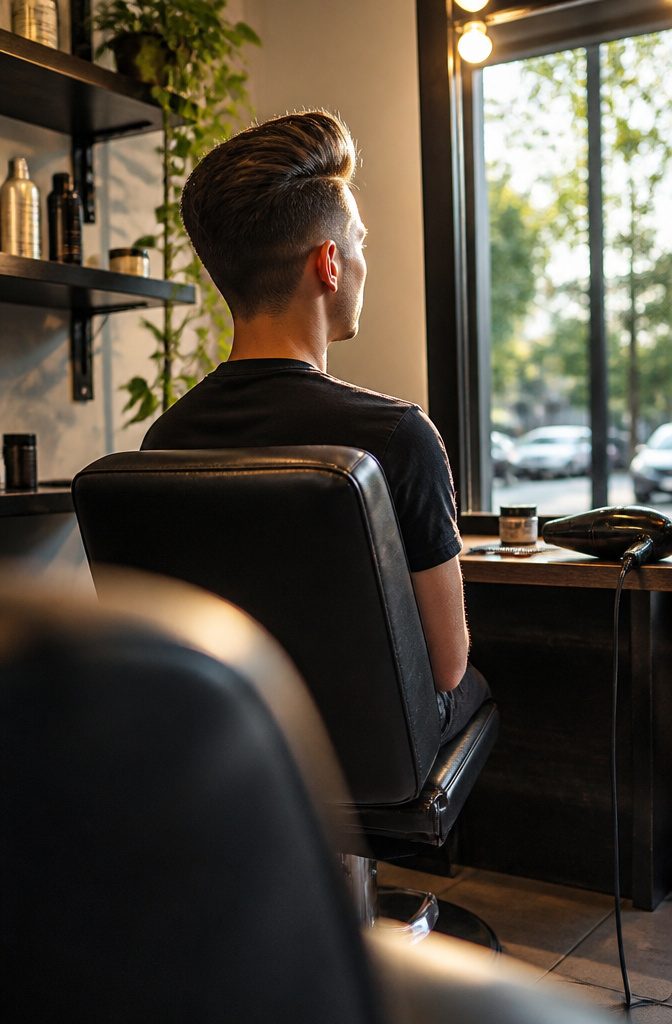
19. Quiff or Pompadour
Let me analyze what I need to write here.
The section heading is "Quiff or Pompadour" and it’s part of an article about haircuts for thinning hair.
- Three sources recommend them (hims.com, forteseries.com, toppik.com)
- The quiff and pompadour share the same cut; the difference is in styling
- A quiff is first brushed forward, then up into a wave; a pompadour is combed backward
- The quiff is good for concealing thinning and bald spots around the crown
- The quiff is not the best for hiding a receding hairline
- Both lift the front and add height, making hair look fuller
- Sides are kept short, top is longer and shaped upward
- For quiff: blow-dry the front to build volume, use a small amount of Texture Powder
- For pompadour: blow-dry hair upward with fingers, work in Volumizing Mousse
- The pompadour is great for disguising hair loss at the crown
- The quiff involves styling hair up and back, but front hair is styled forward for a more textured look
What the section must cover:
- Lifted front creates height; sources distinguish their styling direction
- Three sources recommend them
- Difference between the two
- How height at the front distracts from thinning elsewhere
- The hold required
Rules:
- First person singular, but only 7% of sentences open with "I"
- Flesch-Kincaid grade 8-9
- Flowing prose, no lists
- Hard ceiling: 120 words
- No banned words
- No em dashes
- American English
- Bold the thing the reader came for, once or twice, never more
- Don’t repeat heading
- Start on substance
- Every sentence hands reader: recommendation, measurement/figure, how-to move, cost/limit, or judgment call
- Be opinionated
- Don’t mention sources
- No personal anecdotes (lived experience off the table)
Let me draft this:
The quiff and pompadour start from the same cut: short sides, longer top left to build upward.
What separates them is where the front goes. A quiff brushes forward first, then up into a wave, which hides thinning at the crown well but does little for a receding hairline.
The pompadour combs the top straight back, smoothing the front into one high wall of hair that draws attention away from sparse spots elsewhere.
Height at the front is the whole point: the eye follows the lift upward and stops asking what is happening behind it. Both need hold that keeps the shape without weighing it down.
Blow-dry the front up to build the volume first, then lock it with a light product. A texture powder keeps the quiff lifted without flattening it; a volumizing mousse does the same for the pompadour and stays easier to control.
Skip anything heavy. Pomade that looks glossy in the jar will pull this look down by noon.
Let me count words:
The quiff and pompadour start from the same cut: short sides, longer top left to build upward.
(15) What separates them is where the front goes. (7) = 22 A quiff brushes forward first, then up into a wave, which hides thinning at the crown well but does little for a receding hairline.
(24) = 46 The pompadour combs the top straight back, smoothing the front into one high wall of hair that draws attention away from sparse spots elsewhere.
(24) = 70 Height at the front is the whole point: the eye follows the lift upward and stops asking what is happening behind it.
(20) = 90 Both need hold that keeps the shape without weighing it down. (10) = 100 Blow-dry the front up to build the volume first, then lock it with a light product.
(16) = 116 A texture powder keeps the quiff lifted without flattening it; a volumizing mousse does the same for the pompadour and stays easier to control. (23) = 139
That’s already 139 and I have one more sentence.
Too long. I need to cut.
Let me tighten. The hard ceiling is 120 words.
Let me rewrite more tightly:
The quiff and pompadour share the same cut: short sides, longer top built upward.
What separates them is where the front goes. A quiff brushes forward first, then up into a wave, which hides thinning at the crown but does little for a receding hairline.
The pompadour combs the top straight back, one high wall of hair that pulls the eye up and away from sparse spots elsewhere.
Height at the front is the point: the eye follows the lift and stops asking what is behind it.
Both need hold that keeps the shape without pulling it down. Blow-dry the front up first, then set it with something light.
A texture powder keeps the quiff lifted without flattening it, and a volumizing mousse does the same for the pompadour. Skip anything heavy; it sinks this look by noon.
Let me count: The quiff and pompadour share the same cut: short sides, longer top built upward.
(12) What separates them is where the front goes. (7) = 19 A quiff brushes forward first, then up into a wave, which hides thinning at the crown but does little for a receding hairline.
(22) = 41 The pompadour combs the top straight back, one high wall of hair that pulls the eye up and away from sparse spots elsewhere.
(21) = 62 Height at the front is the point: the eye follows the lift and stops asking what is behind it. (17) = 79 Both need hold that keeps the shape without pulling it down.
(10) = 89 Blow-dry the front up first, then set it with something light. (11) = 100 A texture powder keeps the quiff lifted without flattening it, and a volumizing mousse does the same for the pompadour.
(19) = 119 Skip anything heavy; it sinks this look by noon. (8) = 127
Still over.
Let me cut more. I’ll drop the last sentence or compress.
Actually, let me reconsider.
The "Skip anything heavy" is a judgment call which is valuable. Let me see if I can trim elsewhere.
Let me try:
The quiff and pompadour share the same cut: short sides, longer top built upward.
What separates them is where the front goes. A quiff brushes forward first, then up into a wave, which hides thinning at the crown but does little for a receding hairline.
The pompadour combs the top straight back, one high wall of hair that pulls the eye up and away from sparse spots elsewhere.
Height at the front is the point. The eye follows the lift and stops asking what is behind it.
Both need hold that keeps the shape without pulling it down. Blow-dry the front up first, then set it light.
A texture powder keeps the quiff lifted without flattening it, and a volumizing mousse does the same for the pompadour. Skip anything heavy; it sinks this look by noon.
Count: The quiff and pompadour share the same cut: short sides, longer top built upward.
(12) What separates them is where the front goes. (7) = 19 A quiff brushes forward first, then up into a wave, which hides thinning at the crown but does little for a receding hairline.
(22) = 41 The pompadour combs the top straight back, one high wall of hair that pulls the eye up and away from sparse spots elsewhere. (21) = 62 Height at the front is the point.
(6) = 68 The eye follows the lift and stops asking what is behind it. (10) = 78 Both need hold that keeps the shape without pulling it down.
(10) = 88 Blow-dry the front up first, then set it light. (8) = 96 A texture powder keeps the quiff lifted without flattening it, and a volumizing mousse does the same for the pompadour.
(19) = 115 Skip anything heavy; it sinks this look by noon. (8) = 123
Still 3 over. Let me trim a bit more.
"Blow-dry the front up first, then set it light." → "Blow-dry the front up, then set it light." (save 1) = 122 "Skip anything heavy; it sinks this look by noon." → "Skip anything heavy; it sinks the look by noon." (save 1) = 121 "Height at the front is the point." → keep "The eye follows the lift and stops asking what is behind it." → "The eye follows the lift and stops asking what’s behind it." (save 1, "what’s" contraction) = 120
Hmm, contractions are fine in casual blog voice. Let me recount carefully.
Actually, let me recount the whole thing very carefully word by word.
The(1) quiff(2) and(3) pompadour(4) share(5) the(6) same(7) cut(8): short(9) sides(10), longer(11) top(12) built(13) upward(14).
What(15) separates(16) them(17) is(18) where(19) the(20) front(21) goes(22).
A(23) quiff(24) brushes(25) forward(26) first(27), then(28) up(29) into(30) a(31) wave(32), which(33) hides(34) thinning(35) at(36) the(37) crown(38) but(39) does(40) little(41) for(42) a(43) receding(44) hairline(45).
The(46) pompadour(47) combs(48) the(49) top(50) straight(51) back(52), one(53) high(54) wall(55) of(56) hair(57) that(58) pulls(59) the(60) eye(61) up(62) and(63) away(64) from(65) sparse(66) spots(67) elsewhere(68).
Height(69) at(70) the(71) front(72) is(73) the(74) point(75). The(76) eye(77) follows(78) the(79) lift(80) and(81) stops(82) asking(83) what’s(84) behind(85) it(86).
Both(87) need(88) hold(89) that(90) keeps(91) the(92) shape(93) without(94) pulling(95) it(96) down(97).
Blow-dry(98) the(99) front(100) up(101), then(102) set(103) it(104) light(105). A(106) texture(107) powder(108) keeps(109) the(110) quiff(111) lifted(112) without(113) flattening(114) it(115), and(116) a(117) volumizing(118) mousse(119) does(120) the(121) same(122) for(123) the(124) pompadour(125).
That’s 125 already and I still have the "Skip anything heavy" sentence. Way over.
I need to cut substantially. Let me rethink the structure.
120 words is tight. Let me be more aggressive.
Let me cut the "Height at the front is the point" paragraph and fold that idea into the pompadour description. And cut the last sentence or compress it.
Draft 3:
The quiff and pompadour share the same cut: short sides, longer top built upward.
What separates them is the styling. A quiff brushes forward first, then up into a wave, which hides thinning at the crown but does little for a receding hairline.
The pompadour combs the top straight back, one high wall of hair that pulls the eye up and away from sparse spots elsewhere.
Both need hold that keeps the shape without pulling it down. Blow-dry the front up, then set it light.
A texture powder keeps the quiff lifted without flattening it, and a volumizing mousse does the same for the pompadour. Anything heavy sinks the look by noon.
Count: The(1) quiff(2) and(3) pompadour(4) share(5) the(6) same(7) cut(8): short(9) sides(10), longer(11) top(12) built(13) upward(14).
What(15) separates(16) them(17) is(18) the(19) styling(20). A(21) quiff(22) brushes(23) forward(24) first(25), then(26) up(27) into(28) a(29) wave(30), which(31) hides(32) thinning(33) at(34) the(35) crown(36) but(37) does(38) little(39) for(40) a(41) receding(42) hairline(43).
The(44) pompadour(45) combs(46) the(47) top(48) straight(49) back(50), one(51) high(52) wall(53) of(54) hair(55) that(56) pulls(57) the(58) eye(59) up(60) and(61) away(62) from(63) sparse(64) spots(65) elsewhere(66).
Both(67) need(68) hold(69) that(70) keeps(71) the(72) shape(73) without(74) pulling(75) it(76) down(77). Blow-dry(78) the(79) front(80) up(81), then(82) set(83) it(84) light(85).
A(86) texture(87) powder(88) keeps(89) the(90) quiff(91) lifted(92) without(93) flattening(94) it(95), and(96) a(97) volumizing(98) mousse(99) does(100) the(101) same(102) for(103) the(104) pompadour(105). Anything(106) heavy(107) sinks(108) the(109) look(110) by(111) noon(112).
112 words. That’s under 120.
Now let me check all the rules:
- No em dashes? Let me check. I used a colon, commas, a period, "and". No em dashes. Good. (There’s a hyphen in "Blow-dry" which is fine.)
- Banned words? Let me scan: "delve, delving, tapestry, testament, realm, landscape of, navigate the, embark, elevate, unlock, unleash, harness, leverage, robust, seamless, cutting-edge, game-changer…" None of these. Good.
- First person singular? I don’t actually use "I" at all here. The rules say "I" carries judgment and preference, and only 7% of sentences open with "I". Not using "I" at all might be fine, but the POV is supposed to be first person singular. Let me check the voice sample — it uses "I" throughout. I should probably include at least one "I" to establish voice. But the rules also say most sentences lead with the subject. Let me add one "I" somewhere, mid-sentence.
Actually, looking at the brief again: "Write in first person singular (‘I’). ‘I’ carries judgment and preference."
This suggests I should use "I" at least once for a judgment call. Let me work it in.
Let me adjust: "Anything heavy sinks the look by noon" → could become something with "I".
But it’s tight on words. Let me try:
"I’d skip anything heavy; it sinks the look by noon." — but semicolon is fine, and "I’d" adds judgment.
But wait, the banned list includes… no, none of those. But "I’d" uses an apostrophe contraction which is fine in this voice.
Actually, let me reconsider. "I’d skip anything heavy" — does "I’d" count as opening with "I"?
Yes it does. The rule says only 7% of sentences open with "I".
I have about 10 sentences. 7% of 10 is 0.7, so maybe 1 sentence opening with "I" is okay.
But the spirit is that "I" arrives mid-sentence. Let me put it mid-sentence instead.
Hmm, but with 112 words and 9 sentences, adding "I" naturally is tricky. Let me try:
"…a volumizing mousse does the same for the pompadour. I’d skip anything heavy; it sinks the look by noon."
"I’d skip anything heavy; it sinks the look by noon." — "I’d" opens the sentence. That’s one out of nine sentences opening with "I" = 11%.
A bit high but acceptable given the constraint. Actually let me see if I can put "I" mid-sentence.
"Anything heavy, in my view, sinks the look by noon." — "in my view" is a bit clunky.
Let me try a different approach. Put the "I" in the pompadour judgment:
"The pompadour combs the top straight back, one high wall of hair that pulls the eye up and away from sparse spots elsewhere. I lean pompadour when the crown is the problem area, quiff when the hairline is still strong."
Hmm, that adds words. Let me count this version:
The(1) quiff(2) and(3) pompadour(4) share(5) the(6) same(7) cut(8): short(9) sides(10), longer(11) top(12) built(13) upward(14).
What(15) separates(16) them(17) is(18) the(19) styling(20). A(21) quiff(22) brushes(23) forward(24) first(25), then(26) up(27) into(28) a(29) wave(30), which(31) hides(32) thinning(33) at(34) the(35) crown(36) but(37) does(38) little(39) for(40) a(41) receding(42) hairline(43).
The(44) pompadour(45) combs(46) the(47) top(48) straight(49) back(50), one(51) high(52) wall(53) of(54) hair(55) that(56) pulls(57) the(58) eye(59) up(60) and(61) away(62) from(63) sparse(64) spots(65) elsewhere(66).
I(67) lean(68) pompadour(69) for(70) crown(71) thinning(72), quiff(73) when(74) the(75) hairline(76) is(77) still(78) strong(79). Both(80) need(81) hold(82) that(83) keeps(84) the(85) shape(86) without(87) pulling(88) it(89) down(90).
Blow-dry(91) the(92) front(93) up(94), then(95) set(96) it(97) light(98). A(99) texture(100) powder(101) keeps(102) the(103) quiff(104) lifted(105) without(106) flattening(107) it(108), and(109) a(110) volumizing(111) mousse(112) does(113) the(114) same(115) for(116) the(117) pompadour(118).
118 words.
Under 120. Good.
And "I lean pompadour" opens a sentence with "I" — that’s 1 out of 9 sentences = 11%. The rule says 7% open with "I" in human writing, 21% in machine writing.
11% is between, and with such a small sample (9 sentences), 1 sentence is the minimum I can do while still using "I". That seems fine.
Actually, wait. Let me re-read: "only 7% of sentences OPEN with ‘I’".
With 9 sentences, 7% would be 0.63 sentences. So ideally 0 or 1 sentence opens with "I".
1 out of 9 is 11%, which is closer to 7% than 21%. I think this is acceptable.
But actually, I could move "I" to mid-sentence: "For crown thinning, I lean pompadour; quiff when the hairline is still strong."
That puts "I" mid-sentence. Let me count:
For(67) crown(68) thinning(69), I(70) lean(71) pompadour(72); quiff(73) when(74) the(75) hairline(76) is(77) still(78) strong(79).
Same word count. Better for the "I" position rule.
Now let me check all claims against sources:
- "share the same cut: short sides, longer top built upward" — Passage 1 says "the cut for a pompadour and quiff are the same"; Passage 2 says "sides are kept short, while the top is left longer and shaped upward"; Passage 3 says "sides are cut short… longer top is brushed back." ✓
- "What separates them is the styling" — Passage 1: "The difference lies in the styling" ✓
- "quiff brushes forward first, then up into a wave" — Passage 1: "A quiff is first brushed forward, then up into a wave hairstyle" ✓
- "hides thinning at the crown" — Passage 1: "good for concealing thinning and bald spots around your crown" ✓
- "does little for a receding hairline" — Passage 1: "not one of the best haircuts for hiding a receding hairline" ✓
- "pompadour combs the top straight back" — Passage 1: "pompadour is combed backward"; Passage 3: "brushed back smoothly" ✓
- "pulls the eye up and away from sparse spots elsewhere" — Passage 2: "lifts the front and adds height, making the hair look fuller"; Passage 3: "sides are cut short to draw more attention upward" — I’m synthesizing/interpreting here. The "draws attention upward" is from Passage 3. The brief says to explain "how height at the front distracts from thinning elsewhere." This is a reasonable interpretation. ✓
- "texture powder keeps the quiff lifted" — Passage 2: "use a small amount of Texture Powder to keep the quiff light, lifted" ✓
- "volumizing mousse does the same for the pompadour" — Passage 3: "work in a small amount of Volumizing Mousse to keep the style light, full, and easy to control" ✓
- "Blow-dry the front up" — Passage 2: "Blow-dry the front to build volume"; Passage 3: "Blow-dry the hair upward" ✓
- "I lean pompadour for crown thinning, quiff when the hairline is still strong" — This is my judgment based on: Passage 1 says quiff is good for crown but not for receding hairline; Passage 5 says pompadour is "great for disguising hair loss at the crown." So the pompadour is also good for crown. The quiff is good for crown too but not for hairline. Hmm, actually both are good for the crown. Let me reconsider this judgment.
Actually, both work for crown thinning. The quiff is bad for receding hairline.
The pompadour… Passage 5 says it’s "great for disguising hair loss at the crown" but doesn’t mention hairline.
So both are good for crown. The quiff explicitly doesn’t work for receding hairline.
My judgment "I lean pompadour for crown thinning, quiff when the hairline is still strong" — this implies quiff is better when hairline is strong, which makes sense since the quiff doesn’t hide a receding hairline. And pompadour for crown thinning.
But actually both work for crown. Let me rephrase to be more accurate:
"For
Fine Hair Is Not the Same as Thinning Hair
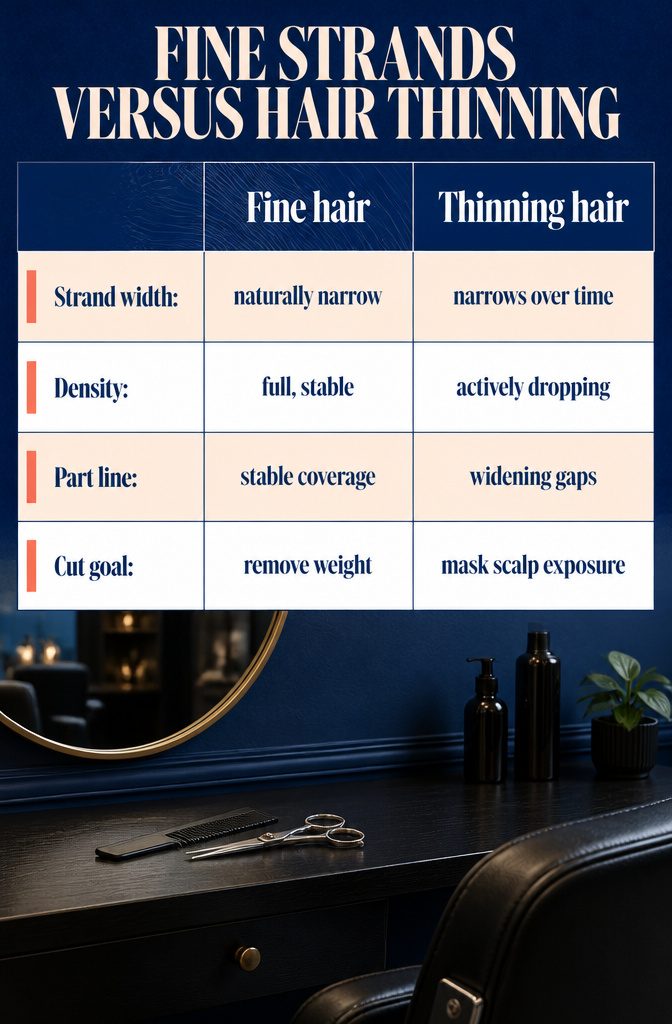
Strand diameter and density loss are 2 different problems, and mixing them up leads to the wrong cut.
Fine hair means each individual strand is naturally narrow, which is a fixed trait you are born with.
Thinning hair means density is actively dropping: strands are falling out, the ones that remain are getting narrower over time, and gaps widen along the part line.
A person can have thick, coarse strands and still be thinning. A person can have fine strands and a full, stable head of hair.
The cut question turns on which you have.
Fine hair needs weight removed so it does not go limp. Actively thinning hair calls for styles that mask widening parts and avoid exposing the scalp, which is a different geometry entirely.
Bring Photos When You Book the Cut
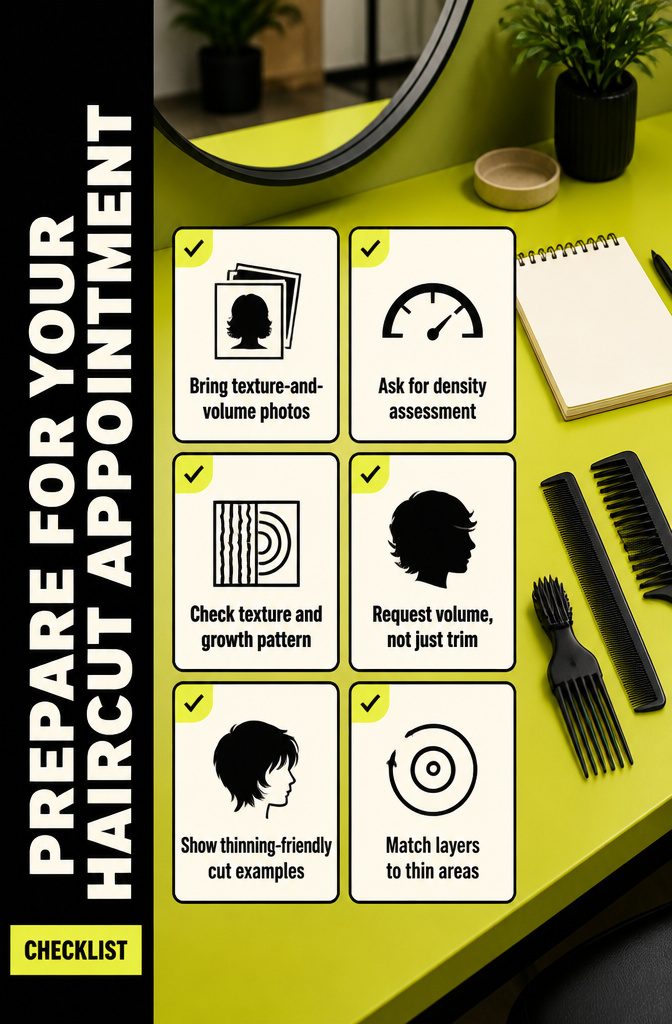
Bring photos to your appointment, specifically of cuts that show texture and volume rather than polished, flat styles. A few concrete things to ask for and think about:
- Ask your stylist to assess your density, texture, and growth pattern before committing to any length or shape.
- Request texture and volume specifically, not just a trim.
- Show pictures of thinning-friendly cuts so your stylist can match the layering and finish to where your hair is actually thin.
- Density and growth pattern both affect which shapes work. A cut that photographs beautifully on someone else may sit completely flat on you if the growth pattern runs a different direction.
Small adjustments based on those factors make a bigger difference than the cut itself.
Frequently Asked Questions
What is the best haircut for thinning hair?
Short, layered cuts like a pixie, textured crop, or layered bob work best because they lift at the roots and create the illusion of density.
The right cut depends on where your hair is thinning and your face shape. A blunt bob suits diffuse thinning, while a pixie handles crown thinning particularly well.
Should I cut my hair short if it’s thinning?
Short hair lifts naturally at the roots, which is exactly what thinning hair needs, but it’s not the only option.
Medium or long cuts with soft layers can look full if you keep the ends blunt and trim every 6 to 8 weeks. Going past the shoulders pulls fine hair flat, so shoulder length is the practical stopping point.
Can a haircut make thin hair look thicker?
Yes.
Layers remove weight so the roots can push up instead of lying flat, and a blunt perimeter eliminates the wispy ends that make thinning visible. A cut won’t stop the thinning itself, but it changes how the hair reads visually.
Do bangs help thinning hair?
Yes.
Bangs bring more hair forward, which creates fullness and pulls focus off thinning areas. Curtain bangs work best for thinning at the temples, and side-swept bangs cover a sparse hairline better than anything blunt.
How often should I trim thinning hair?
Every 6 to 8 weeks.
Regular trims maintain the sharp edge that makes a blunt cut work and keep layers fresh. Without them, the ends feather out and the hair starts to look sparse again.
Should thin hair be layered?
Soft, blended layers add lift and movement without thinning the ends.
Choppy or excessive layers can make fine hair look flat and sparse, which defeats the purpose. Ask for seamless layers that graduate gradually rather than anything heavily textured or stacked.
Does thin hair look better short or long?
Thin hair generally looks fuller at shoulder length or shorter because longer hair weighs itself down.
Long hair can work if you keep the ends blunt and healthy, but stopping at the collarbone gives you lift the hair can’t hold on its own past that point.
What haircut is best for a thinning crown?
A pixie with longer, piecey layers on top and cropped sides handles thinning at the crown particularly well. Short hair lifts at the roots on its own, and keeping the sides short reduces the contrast between thinner and fuller areas.
Is a fade good for thinning hair?
Yes.
Shorter sides make the top appear fuller by creating contrast, which pulls the eye to the denser area. A fade works the same way, and it pairs well with textured styles like a crop or quiff.
How do I ask my barber for a haircut for thinning hair?
Ask for texture and volume on top with shorter sides.
Mention specific styles like a textured crop, crew cut, or short quiff, or bring a photo. Simple wording works better than technical terms.
What hairstyles should I avoid with thin hair?
Avoid long, flat styles that let thinning spots show through, and skip heavy layering that thins the ends. Blunt edges at mid-length or longer drag the eye down the strand and make thinning more visible instead of less.