Growing out a haircut takes 3 to 30 months depending on the length you want, and most attempts fail at the awkward stage when the hair is too long to look short and too short to look long.
That stage usually peaks around month 3 for buzz cuts or months 6 to 9 for longer starting points, and getting past it requires maintenance trims that clean up the sides and back while leaving the top alone.
1. Decide What Length You Want and Tell Your Stylist
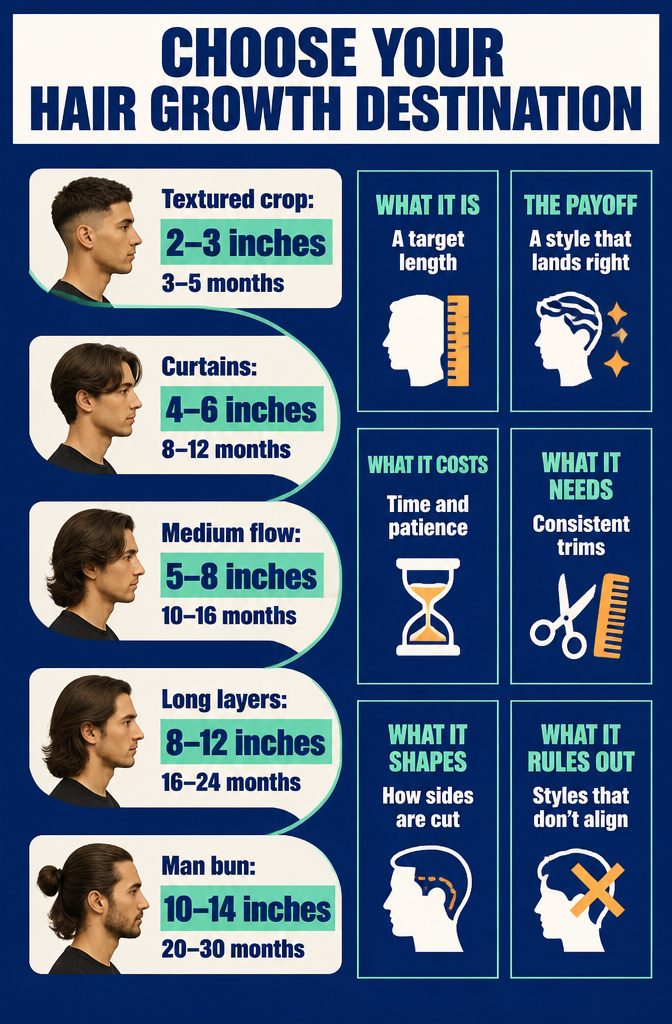
The first thing to know before the first trim: tell your barber or stylist what length you are actually going toward. A textured crop takes 2–3 inches and 3–5 months.
Curtains need 4–6 inches and 8–12 months. Medium flow runs 5–8 inches over 10–16 months.
Long layers land at 8–12 inches, about 16–24 months. A man bun sits at 10–14 inches, which means 20–30 months.
Those timelines matter because the goal decides how your barber shapes the hair along the way. If you are heading to ear length, the sides get trimmed differently than if you want shoulder length.
Face shape, work expectations and hair type all sit in this decision, but the clearest path is naming the target style out loud at the first visit so your barber knows which areas to leave alone and which to clean up.
2. Clean Up the Neckline and Sides While the Top Grows
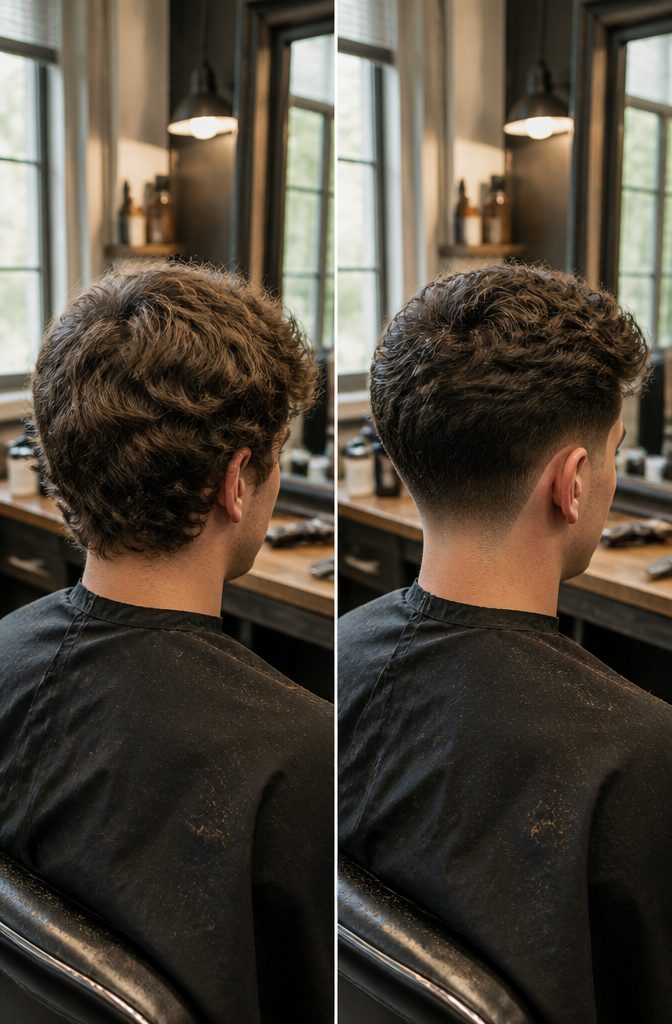
Hair grows about half an inch per month, which means the first eight to twelve weeks present the same problem: the sides and back fill in faster than the top, and the result looks round and uneven rather than intentional.
The fix is selective maintenance. Keep the neckline, sideburns and the area around the ears cleaned up while leaving the top completely alone.
If you visit a barber, ask for a taper at the temple and neck or a medium fade along the sides and back.
That gives the cut dimension and pushes visual weight toward the top, where the length needs to build.
The first real shaping trim happens around month two, when the sides start to stick out and cover the tops of the ears.
Your barber takes the bulk off the sides and back but leaves the top untouched, so the top can catch up in length. You lose almost no progress and gain a lot of shape.
If you are trimming the hairline at home instead, focus on the sideburns and the two trails of hair that run down the neck, and resist the temptation to touch anything else.
3. Get Through the Awkward Stage Without Cutting the Length
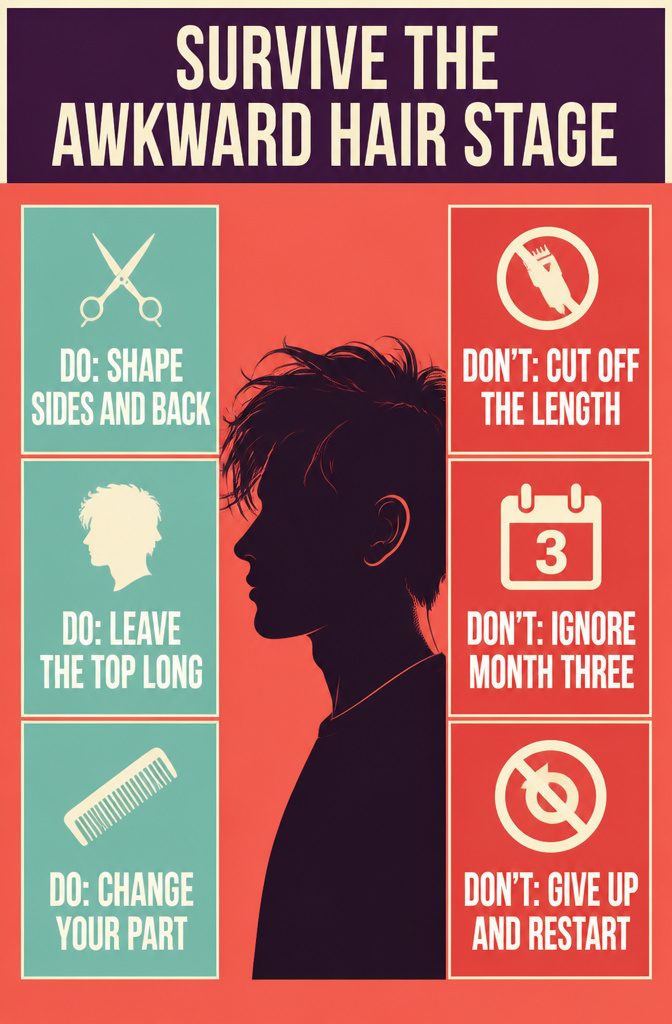
The awkward stage arrives when the hair is too long to look short and too short to look long. Sides puff out, the back flips, the top falls forward into your eyes.
For hair starting from a buzz cut or very short length, month three is usually the hardest, though the awkward phase can peak later, around months six to nine, depending on where you started.
A shaping cut keeps you moving forward.
The barber tidies the sides and back, takes weight out where it bulks, and leaves the top long. You lose the stray hairs without losing progress.
A small amount of product pushed through the top lets you move it back or off to the side. Changing your part shifts the way things fall.
When the hair over the ears is long enough, tuck it behind them. On days when nothing cooperates, a cap or beanie is a legitimate fix.
Most grow-outs fail here. This stage is temporary, and pushing through it is what separates the people who reach the length they want from the people who give up and start over.
4. Ask for Maintenance Trims That Preserve the Length
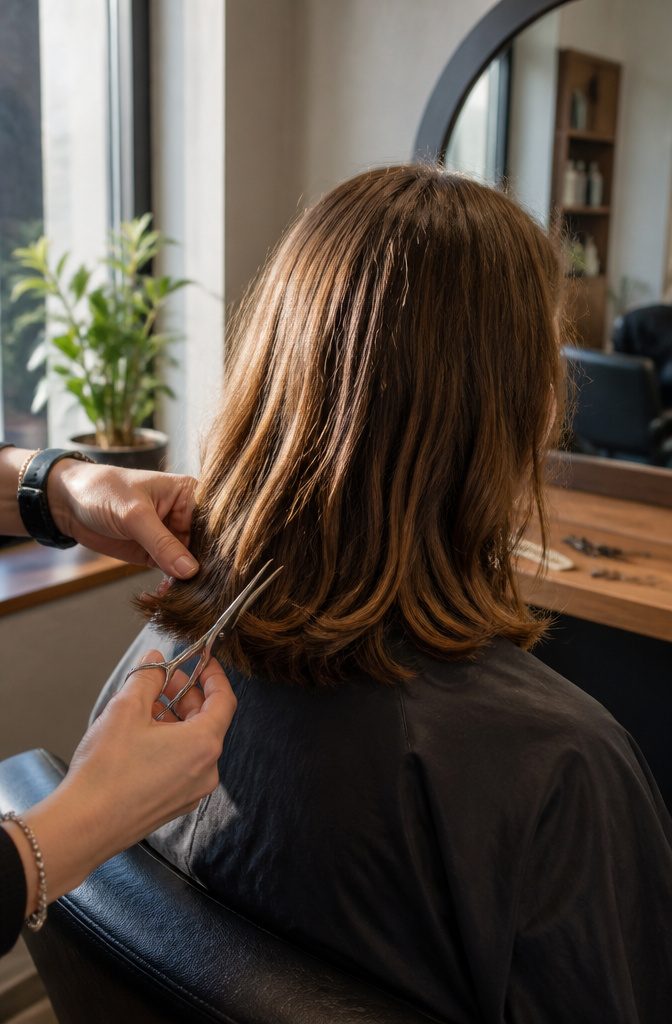
The trim you book while growing out hair is not the same thing as a haircut.
A maintenance trim removes bulk from the sides and back, tidies the ends, and keeps the shape balanced without touching the length you are adding.
I ask the stylist to take no more than a quarter inch off the length and say the words "I am growing it out" at every visit. The appointment takes about thirty minutes and costs around $25.
Timing those trims depends on how long the hair already is. At medium length, I go every six to eight weeks.
Once it reaches ear-to-chin, I stretch it to eight to ten weeks. Past that, every ten to twelve weeks keeps the ends healthy without stalling the grow-out.
If you are maintaining very short sides while the top gains length, the interval can tighten to every two weeks early on, then lengthen as the whole head reaches the target.
5. Change Your Care and Styling as the Hair Gets Longer
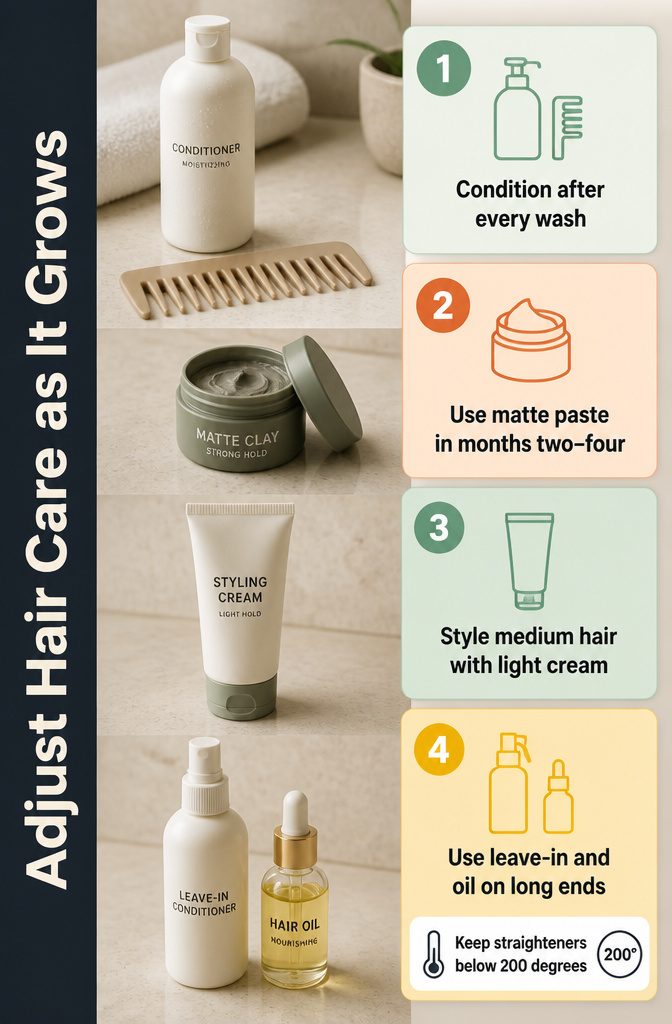
As the length changes, so does what keeps it manageable.
Conditioner after every wash is a good starting point, and switching to a wide-tooth or saw-cut, flat-tooth comb helps detangle longer hair without the snagging you get from a nylon brush.
Wet hair is more fragile, so gentle moves through it matter.
Beyond about 15 millimeters, it starts to sprout in all directions. This is because it follows the exact growth pattern of your hair and hasn’t been specifically cut to makes these quirks more flattering. All of this can often be fixed with a simple fingernail-sized blob of matte clay or styling paste.
— GQ
That fingernail-sized blob, worked between your hands and smoothed from back to front while the hair is still damp, can fix a lot of what looks unruly at the early awkward stage.
Matte paste or clay works well in months two through four to push the top back and control the sides. At medium length, a light styling cream gives the hair weight and controls frizz without stiffness.
Once it reaches long, leave-in conditioner and a little oil on the ends keep things soft. If you use heat tools often, keep the straightener below 200 degrees to avoid damage.
6. Stop at a Length That Works or Keep Going

You are not locked into one goal. Some people start growing out a pixie with shoulder length in mind, then find they prefer the way their hair looks at chin length and stop there.
Others aim for a mid-length style and keep going once they see how the added length frames their face. The year-long stretch from short hair to long is not a contract with a fixed endpoint.
If your hair is thinning, the grow-out may not deliver what you pictured. Around 40 percent of men over 35 have noticeably thin hair, and fine or thinning hair can look sparse rather than full as it gets longer.
A medium length may be the better stopping point, or you may decide to go back to short. If your hair is shedding suddenly or forming patches, see a dermatologist before committing to a long grow-out.
What Suits Your Hair Type
What Suits Your Hair Type
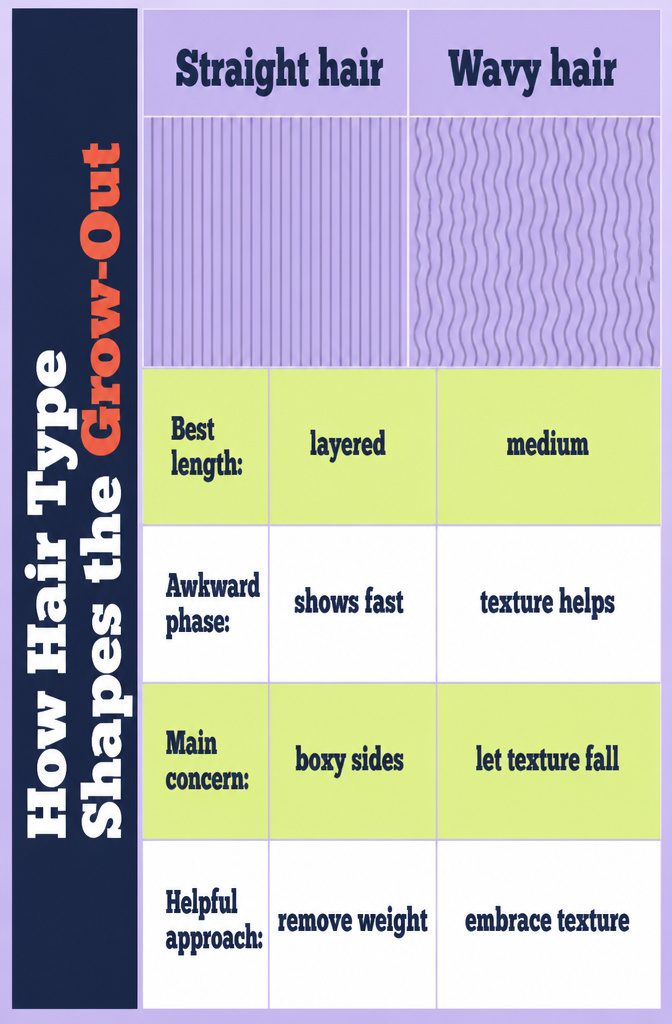
The natural state of your hair decides how long the awkward stage lasts and which styles you can actually reach.
Straight hair shows the awkward stage fastest: the sides stick out while the top catches up, and layers with weight removal keep it from looking boxy.
Wavy hair often looks best at medium length, so the grow-out can work in your favor if you let the texture do what it wants.
Curly hair grows out as much as it grows down, which means you risk a triangle shape unless you get regular trims to keep it round. Thick hair needs weight removal or it turns into a helmet.
Thinning hair presents the hardest call: longer lengths can separate and show more scalp, so be honest about whether a grow-out suits you at all before you commit to six months of it.
Styles You Can Grow Toward
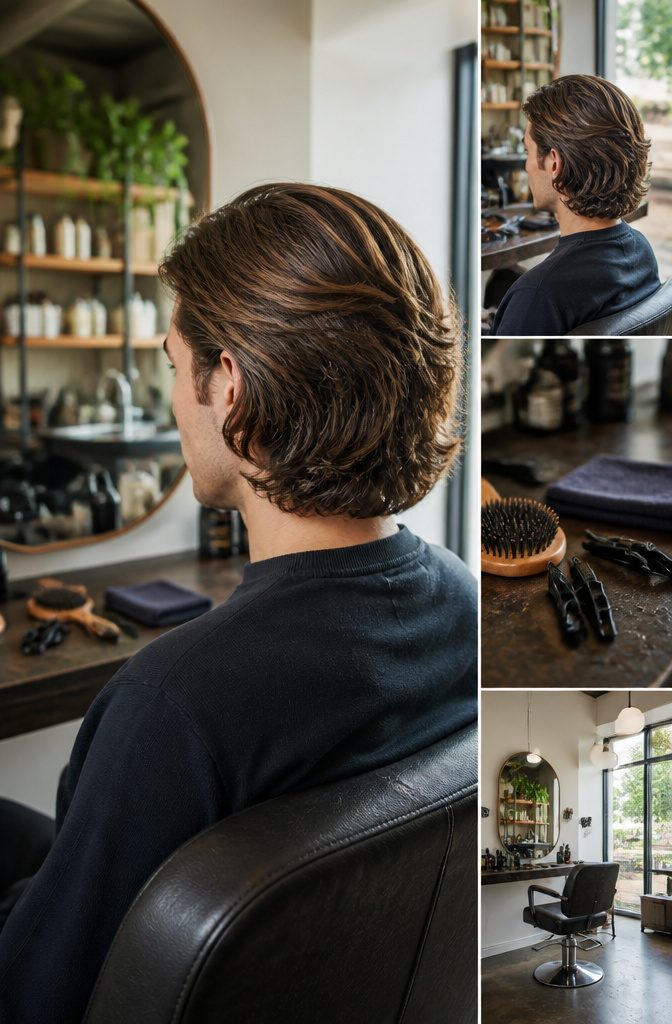
If you know where you’re headed, the in-between cuts make more sense. Here are the styles the grow-out can land on:
- Pixie: works if you’re starting from a buzz cut and want to stop at short, textured length with longer hair on top than the sides
- Bixie: the halfway point between pixie and bob, layered enough to tuck behind the ears while the bulk stays manageable
- Wolf cut: best for wavy hair growing out from pixie length, since the natural grow-out pattern (longer in back, shorter in front) already mimics the shape
- Mixie: a pixie-mullet hybrid that plays to how the back grows faster than the rest, so you maintain layers at each trim instead of fighting the uneven growth
- Curly crop: suits curly hair types because the top stays a bit longer than the sides, giving you less distance to cover before everything evens out
- Curtains: needs straight, wavy, or fluffy hair with enough front length to part and sweep to the sides
- Medium flow: works for thick or wavy hair and balanced face shapes, where the hair sweeps back or tucks without bulk taking over
- French bob: chin-length and blunt, grows out evenly because there’s no flip stage when the ends hit the shoulders
- Italian bob: just below the chin with subtle layers for movement, suited to finer hair that needs body
- Shoulder-length blunt bob: already past the shoulders, so it skips the awkward flipping stage entirely and grows out in one clean line
- Boho bob: a bob-length protective style with braids, lets you add extra hair for instant length while your own hair rests
- Modern shag: heavy on layers, which look intentional as they grow and add movement and dimension throughout
- Long layered hair: the landing spot for thick hair that would otherwise sit heavy, gives the length somewhere to move
- Knotless braids: a protective style that lets the hair rest with minimal manipulation, making scalp care easier during the grow-out
- Extensions: the shortcut when you don’t want to wait, adding length immediately while your natural hair catches up
- Man bun: requires growing through the longest awkward period, but works once everything reaches tie-back length
How Long the Grow-Out Takes
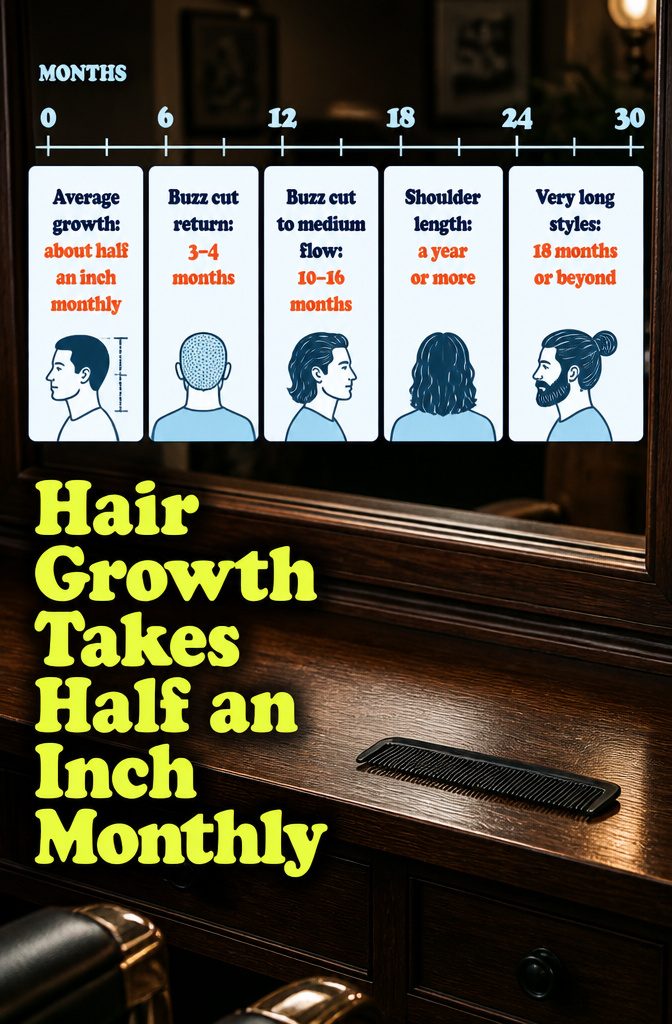
Hair grows about half an inch per month on average, which means getting from one length to the next is mostly a matter of simple math and a lot of waiting.
A buzz cut typically takes three to four months to return to its original length, assuming you started with a few inches on top.
From that same buzz cut to a medium flow style, count on ten to sixteen months. Shoulder-length hair usually takes a year or more, and anything longer stretches the timeline out to eighteen months or beyond.
The timeline shifts based on where you start and where you want to land.
Short to chin-length usually takes six to nine months. A textured crop might come in at three to five months, while curtains or a tapered middle part can take eight to twelve.
A man bun sits at the far end, closer to twenty or thirty months from a buzz. Genetics and overall health will move those numbers up or down, but the half-inch rule holds for most people.
Frequently Asked Questions
How long does it take to grow out a haircut?
Hair grows about half an inch per month, so short to chin-length takes 6 to 9 months and shoulder-length takes a year or more.
From a buzz cut to medium flow, expect 10 to 16 months. A man bun sits at the far end, closer to 20 or 30 months from a buzz.
How often should I trim my hair while growing it out?
Every 6 to 8 weeks at medium length, stretching to 8 to 10 weeks once it reaches ear-to-chin, and every 10 to 12 weeks past that.
Tell your stylist to take no more than a quarter inch off the length and say you are growing it out at every visit.
What products help when growing out a haircut?
Matte paste or clay works well in months 2 through 4 to push the top back and control the sides.
At medium length, a light styling cream gives the hair weight and controls frizz. Once it reaches long, leave-in conditioner and a little oil on the ends keep things soft.
How do I get through the awkward stage of growing out hair?
Book a shaping cut that tidies the sides and back while leaving the top long. Push the top back with a little product, change your part, or tuck the hair behind your ears when it is long enough.
The stage is temporary, and pushing through it is what separates people who reach the length they want from those who give up.
Should I cut the sides while growing out my hair?
Yes. Keep the neckline, sideburns and the area around the ears cleaned up while leaving the top alone.
Ask for a taper at the temple and neck or a medium fade along the sides and back. That gives the cut dimension and pushes visual weight toward the top, where the length needs to build.
What should I do if my hair is thinning while growing it out?
See a dermatologist if your hair is shedding suddenly or forming patches before committing to a long grow-out.
Around 40 percent of men over 35 have noticeably thin hair, and fine or thinning hair can look sparse rather than full as it gets longer. A medium length may be the better stopping point.
How long does a buzz cut take to grow back?
A buzz cut typically takes 3 to 4 months to return to its original length, assuming you started with a few inches on top.
Genetics will move that number up or down, but hair grows about half an inch per month on average for most people.