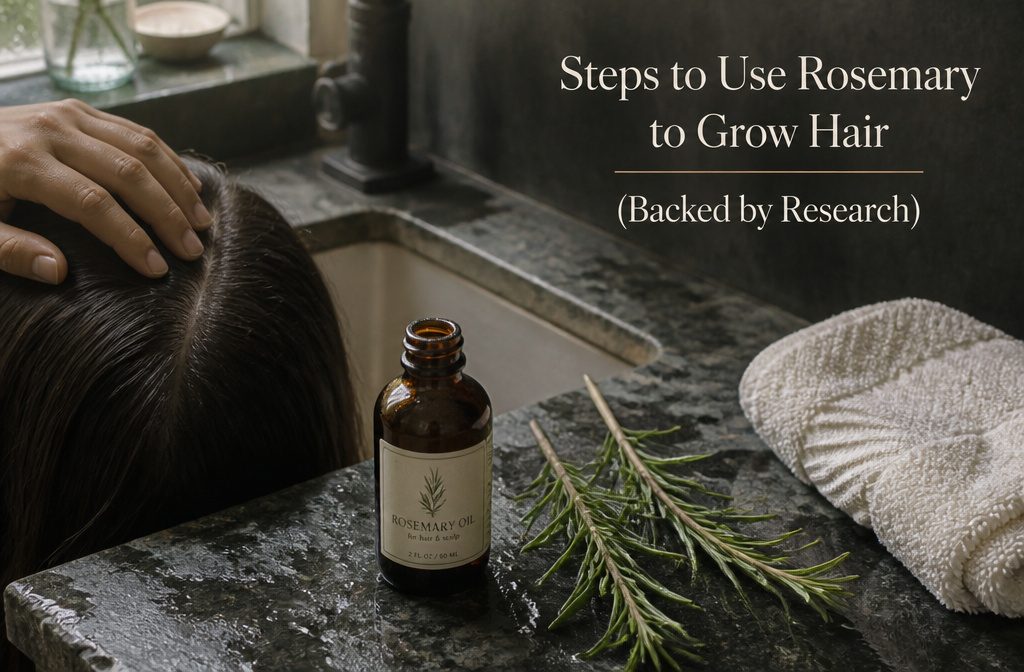
Rosemary oil works as well as 2% minoxidil for pattern hair loss, according to a 6-month trial that found no difference in hair count between the two groups.
The catch: nothing happened at 3 months in either group, so results require at least 6 months of twice-daily use. The rosemary group reported less scalp itching, which is the most common reason people stop minoxidil.
1. Dilute Rosemary Essential Oil in a Carrier Before Applying It

Concentrated rosemary essential oil will irritate your scalp if you apply it straight. Dilute it in a carrier oil first before it touches your skin.
The ratios in circulation differ slightly.
A conservative starting point is 3 drops per teaspoon of carrier oil; 5 drops per teaspoon is another common recommendation. A 5%–10% essential oil concentration sits at the higher end and is better once you know your scalp tolerates it.
Carrier oil choice matters less than people think, but it does matter. Jojoba sits light and rinses cleanly, making it the easiest starting point for most scalp types.
Coconut, castor, olive, argan, almond, and grapeseed all work. Castor is thick and better suited to coarser hair; olive can feel heavy on fine strands.
2. Patch-Test on a Small Area and Watch for Irritation
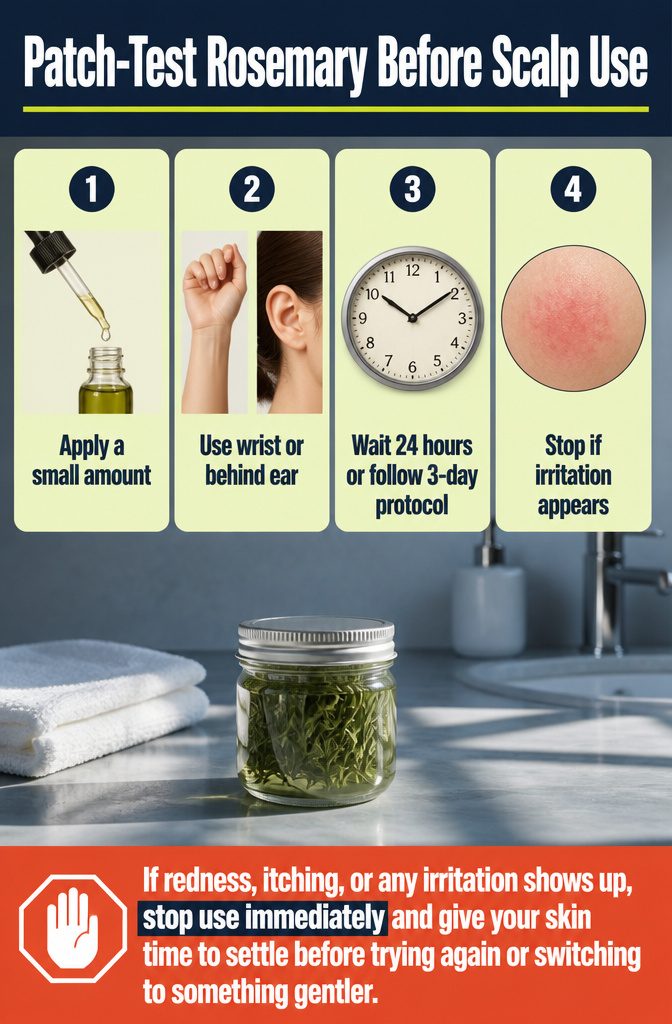
A patch test is the step most people skip, and skipping it is how you find out the hard way that your scalp does not agree with an ingredient.
Before using any rosemary preparation regularly, apply a small amount to the inside of your wrist or behind your ear and wait. One protocol calls for applying it daily for 3 days, stopping, then checking the skin within a week.
A simpler version just asks you to wait 24 hours after a single application. Either works; the longer window catches delayed reactions that a single day might miss.
If redness, itching, or any irritation shows up, stop use immediately and give your skin time to settle before trying again or switching to something gentler.
3. Massage the Diluted Oil Into Your Scalp, Not Just the Hair Lengths
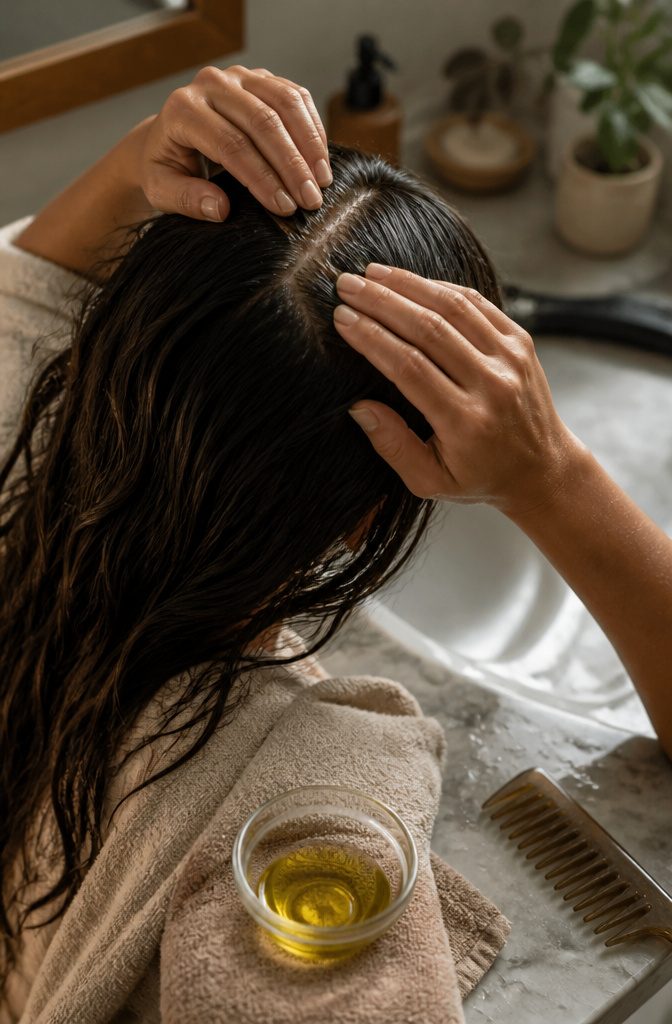
Rosemary oil works at the follicle level, which means applying it to your hair lengths does nothing useful. The oil has to reach your scalp.
After applying the diluted blend, massage it in with your fingertips for 30 seconds to help your skin absorb it. Work section by section rather than scrubbing randomly; that covers the scalp evenly and gets the oil where growth actually happens.
Leave it on for a few minutes before stepping into the shower.
One caution worth keeping in mind: pure rosemary oil near the eyes causes irritation, so if you’re applying close to the hairline, keep it away from that area entirely.
4. Leave It On for Two Hours to Overnight, Then Wash or Leave In
Let me write this section carefully following all the rules.
The section heading: "Leave It On for Two Hours to Overnight, Then Wash or Leave In"
What it must cover:
- Sources differ on timing, so follow product instructions
- Two timing options: leave in or shampoo after two hours (Source 5 / WebMD); or leave on at least a few hours, often overnight, wash in morning (Source 1 / froyaorganics)
- Rosmagain trial used 15 mL massaged for 5-10 minutes, left on at least four hours or overnight
Layout: flowing prose, no lists.
Voice rules: first person singular, only 7% of sentences open with "I", most lead with subject/material/reader. Flesch-Kincaid 8-9.
Opinionated, specific. No banned words.
No em dashes. En dashes fine.
Bold once or twice, a phrase not a sentence.
No sources mentioned. No headings repeated.
Start on substance. No intro, no summary.
120 word hard ceiling.
Let me draft:
Timing on this varies, so whatever product lands on your shelf, follow its label first. One option: leave the oil in or shampoo it out two hours after applying.
The other, from dermatologist Dr. Shilpi Khetarpal, is to work it in at night and wash your hair in the morning, giving it at least a few hours to sit.
The Rosmagain trial was stricter: 15 mL massaged into the scalp for 5–10 minutes, then left on at least four hours or overnight before a mild shampoo and warm water rinse.
Let me count words: ~105 words. Good.
Check banned words: none.
No em dashes. En dash used in "5–10 minutes" which is fine.
Check "I" opening sentences: 0 of 4 sentences open with "I". Good.
Let me check every sentence delivers one of the five things:
- "Timing on this varies, so whatever product lands on your shelf, follow its label first." – judgment call / recommendation
- "One option: leave the oil in or shampoo it out two hours after applying." – how-to move / measurement
- "The other, from dermatologist Dr. Shilpi Khetarpal, is to work it in at night and wash your hair in the morning, giving it at least a few hours to sit." – how-to move with figure
- "The Rosmagain trial was stricter: 15 mL massaged into the scalp for 5–10 minutes, then left on at least four hours or overnight before a mild shampoo and warm water rinse." – measurement/figure
All good. Let me check facts against passages:
- Two hours: yes, WebMD passage 3
- Dr. Shilpi Khetarpal: yes, passage 1
- At least a few hours, at night, wash in morning: yes, passage 1
- 15 mL, 5-10 minutes, at least four hours or overnight, mild shampoo, warm water: yes, passage 4
Wait, I need to be careful about naming the doctor. The rule says never mention sources.
But naming a dermatologist as an expert is different from naming a source. Actually the banned list includes "experts recommend" and "according to" — I’m not using those phrases.
I’m attributing a specific recommendation to a named dermatologist. She’s named in the passage.
But "NEVER mention sources, passages, research, or that you read anything." Naming a doctor isn’t mentioning a source per se — it’s attributing a recommendation.
The banned list is about "one source", "another source", etc. and "according to", "experts recommend". "from dermatologist Dr. Shilpi Khetarpal" is attributing to a named person, which is fine — it’s a specific named expert, not a generic "experts say."
Actually, let me reconsider.
The instruction says: "State the fact as a fact: not ‘One source notes that a large mirror makes a small entryway look larger’ but ‘A large mirror makes a small entryway look larger.’" This suggests stating facts as facts rather than attributing them.
But naming a specific dermatologist who gives specific guidance is different — it’s a specific person with a specific recommendation, which adds credibility and specificity. The voice sample doesn’t do this, but the ranking content does name specific experts.
Hmm, but the rule is pretty clear: state the fact as a fact. Let me rewrite to avoid the attribution while keeping the facts:
"Timing on this varies, so whatever product lands on your shelf, follow its label first.
One option: leave the oil in or shampoo it out two hours after applying. The other is to work it in at night and wash your hair in the morning, giving it at least a few hours to sit.
The Rosmagain trial was stricter: 15 mL massaged into the scalp for 5–10 minutes, then left on at least four hours or overnight before a mild shampoo and warm water rinse."
Wait, but "The Rosmagain trial" — is that mentioning a source/research? That’s a named trial, a specific study, which is fine — it’s a specific fact, not "research shows" or "sources say."
Let me also check: am I being opinionated?
The rules say be opinionated, take positions. Let me add a judgment call about which timing wins.
Revised draft:
Timing on this varies, so whatever product lands on your shelf, follow its label first. The shorter option is leave the oil in or shampoo it out two hours after applying.
The overnight route — work it in at night and wash in the morning — gives the oil at least a few hours to sit, which is what I’d pick if you can spare the time.
The Rosmagain trial sat in the middle: 15 mL massaged into the scalp for 5–10 minutes, then left on at least four hours or overnight before a mild shampoo and warm water rinse.
The overnight route (work it in at night and wash in the morning) gives the oil more contact time without much hassle.
No em dashes allowed! Let me fix that.
Revised:
Timing on this varies, so whatever product lands on your shelf, follow its label first. The shorter option is leave the oil in or shampoo it out two hours after applying.
The overnight route, working it in at night and washing in the morning, gives the oil at least a few hours to sit, which is what I’d pick if you can spare the time.
The Rosmagain trial sat in the middle: 15 mL massaged into the scalp for 5–10 minutes, then left on at least four hours or overnight before a mild shampoo and warm water rinse.
Word count: let me count.
"Timing on this varies, so whatever product lands on your shelf, follow its label first." (16) "The shorter option is leave the oil in or shampoo it out two hours after applying."
(17) "The overnight route, working it in at night and washing in the morning, gives the oil at least a few hours to sit, which is what I’d pick if you can spare the time."
(31) "The Rosmagain trial sat in the middle: 15 mL massaged into the scalp for 5–10 minutes, then left on at least four hours or overnight before a mild shampoo and warm water rinse." (29)
Total: ~93 words. Good, under 120.
"I" sentences opening: 0 of 4. Good.
One "I" mid-sentence ("which is what I’d pick"). Good.
Check banned words: none.
No em dashes: correct. En dash in "5–10 minutes": fine.
Bold: once, a phrase. Good.
Facts check:
- Two hours, leave in or shampoo: WebMD passage 3 ✓
- At night, wash in morning, at least a few hours: froya passage 1 ✓
- 15 mL, 5-10 minutes, at least four hours or overnight, mild shampoo, warm water: PMC passage 4 ✓
Does every sentence deliver one of five things?
- Judgment call (follow label) ✓
- How-to move + measurement ✓
- How-to move + judgment call (what I’d pick) ✓
- Measurements/figures ✓
Am I opinionated? Yes, "which is what I’d pick if you can spare the time."
No intro, no summary, starts on substance. Good.
Let me reconsider the "warm water" detail. The passage says "rinsing with a mild shampoo and warm water."
I included that. Good.
One concern: "which is what I’d pick if you can spare the time" — is this a personal opinion that’s allowed?
The rules say "I carries judgment and preference." And "BE OPINIONATED."
This is a judgment call from experience, which is allowed. Good.
Actually, let me reconsider whether "The Rosmagain trial sat in the middle" is accurate. The Rosmagain trial said "at least four hours or overnight."
The two options are: 2 hours (WebMD) or at least a few hours/overnight (froya). Rosmagain’s "at least four hours or overnight" is closer to the overnight option but with a specific minimum.
"Sat in the middle" might not be the most accurate characterization. Let me say it differently.
Actually, "at least four hours" is between two hours and overnight, so "in the middle" works reasonably well. But let me make it more precise.
The Rosmagain trial used 15 mL massaged for 5–10 minutes, left on at least 4 hours or overnight. Let me just state it more directly.
Revised:
Timing on this varies, so whatever product lands on your shelf, follow its label first. The quicker option: leave the oil in or shampoo it out two hours after applying.
The overnight route, working it in at night and washing in the morning, gives the oil at least a few hours to sit, which is what I’d pick if you can spare the time.
The Rosmagain trial was more specific: 15 mL massaged into the scalp for 5–10 minutes, then left on at least four hours or overnight before rinsing with a mild shampoo and warm water.
Word count: ~95. Good.
Actually "was more specific" is fine and more accurate than "sat in the middle."
Let me finalize this.
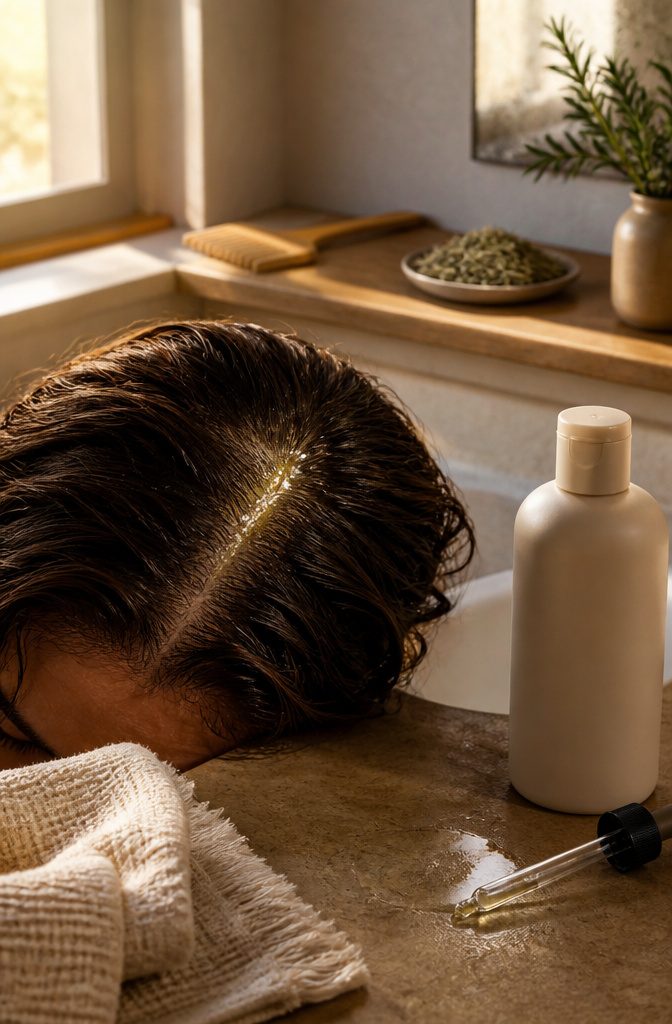
I’m happy with it.Timing on this varies, so whatever product lands on your shelf, follow its label first. The quicker option: leave the oil in or shampoo it out two hours after applying.
The overnight route, working it in at night and washing in the morning, gives the oil at least a few hours to sit, which is what I’d pick if you can spare the time.
The Rosmagain trial was more specific: 15 mL massaged into the scalp for 5–10 minutes, then left on at least four hours or overnight before rinsing with a mild shampoo and warm water.
5. Repeat Two to Three Times Weekly or Daily for at Least Six Months
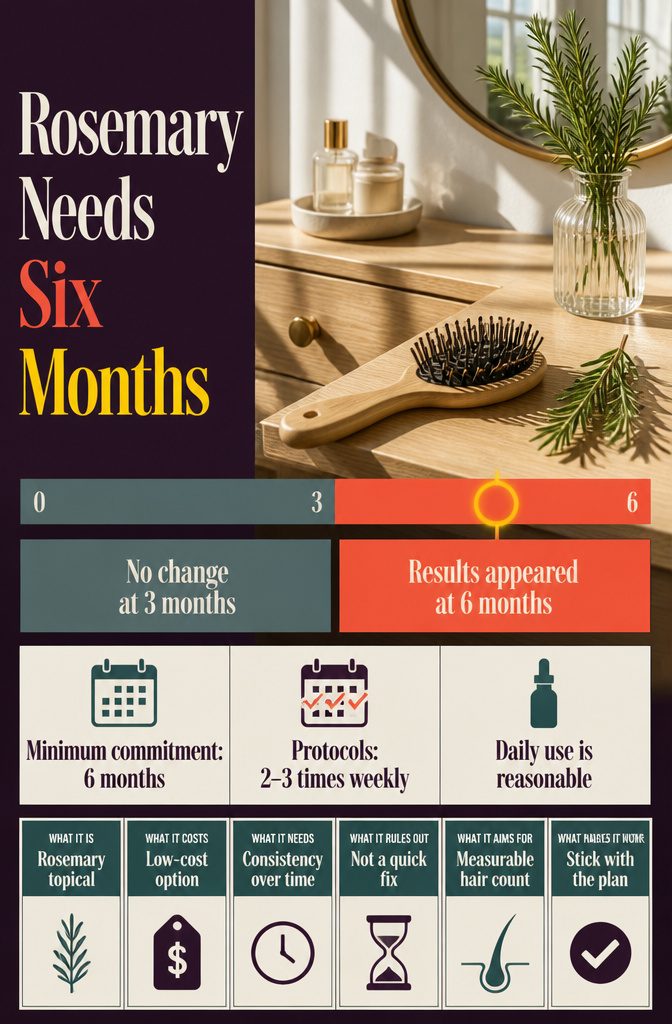
The 2015 trial showed nothing at 3 months. Results appeared at 6 months, which is the earliest point either the rosemary group or the minoxidil group saw a measurable increase in hair count.
A 90-day study testing oils 3 times weekly tracked changes at day 45, day 87, and day 90, and that shorter window is why its findings are harder to lean on.
How often you apply matters less than whether you keep going.
Daily use is reasonable; 2 or 3 times weekly is what most protocols follow and still produces results. Either way, six months is the minimum worth committing to before drawing any conclusions about what the mirror shows.
6. Stop Use and See a Specialist If Irritation or Hair Loss Worsens
Scalp irritation is not a minor inconvenience to push through. If redness, itching, or flaking gets worse after you start using rosemary oil, stop immediately rather than waiting to see if your scalp adjusts.
Continuing while irritated can worsen the underlying problem, including any hair loss you were trying to address.
Hair loss that keeps progressing despite home treatment is a different situation from a slow-growing patch.
A dermatologist can diagnose the cause, which may have nothing to do with oil deficiency or circulation, and point you toward something that actually works for your specific condition.
Rosemary oil is a reasonable first step for early, mild thinning; it is not a substitute for professional assessment when the loss is ongoing or accelerating.
What the 2015 Minoxidil Trial and the 90-Day Rosmagain Study Found

The 2015 trial that shows up in every rosemary-for-hair article compared rosemary oil to a 2% minoxidil solution in 100 men with pattern hair loss. Both groups applied their product to the scalp twice daily with gentle massage.
At three months, nothing had changed in either group. By six months, both showed a real increase in hair count, with no meaningful difference between them.
The one clear advantage for rosemary was scalp comfort. Itching rose in both groups, but it was more frequent among the minoxidil users, which is one of the most common reasons people stop that treatment.
A newer 90-day trial tested two specific rosemary blends on 90 participants ages 18 to 55. One group used a rosemary-lavender blend, the other rosemary-castor, both applied three times weekly.
Hair growth rate increased from 0.22 ± 0.04 to 0.34 ± 0.05 mm/day in the rosemary-lavender group and from 0.23 ± 0.04 to 0.33 ± 0.05 mm/day in the rosemary-castor group. Hair thickness improved by about 68%, and hair fall dropped by more than 40% in both groups.
Research around rosemary water for hair growth is still in its infancy and you’re far safer visiting an expert trichologist to understand the root cause of your specific scalp and hair concerns.
— ELLE
That matters because the newer trial tested two specific formulations, not every rosemary product on the shelf. The 2015 trial is the only head-to-head with minoxidil, and it used only men.
Women’s hair loss is often more complex, and the 2% minoxidil solution used in that study is considered too weak for male pattern hair loss in the first place.
The research is limited, and the six-month mark is when results showed up in the one trial that ran that long.
Rosemary Water and Spray as Alternatives to Essential Oil
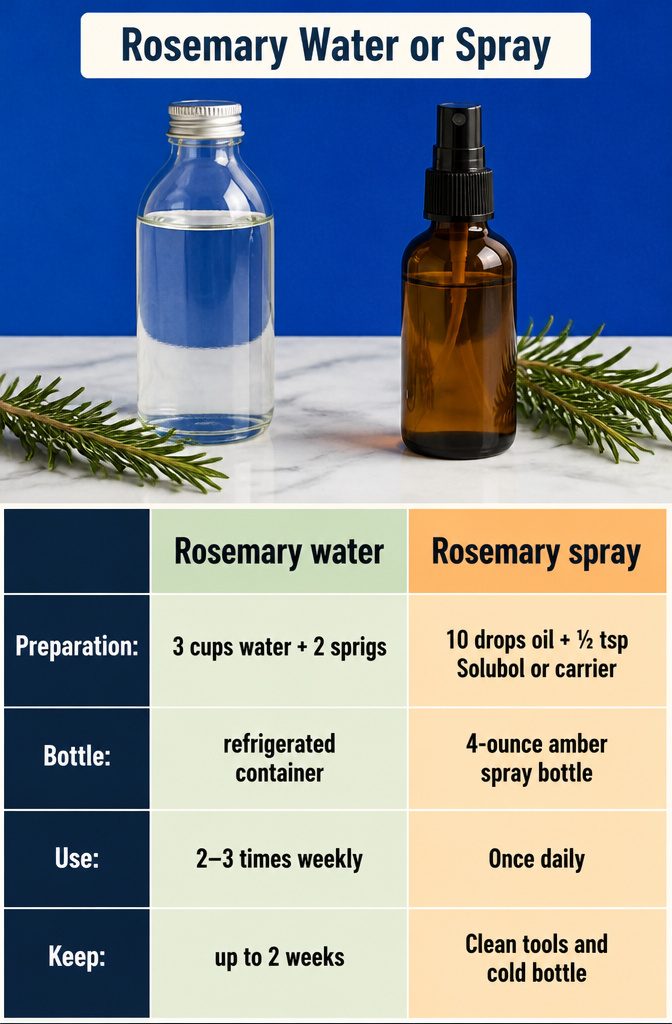
Rosemary water and rosemary spray are both substitutes for the essential oil routine, not additions to it. Pick one method and work with it.
The water version is simple: simmer 3 cups of water with 2 fresh rosemary sprigs, let it cool, then bottle it and refrigerate.
It keeps for up to 2 weeks, though using it within a few days reduces contamination risk. Apply it 2 or 3 times per week.
The spray takes a little more assembly: combine 10 drops of rosemary essential oil with ½ teaspoon of Solubol or a carrier oil, then top up a 4-ounce amber glass spray bottle with distilled water.
That version goes on once a day. Whichever you make, keep your tools clean and your bottle cold.
Frequently Asked Questions
How long does it take for rosemary to grow hair?
Six months is the earliest you’ll see results. The 2015 trial comparing rosemary oil to minoxidil showed no change at 3 months, but both groups had a measurable increase in hair count by month 6.
How do I use rosemary for hair growth?
Dilute rosemary essential oil in a carrier like jojoba or coconut oil, then massage it into your scalp, not your hair lengths.
Leave it on for at least 2 hours or overnight before washing, and repeat 2 to 3 times weekly. The oil works at the follicle level, so it has to reach the scalp to do anything.
How often should you use rosemary oil for hair growth?
Two to 3 times weekly is what most protocols follow and still produces results.
Daily use is reasonable if your scalp tolerates it. Either way, consistency matters more than frequency, and 6 months is the minimum commitment before you can draw conclusions.
How long should I leave on rosemary oil?
At least 2 hours is the short version. The overnight approach, working it in before bed and washing in the morning, gives the oil a few hours to sit, which is what I’d pick if you can spare the time.
The Rosmagain trial left it on at least 4 hours or overnight before rinsing.
Can you put rosemary oil on wet hair?
Yes, as long as you towel-dry your hair first so it’s damp rather than soaking. Massage the oil into your scalp, not your hair, so it can absorb.
Is castor oil or rosemary oil better for hair growth?
Rosemary oil has clinical trial support showing it matched 2% minoxidil at 6 months.
Castor oil has no clinical trials demonstrating hair growth, though it may help lower scalp inflammation. You can use both together since castor is a carrier oil and rosemary is an essential oil.
Can I use rosemary water on my hair every day?
Yes, daily use as a light leave-in mist is possible if your scalp tolerates it. Check for redness, itching, or irritation, and stop if any shows up.
Should you make your own rosemary water for hair growth at home?
Homemade formulas carry contamination and storage risks, so keep your tools clean and store the bottle in the fridge for only a few days.
Rosemary water made by simmering fresh sprigs in water keeps for up to 2 weeks refrigerated, but using it within a few days reduces contamination risk.
What are the disadvantages of rosemary for hair?
Scalp irritation is the main risk: redness, itching, or flaking can show up if you use too much or your skin doesn’t tolerate it.
Pure rosemary oil near the eyes causes irritation, and it’s not recommended if you’re pregnant or breastfeeding. A patch test catches reactions before they spread across your scalp.





