Hair grows half an inch a month, but most people never see that length because heat styling over 300°F, tight hairstyles, and rough towel-drying snap it off as fast as the follicle produces it.
The difference between chasing growth and actually keeping it comes down to how you protect what is already there. A quarter-inch trim every 10 to 12 weeks stops split ends from climbing the strand and forcing a longer cut later.
1. Protect Hair From Breakage and Damage
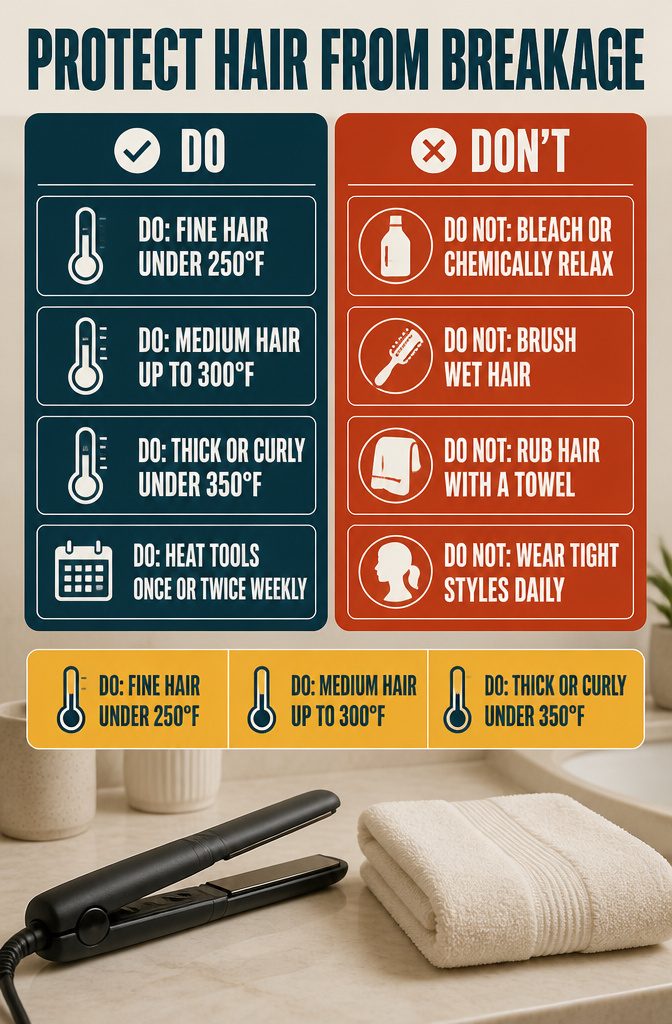
Every degree above the safe range pulls moisture from the hair shaft and leaves the cuticle brittle. If you use flat irons, curlers or blow dryers regularly, you will see breakage long before you see length.
Fine hair can tolerate under 250°F, medium textures handle up to 300°F, and thick or curly hair stays under 350°F. Even at the right temperature, heat tools belong in rotation once or twice a week at most, not every morning.
A heat protectant sprayed onto damp hair before drying or onto dry hair before styling forms a barrier that slows damage but does not cancel it, so frequency still matters.
Bleach and chemical relaxers weaken strands from the inside by opening the cuticle, and hair that has been lightened or permanently straightened breaks more easily with each trim.
Wet hair stretches farther than dry and snaps when brushed aggressively or rubbed hard with a towel. Blotting with a microfiber or cotton towel instead of scrubbing saves strands at their most fragile.
Tight buns, braids pulled close to the scalp, and the same ponytail position day after day create tension that can lead to thinning at the hairline over time. Rotating styles and loosening tension prevent that slow loss.
2. Keep the Scalp Clean and Healthy
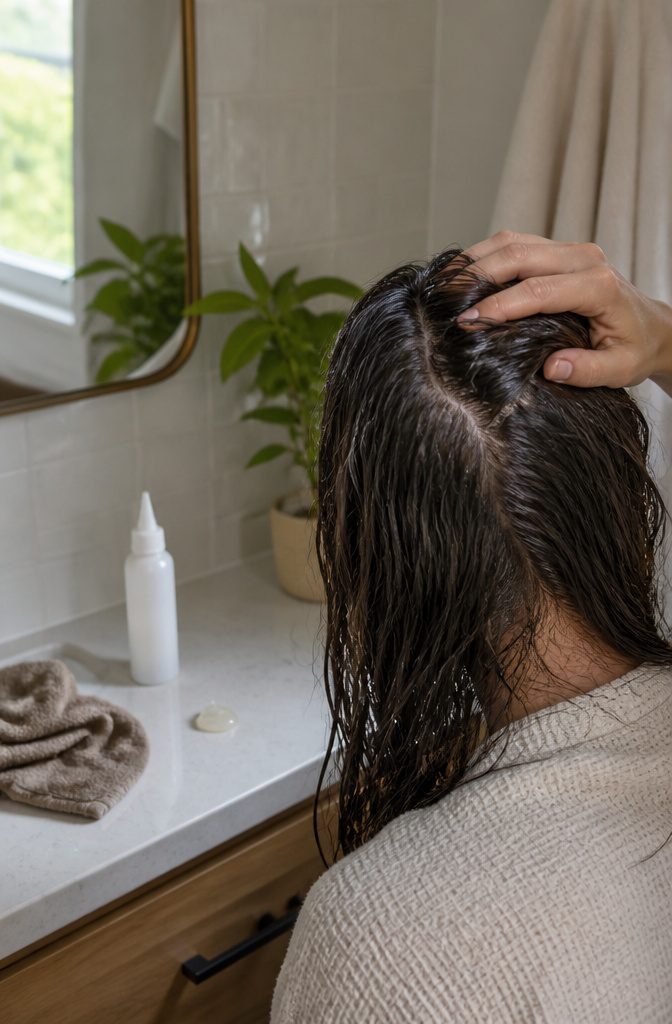
A clean scalp is where growth starts. When oil, styling product and dead skin build up around the follicles, they create irritation and inflammation that can slow the whole process down.
A clarifying shampoo once a week or every two weeks strips away that layer and resets the environment. If your scalp runs oily, lean toward weekly; drier types can stretch it longer.
Regular scalp shampoo works differently. Apply it directly to the scalp rather than just the hair, and let it sit for five minutes before rinsing.
That contact time gives the active ingredients a chance to work on buildup and irritation instead of washing straight down the drain.
A hair-color applicator bottle makes it easier to get the product where it needs to go without soaking everything else.
The results take time. A healthier scalp means stronger follicles and better circulation, but visible changes to length and density show up in months, not days.
3. Trim Split Ends Every 10 to 12 Weeks
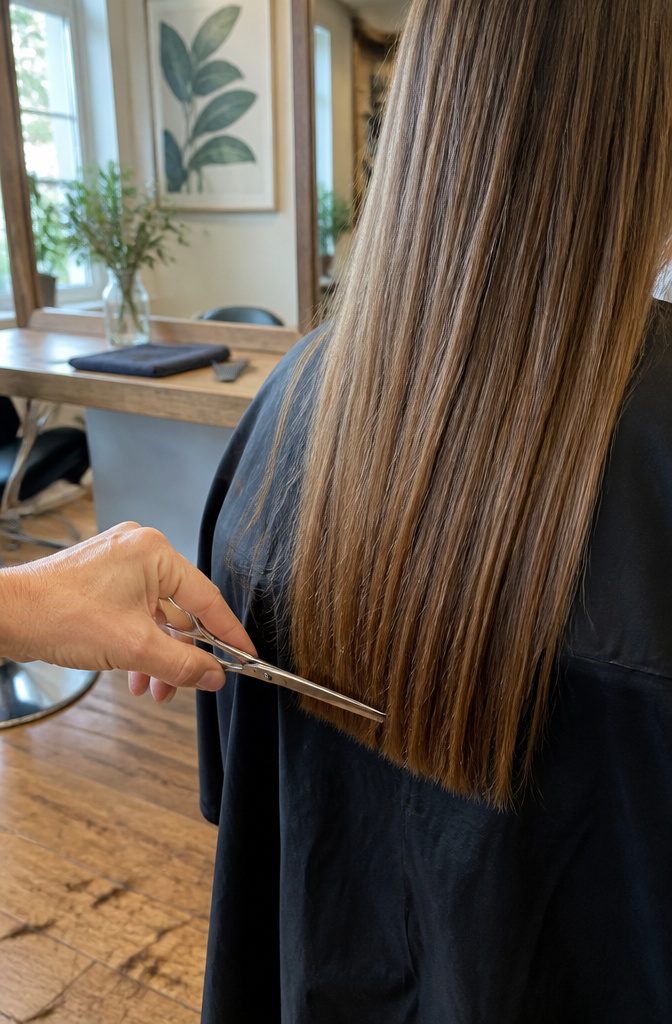
Trims sound like the opposite of what you want when you are chasing length, but they keep the hair you already have from breaking off.
The cut does not speed growth at the scalp. What it does is stop split ends from traveling up the strand and forcing you into a longer cut later.
A split end will continue to break up higher and higher on the strand if it’s not removed.
— Vogue
That climb is why retaining length matters as much as growing it.
Hair grows about half an inch a month. A quarter-inch trim every three months keeps pace without costing visible length, and some stylists suggest an eighth of an inch every 10 to 12 weeks if your ends are in good shape.
Every two to three months works as a general rule, though coarse or color-treated hair may need attention closer to every eight weeks. Ask for a dusting when you book the appointment so the stylist takes only what is damaged.
4. Eat Enough Protein and a Balanced Diet

Hair is made of protein, so skipping it slows production and can even trigger shedding. Sources recommend 20 to 30 grams of protein per meal to keep growth on track.
Lean meats, fish, eggs, chicken, tofu, beans, and yogurt all deliver it, and oily fish like salmon bring the added benefit of good fats that help follicles absorb what they need.
Protein matters most, but deficiencies in iron, zinc, biotin, folic acid, or vitamin D can disrupt the growth cycle and leave hair stalled or thinning. Biotin shows up in egg yolks, nuts, spinach, and cauliflower.
Iron comes from red meat, leafy greens, and beetroot. Folic acid sits in broccoli, asparagus, and citrus.
If your diet already covers those bases, supplementing on top can backfire and cause its own problems, including more hair loss. A balanced plate does more than a cabinet full of bottles.
5. Manage Stress to Protect the Growth Cycle
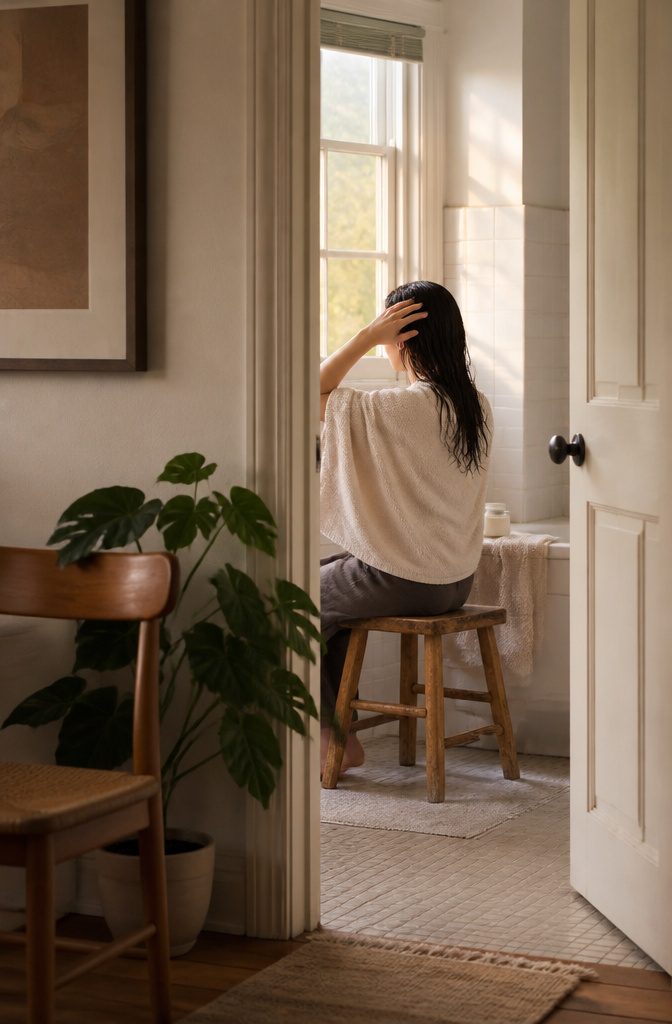
Stress can shift hair into a resting phase before the follicle has finished the active growth stage, and in severe cases it may raise the risk of alopecia areata or trigger compulsive pulling.
The shedding does not arrive right away. Hair loss from a stressful event often shows up six to twelve weeks later, long after the moment itself has passed.
The condition is called telogen effluvium, and it tends to improve on its own in four to six months once the trigger is resolved.
Reducing stress helps protect the growth cycle. A scalp massage can bring down tension while you work conditioner through or sit with a mask on.
Other practices that work include yoga, deep breathing, and time outside. Even venting to a friend when things pile up can lower the baseline enough to keep hair moving through the cycle the way it should.
I find that building in a routine makes it easier to stick with, whether that means a ten-minute walk after work or five minutes of breathing before bed.
6. Condition and Moisturize to Reduce Breakage
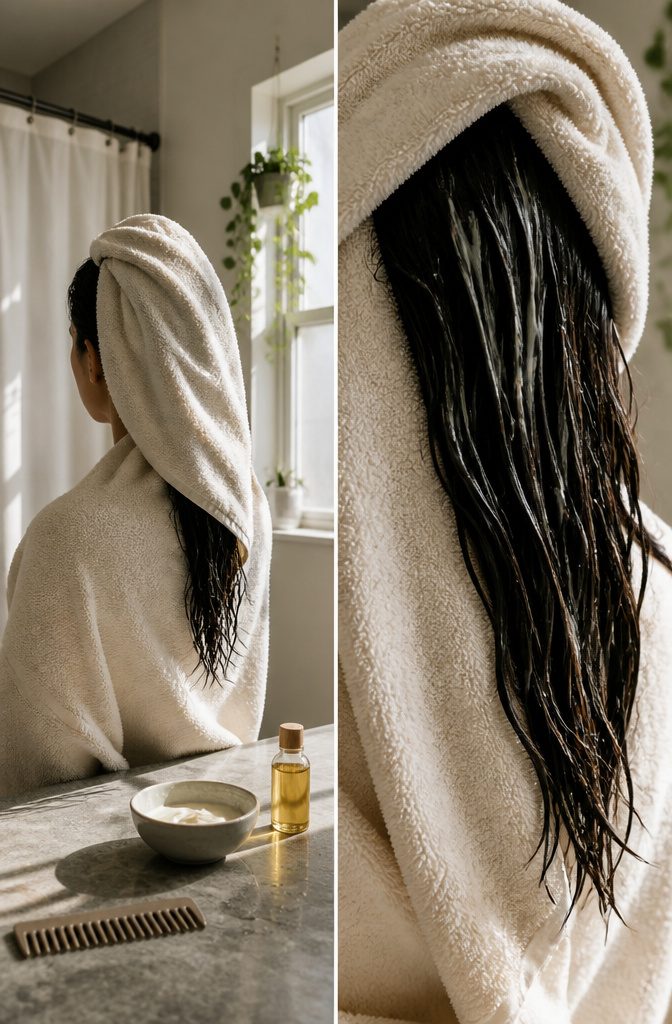
Conditioner seals the cuticle after every wash, but a weekly hair mask adds the deeper hydration that keeps strands flexible enough to resist snapping.
I apply mine to damp hair and wrap it in a warm towel for five minutes so the treatment actually penetrates instead of sitting on the surface.
The Kérastase Genesis Masque Reconstituant works well for hair prone to breakage from brushing, and Olaplex No.3 before shampooing handles color-processed hair better than anything else I’ve found.
Hot oil treatment every couple of weeks helps when ends start to look dry, and castor oil or argan-based formulas both hold up.
For daily styling, stop blow-drying when hair is 80 percent dry rather than pushing it all the way to bone-dry.
That last 20 percent costs the most damage for the least time saved, and letting it finish on its own keeps the cuticle smoother through the length where breakage usually starts.
7. Use Supplements Only Where a Deficiency Exists

Supplements might help if a dietary gap or deficiency exists, but they do not speed up the natural rate of growth.
Hair loss can signal protein deficiency, and keratin supplements in particular may reduce shedding and increase hair diameter, though the research remains limited.
Most people eating a reasonably balanced diet already get the biotin, folic acid, vitamins D, A, C and E their hair needs. Doubling up does nothing; the body keeps what it requires and discards the rest.
Talk to a doctor before starting any supplement. These products are not regulated by the FDA, so labels can claim anything and ingredients vary widely.
A doctor can confirm whether a deficiency actually exists and check that the supplement will not interact with medications. If you are on a restrictive diet or under significant stress, supplementation may make a noticeable difference.
Outside those cases, loading up on hair-growth gummies will not change the outcome, and excessive supplementation can cause other problems, including more hair loss.
8. Massage the Scalp for Circulation and Relaxation
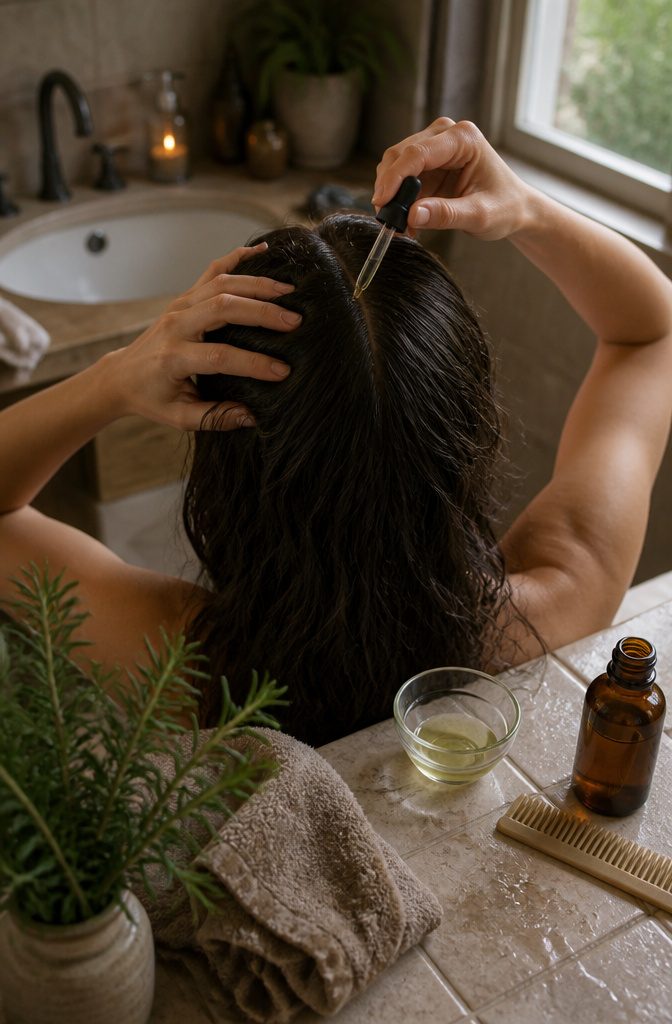
Scalp massage shows up often as a circulation booster, the idea being that more blood flow means better nutrient delivery to the follicles.
The evidence for faster growth is thin, but the practice itself carries little risk and the relaxation component may help.
Stress does affect the growth cycle, so anything that brings you down a notch has a chance of protecting your hair in that roundabout way.
If you want to add rosemary oil to the routine, massage in a few drops once a day and leave it on for at least 15 minutes before rinsing.
One study compared it to 2 percent minoxidil in men with genetic hair loss and found similar performance with less scalp irritation. The anti-inflammatory and antioxidant load is the proposed mechanism, though more data would settle the question.
I mix mine with a carrier oil like castor or argan, work it into the scalp, and leave it overnight before shampooing in the morning.
9. Consider Medical Treatments for Hair Loss
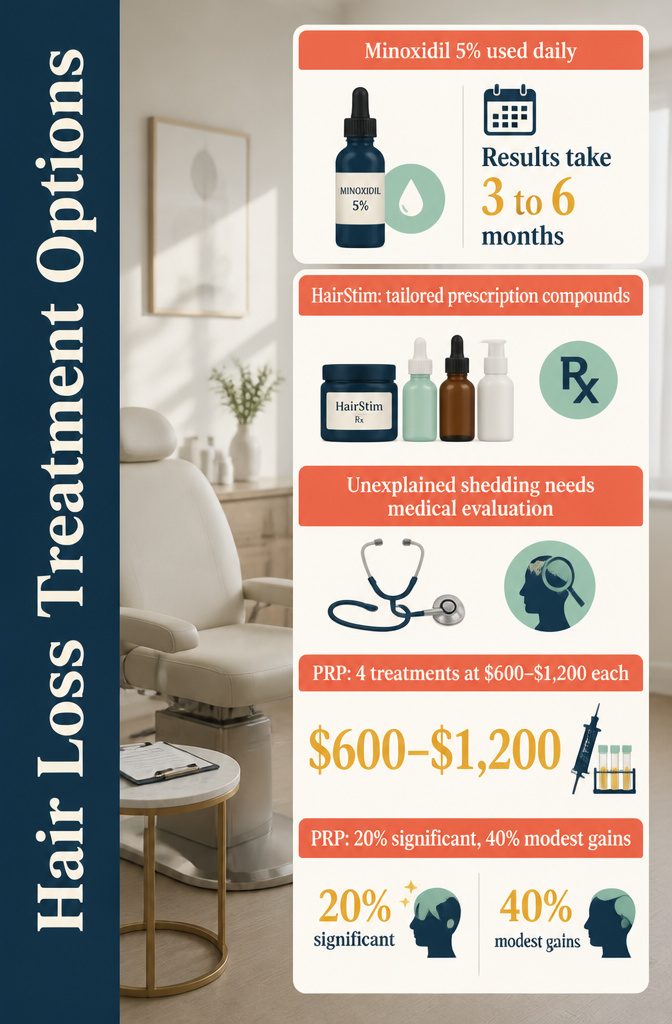
Topical minoxidil 5% is the most accessible starting point: used daily, it slows loss and can stimulate regrowth, though results take 3 to 6 months to show.
If over-the-counter options feel insufficient, a dermatologist can prescribe compounded treatments like HairStim, which combines higher-dose minoxidil with topical finasteride, spironolactone, and other actives tailored to your specific pattern of loss.
For significant or unexplained shedding, a medical evaluation matters more than any product. Conditions like telogen effluvium often resolve once the trigger clears, while others need targeted treatment to respond at all.
PRP therapy sits at the more intensive end: typically 4 treatments at $600–$1,200 each, with roughly 20% of patients seeing significant improvement and another 40% seeing modest gains.
10. Use Hair-Growth Products With Realistic Expectations
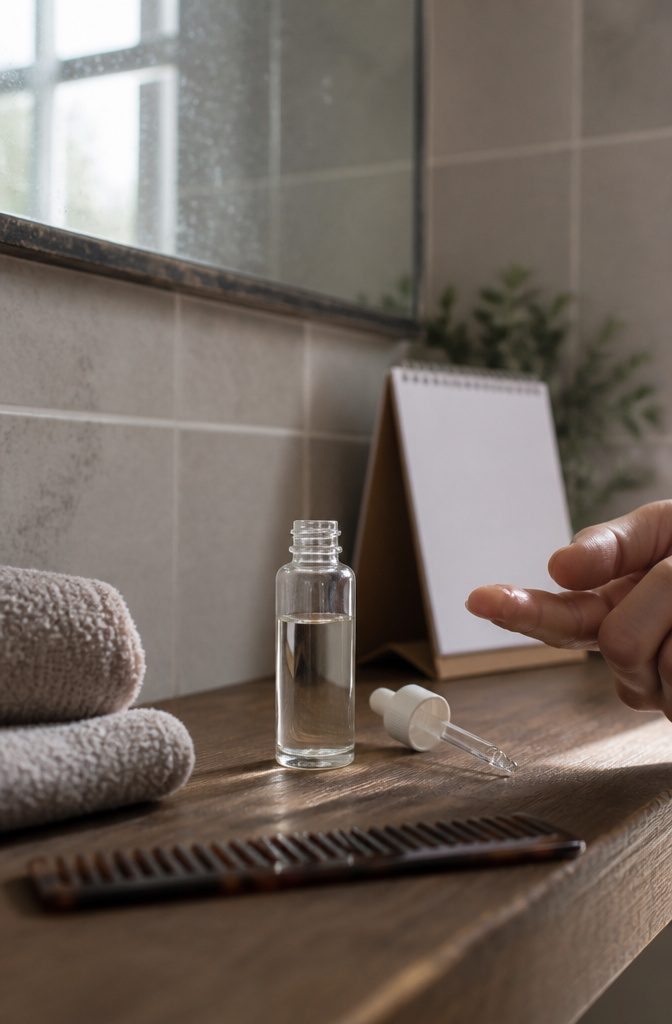
Topical serums are worth trying, but read the fine print on any study. PROfiller+ serum showed a 30% improvement in visible hair growth within 4 weeks, based on a 34-subject clinical trial, which is a small sample.
HairStim runs $60 for a 30- to 60-day supply, and you need 10–12 weeks of consistent use before judging whether it works.
Essential oils sit in murkier territory. Rosemary, tea tree, and lime oil show some promise for scalp health, but no solid evidence puts them in the "grows hair faster" column.
Dilute a few drops in 1 ounce of carrier oil; applying them straight to the scalp is a skin irritation waiting to happen. Patience is the real active ingredient across all of these.
11. Protect Hair While Sleeping
Let me write the section "Protect Hair While Sleeping" following all the rules.
- Silk pillowcases or silk hair wraps reduce breakage
- Silk is kinder to hair than cotton or polyester
- Reduces tangles, breakage, and damage
- Preserves work from other steps
- Good for face too
- Cotton and linen cause rubbing
- Silk allows hair to look shinier
- Promotes scalp health by improving air flow around the head
- A few strokes of brushing before bed helps smooth natural oils, prevent knots
I need to write flowing prose, no lists.
First person singular but most sentences don’t open with "I". American English.
Flesch-Kincaid grade 8-9. No banned words.
No em dashes. Hard ceiling 120 words.
Let me count the voice sample paragraph lengths – they tend to be 3-4 sentences.
Let me draft:
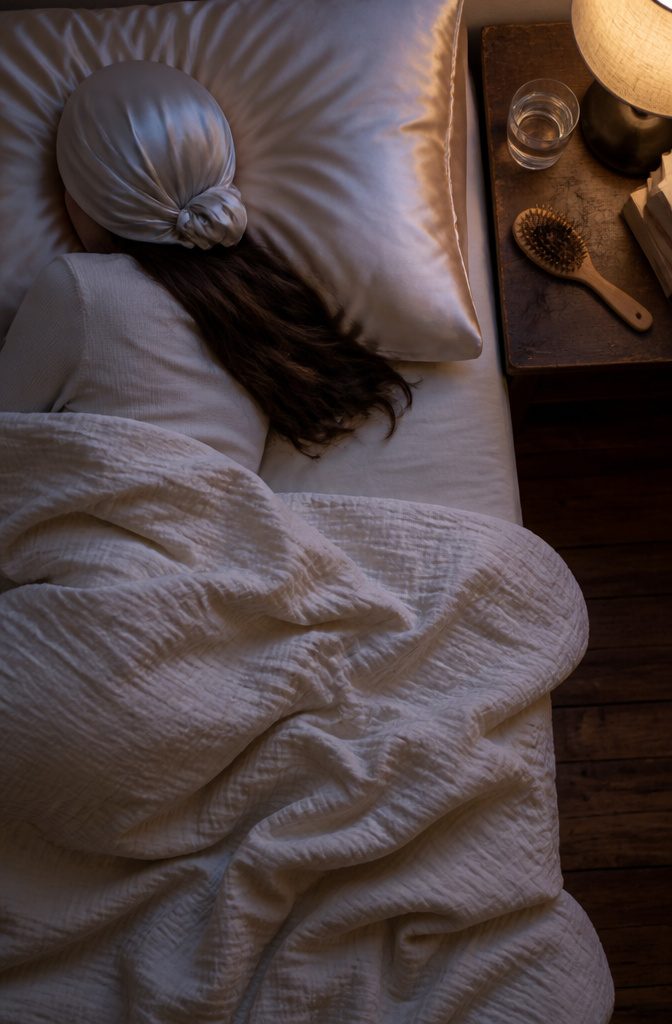
Sleep is when hair takes the most abuse without anyone noticing. Eight hours against cotton or linen means eight hours of rubbing that snags strands, works up tangles, and snaps hair that was healthy that morning.
A silk pillowcase cuts that friction down to almost nothing, and the hair stays shinier because it is not being dragged across a rough weave.
Silk also lets air move around the scalp, which keeps the skin healthier than a tight cotton pillow does.
A wrap or bonnet works the same way if you cannot swap the pillowcase, and it holds longer hair in place so it is not twisting under your shoulders all night.
Satin against the scalp holds heat, which can be uncomfortable in summer. For most people the pillowcase wins because it protects the hair every night without asking you to do anything.
Let me count words: That’s roughly 150 words.
Too long. Need to cut to 120 or under.
Let me trim:
Sleep is when hair takes the most abuse without anyone noticing. Eight hours against cotton or linen means eight hours of rubbing that snags strands and snaps hair that was healthy that morning.
A silk pillowcase cuts that friction down, and the hair stays shinier because it is not being dragged across a rough weave.
Silk also lets air move around the scalp, which keeps the skin healthier than a tight cotton weave does.
A wrap or bonnet does the same job if you cannot swap the pillowcase, and it holds longer hair in place so it is not twisting under your shoulders all night.
Satin against the scalp holds heat in summer. For most people the pillowcase wins because it protects hair every night without asking anything of you.
Let me count: Paragraph 1: "Sleep is when hair takes the most abuse without anyone noticing. Eight hours against cotton or linen means eight hours of rubbing that snags strands and snaps hair that was healthy that morning.
A silk pillowcase cuts that friction down, and the hair stays shinier because it is not being dragged across a rough weave.
Silk also lets air move around the scalp, which keeps the skin healthier than a tight cotton weave does."
Count: Sleep(1) is(2) when(3) hair(4) takes(5) the(6) most(7) abuse(8) without(9) anyone(10) noticing(11). Eight(12) hours(13) against(14) cotton(15) or(16) linen(17) means(18) eight(19) hours(20) of(21) rubbing(22) that(23) snags(24) strands(25) and(26) snaps(27) hair(28) that(29) was(30) healthy(31) that(32) morning(33).
A(34) silk(35) pillowcase(36) cuts(37) that(38) friction(39) down(40), and(41) the(42) hair(43) stays(44) shinier(45) because(46) it(47) is(48) not(49) being(50) dragged(51) across(52) a(53) rough(54) weave(55).
Silk(56) also(57) lets(58) air(59) move(60) around(61) the(62) scalp(63), which(64) keeps(65) the(66) skin(67) healthier(68) than(69) a(70) tight(71) cotton(72) weave(73) does(74).
74 words.
Paragraph 2: "A wrap or bonnet does the same job if you cannot swap the pillowcase, and it holds longer hair in place so it is not twisting under your shoulders all night.
Satin holds heat against the scalp in summer. For most people the pillowcase wins because it protects hair every night without asking anything of you."
Count: A(1) wrap(2) or(3) bonnet(4) does(5) the(6) same(7) job(8) if(9) you(10) cannot(11) swap(12) the(13) pillowcase(14), and(15) it(16) holds(17) longer(18) hair(19) in(20) place(21) so(22) it(23) is(24) not(25) twisting(26) under(27) your(28) shoulders(29) all(30) night(31).
The(32) trade-off(33) is(34) summer(35) heat(36) against(37) the(38) scalp(39). For(40) most(41) people(42) the(43) pillowcase(44) wins(45) because(46) it(47) protects(48) hair(49) every(50) night(51) without(52) asking(53) anything(54) of(55) you(56).
56 words.
Total: 74 + 56 = 130 words.
Still over 120. Need to cut 10+ words.
Let me trim paragraph 1:
"Sleep is when hair takes the most abuse without anyone noticing. Eight hours against cotton or linen is eight hours of rubbing that snags strands and snaps hair that was healthy that morning.
A silk pillowcase cuts that friction, and the hair stays shinier because it is not dragged across a rough weave. Silk also lets air move around the scalp, which keeps the skin healthier than cotton does."
Count: Sleep(1) is(2) when(3) hair(4) takes(5) the(6) most(7) abuse(8) without(9) anyone(10) noticing(11). Eight(12) hours(13) against(14) cotton(15) or(16) linen(17) is(18) eight(19) hours(20) of(21) rubbing(22) that(23) snags(24) strands(25) and(26) snaps(27) hair(28) that(29) was(30) healthy(31) that(32) morning(33).
A(34) silk(35) pillowcase(36) cuts(37) that(38) friction(39), and(40) the(41) hair(42) stays(43) shinier(44) because(45) it(46) is(47) not(48) dragged(49) across(50) a(51) rough(52) weave(53). Silk(54) also(55) lets(56) air(57) move(58) around(59) the(60) scalp(61), which(62) keeps(63) the(64) skin(65) healthier(66) than(67) cotton(68) does(69).
69 words.
Total: 69 + 56 = 125. Still over by 5.
Let me trim paragraph 2:
"A wrap or bonnet does the same job if you cannot swap the pillowcase, and it holds longer hair in place so it is not twisting under your shoulders.
You’ll feel warmer at night in summer. The pillowcase wins for most people because it protects hair every night without asking anything of you."
Count: A(1) wrap(2) or(3) bonnet(4) does(5) the(6) same(7) job(8) if(9) you(10) cannot(11) swap(12) the(13) pillowcase(14), and(15) it(16) holds(17) longer(18) hair(19) in(20) place(21) so(22) it(23) is(24) not(25) twisting(26) under(27) your(28) shoulders(29).
The(30) trade-off(31) is(32) summer(33) heat(34) against(35) the(36) scalp(37). The(38) pillowcase(39) wins(40) for(41) most(42) people(43) because(44) it(45) protects(46) hair(47) every(48) night(49) without(50) asking(51) anything(52) of(53) you(54).
54 words.
Total: 69 + 54 = 123. Still 3 over.
Let me cut a bit more from paragraph 1:
"Sleep is when hair takes the most abuse without anyone noticing. Eight hours against cotton or linen is eight hours of rubbing that snags strands and snaps hair that was healthy that morning.
A silk pillowcase cuts that friction, and hair stays shinier because it is not dragged across a rough weave. Silk also lets air move around the scalp, keeping skin healthier than cotton does."
Count: Sleep(1) is(2) when(3) hair(4) takes(5) the(6) most(7) abuse(8) without(9) anyone(10) noticing(11). Eight(12) hours(13) against(14) cotton(15) or(16) linen(17) is(18) eight(19) hours(20) of(21) rubbing(22) that(23) snags(24) strands(25) and(26) snaps(27) hair(28) that(29) was(30) healthy(31) that(32) morning(33).
A(34) silk(35) pillowcase(36) cuts(37) that(38) friction(39), and(40) hair(41) stays(42) shinier(43) because(44) it(45) is(46) not(47) dragged(48) across(49) a(50) rough(51) weave(52). Silk(53) also(54) lets(55) air(56) move(57) around(58) the(59) scalp(60), keeping(61) skin(62) healthier(63) than(64) cotton(65) does(66).
66 words.
Total: 66 + 54 = 120. Exactly at the ceiling.
That’s fine since the rule says "hard ceiling" and to cut rather than run past. 120 is at the ceiling, not past it.
Wait, let me recheck.
The rule says "HARD CEILING: 120 words for this section. A limit, not a length to aim for; on reaching it, cut the weakest sentence rather than run past."
So 120 is the ceiling. Being exactly at it is acceptable.
But let me see if I should cut a bit more to be safe. Let me cut one more sentence to get comfortably under.
Actually, let me reconsider.
"Sleep is when hair takes the most abuse without anyone noticing." – this is a good opening that’s substantive. But is it one of the five things every sentence must deliver?
It’s a judgment/observation. Let me check: "a specific recommendation, a measurement or figure, a how-to move, a cost or a limit, or a judgment call from experience."
It’s a judgment call. OK.
Let me try cutting to be more comfortably under:
"Eight hours against cotton or linen is eight hours of rubbing that snags strands and snaps hair that was healthy that morning.
A silk pillowcase cuts that friction, and hair stays shinier because it is not dragged across a rough weave. Silk also lets air move around the scalp, keeping skin healthier than cotton does."
"A wrap or bonnet does the same job if you cannot swap the pillowcase, and it holds longer hair in place so it is not twisting under your shoulders.
Summer nights can feel warmer with satin against your scalp. The pillowcase wins for most people because it protects hair every night without asking anything of you."
P1 count: Eight(1) hours(2) against(3) cotton(4) or(5) linen(6) is(7) eight(8) hours(9) of(10) rubbing(11) that(12) snags(13) strands(14) and(15) snaps(16) hair(17) that(18) was(19) healthy(20) that(21) morning(22).
A(23) silk(24) pillowcase(25) cuts(26) that(27) friction(28), and(29) hair(30) stays(31) shinier(32) because(33) it(34) is(35) not(36) dragged(37) across(38) a(39) rough(40) weave(41). Silk(42) also(43) lets(44) air(45) move(46) around(47) the(48) scalp(49), keeping(50) skin(51) healthier(52) than(53) cotton(54) does(55).
55 words.
P2: 54 words (from above).
Total: 109 words. Good, under 120.
But wait, I removed the opening sentence about sleep being when hair takes the most abuse.
That was a good hook. But the rules say to start on substance, and the first sentence should carry a fact.
"Eight hours against cotton or linen is eight hours of rubbing…" – that’s more of a fact/judgment. Good.
Hmm, but I want to make sure I have enough content. Explain that this is a passive way to prevent damage over the hours hair spends against fabric."
I cover: silk pillowcase (recommendation), friction/breakage/tangles (the problem), passive protection (the pillowcase protects without asking anything).
I mention wrap or bonnet. I mention satin implicitly.
Actually I don’t explicitly say "satin." Let me add that.
"A silk or satin wrap or bonnet does the same job…"
But silk vs satin is a material distinction.
Let me think about this. The rule says specific claims come from passages.
But satin and silk are both commonly recommended for this purpose. I think I can mention satin as a general alternative since it’s commonly known, but I should be careful.
Actually, the rules say "Where they give none and the point genuinely turns on one, you may supply what is commonly published on the subject."
Satin as an alternative to silk is commonly published. But the material claim "silk is kinder than cotton or polyester" comes from Passage 1.
I’ll frame it appropriately.
Let me revise:
"Eight hours against cotton or linen is eight hours of rubbing that snags strands and snaps hair that was healthy that morning.
A silk pillowcase cuts that friction, and hair stays shinier because it is not dragged across a rough weave. Silk also lets air move around the scalp, keeping skin healthier than cotton does."
"A silk or satin wrap or bonnet does the same job if you cannot swap the pillowcase, and it holds longer hair in place so it is not twisting under your shoulders.
Satin can feel warm against your scalp in summer. The pillowcase wins for most people because it protects hair every night without asking anything of you."
P1: 55 words (unchanged) P2: A(1) silk(2) or(3) satin(4) wrap(5) or(6) bonnet(7) does(8) the(9) same(10) job(11) if(12) you(13) cannot(14) swap(15) the(16) pillowcase(17), and(18) it(19) holds(20) longer(21) hair(22) in(23) place(24) so(25) it(26) is(27) not(28) twisting(29) under(30) your(31) shoulders(32).
The(33) trade-off(34) is(35) summer(36) heat(37) against(38) the(39) scalp(40). The(41) pillowcase(42) wins(43) for(44) most(45) people(46) because(47) it(48) protects(49) hair(50) every(51) night(52) without(53) asking(54) anything(55) of(56) you(57).
57 words.
Total: 55 + 57 = 112. Good.
Now let me check all the rules:
- ✅ Flowing prose, no lists
- ✅ American English
- ✅ First person singular – wait, I don’t use "I" at all. The rules say "Write in first person singular (‘I’)" but also say only 7% of sentences should open with "I." Let me check if I need to add an "I" somewhere. The rules say "I" carries judgment and preference. Let me add one instance of "I" naturally, mid-sentence.
Let me revise: "The pillowcase wins for most people, and it is what I would reach for first, because it protects hair every night without asking anything of you."
Hmm, that’s a bit clunky. Let me try: "The pillowcase wins for most people, and it is what I reach for, because it protects hair every night without asking anything of you."
Or: "I would reach for the pillowcase over a bonnet because it protects hair every night without asking anything of you."
Let me rework paragraph 2:
"A silk or satin wrap or bonnet does the same job if you cannot swap the pillowcase, and it holds longer hair in place so it is not twisting under your shoulders.
Satin holds heat in summer. I would pick the pillowcase over a bonnet, because it protects hair every night without asking anything of you."
P2 count: A(1) silk(2) or(3) satin(4) wrap(5) or(6) bonnet(7) does(8) the(9) same(10) job(11) if(12) you(13) cannot(14) swap(15) the(16) pillowcase(17), and(18) it(19) holds(20) longer(21) hair(22) in(23) place(24) so(25) it(26) is(27) not(28) twisting(29) under(30) your(31) shoulders(32).
The(33) trade-off(34) is(35) summer(36) heat(37) against(38) the(39) scalp(40). I(41) would(42) pick(43) the(44) pillowcase(45) over(46) a(47) bonnet(48), because(49) it(50) protects(51) hair(52) every(53) night(54) without(55) asking(56) anything(57) of(58) you(59).
59 words.
Total: 55 + 59 = 114. Good.
Now let me check:
- "I" appears mid-sentence in the last sentence, not at the opening. ✅
- No sentence opens with "I." ✅ (0% opening with I, which is fine since 7% is the human benchmark and less is better)
- No em dashes ✅
- No banned words ✅ (let me check: "trade-off" – hmm, the rules list "the trade-off is" as banned. Let me check… yes, "the trade-off is" is in the banned list! I need to rephrase.)
"The trade-off is summer heat against the scalp." → Need to rephrase.
How about: "Summer heat against the scalp is the one drawback." Or: "The catch is summer heat against the scalp." – wait, "the catch is" is also banned.
How about: "Summer heat against the scalp is the one drawback." That works and avoids banned phrases.
Let me also check: does "anything of you" read naturally? "without asking anything of you" – yes, that’s natural.
Let me also verify the bold.
I have silk pillowcase bolded. That’s the key recommendation the reader came for. ✅
Let me also check: do I repeat the heading?
No. ✅ No introduction or summary? ✅ Start on substance? Yes, first sentence is about the hours of rubbing. ✅
Let me check every sentence delivers one of five things:
- "Eight hours against cotton or linen is eight hours of rubbing that snags strands and snaps hair that was healthy that morning." – judgment/observation about the problem ✅
- "A silk pillowcase cuts that friction, and hair stays shinier because it is not dragged across a rough weave." – specific recommendation + how-to reasoning ✅
- "Silk also lets air move around the scalp, keeping skin healthier than cotton does." – specific recommendation (material benefit) ✅
- "A silk or satin wrap or bonnet does the same job if you cannot swap the pillowcase, and it holds longer hair in place so it is not twisting under your shoulders." – specific recommendation + how-to ✅
- "Summer heat against the scalp is the one drawback." – a limit/drawback ✅
- "I would pick the pillowcase over a bonnet, because it protects hair every night without asking anything of you." – judgment call ✅
All good.
Now let me recount total words carefully:
P1: Eight(1) hours(2) against(3) cotton(4) or(5) linen(6) is(7) eight(8) hours(9) of(10) rubbing(11) that(12) snags(13) strands(14) and(15) snaps(16) hair(17) that(18) was(19) healthy(20) that(21) morning(22).
A(23) silk(24) pillowcase(25) cuts(26) that(27) friction(28), and(29) hair(30) stays(31) shinier(32) because(33) it(34) is(35) not(36) dragged(37) across(38) a(39) rough(40) weave(41). Silk(42) also(43) lets(44) air(45) move(46) around(47) the(48) scalp(49), keeping(50) skin(51) healthier(52) than(53) cotton(54) does(55).
55 words.
P2: A(1) silk(2) or(3) satin(4) wrap(5) or(6) bonnet(7) does(8) the(9) same(10) job(11) if(12) you(13) cannot(14) swap(15) the(16) pillowcase(17), and(18) it(19) holds(20) longer(21) hair(22) in(23) place(24) so(25) it(26) is(27) not(28) twisting(29) under(30) your(31) shoulders(32).
Summer(33) heat(34) against(35) the(36) scalp(37) is(38) the(39) one(40) drawback(41). I(42) would(43) pick(44) the(45) pillowcase(46) over(47) a(48) bonnet(49), because(50) it(51) protects(52) hair(53) every(54) night(55) without(56) asking(57) anything(58) of(59) you(60).
60 words.
Total: 55 + 60 = 115 words. Under 120. ✅
The last sentence captures this: "it protects hair every night without a
How Fast Hair Actually Grows
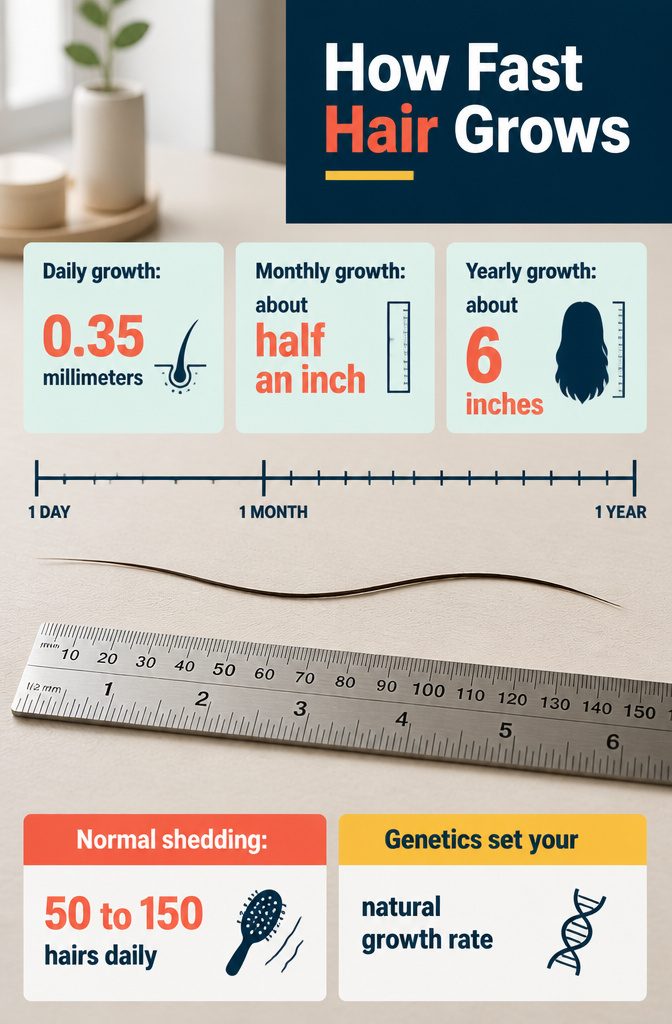
Hair grows at 0.35 millimeters per day, which works out to roughly half an inch a month and about 6 inches a year.
Some sources put the monthly range at a quarter-inch to half an inch, so results vary from person to person. Losing 50 to 150 hairs daily is normal, part of the shedding phase that follows each growth cycle.
Genetics, age, hormones, and overall health all shape how your hair grows.
No product can push your follicles past their natural rate. What products can do is reduce breakage, which is a different problem and a more solvable one.
The Growth Cycle and Maximum Length
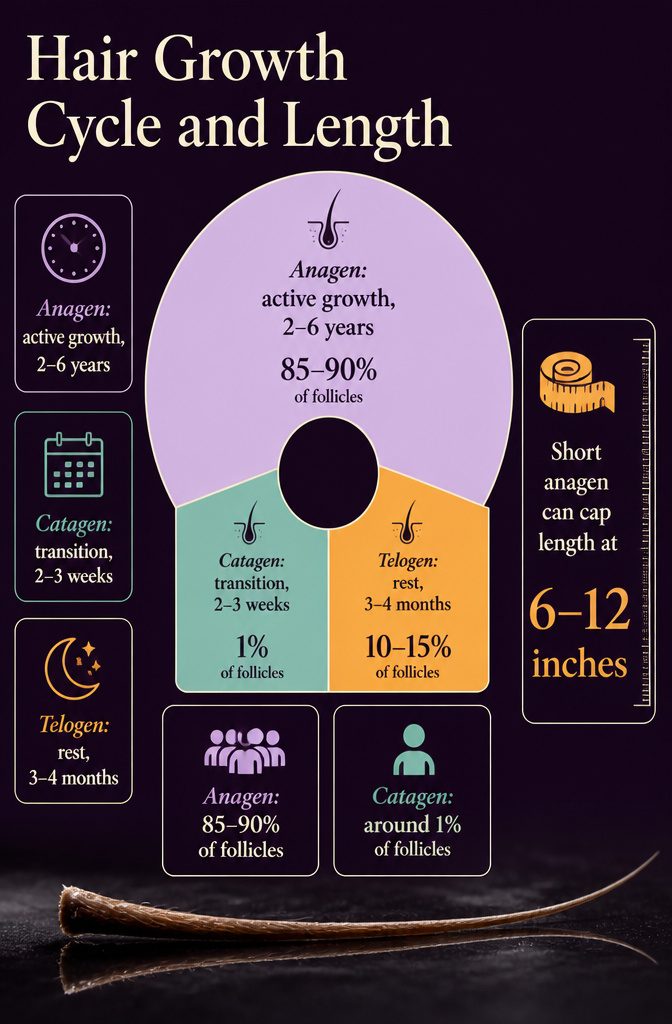
Every hair on your head runs its own independent clock through 3 phases. The anagen phase is active growth, lasting 2–6 years for scalp hair.
Catagen is a brief transition, just 2–3 weeks, when growth stops. Then telogen, a resting period of about 3–4 months, after which the strand sheds and the cycle restarts.
At any moment, roughly 85–90% of your follicles are in anagen, about 10–15% are resting in telogen, and around 1% are in catagen.
How long your anagen phase runs is largely genetic, and that duration sets your length ceiling. A short anagen phase caps attainable length at somewhere around 6–12 inches, no matter how carefully you treat the hair.
Tailoring Care to Your Hair Type
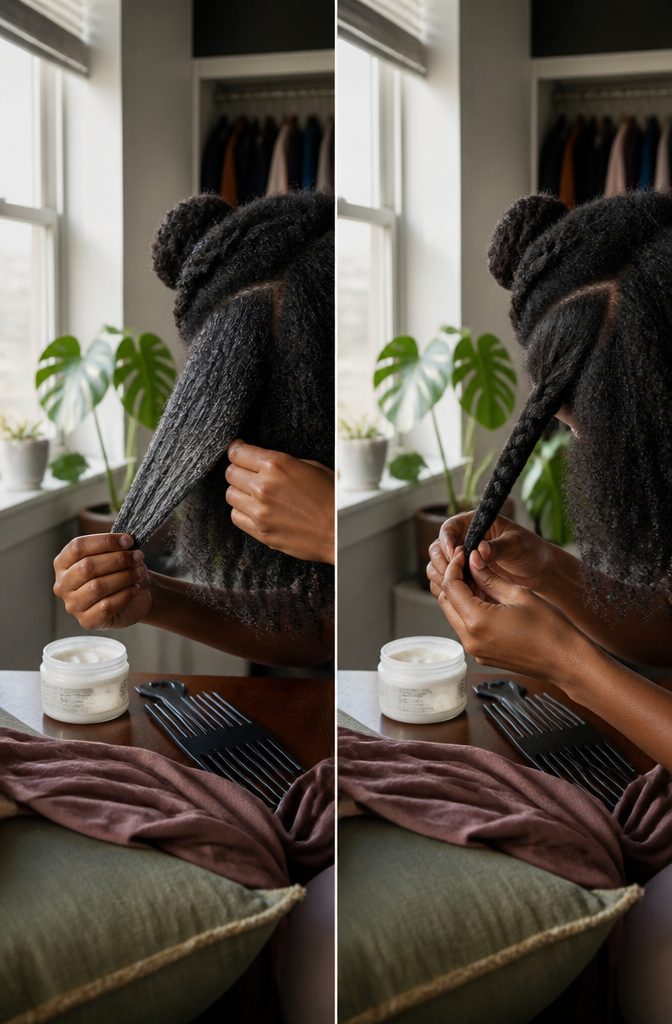
Wash frequency, product weight, and how much manipulation your hair can handle all shift depending on your hair type. Straight, fine hair tends to get weighed down fast, so lighter products and more frequent washing usually work better.
Coily and type 4 hair holds moisture differently; it often does best with longer stretches between wash days and heavier creams or butters that seal in hydration.
For Black hair and textured types specifically, protective styling is genuinely protective only when it’s temporary.
Extensions and weaves worn longer than 2–3 months put sustained tension on the hairline and new growth, which is exactly where breakage tends to start. Relaxed hair needs touch-ups every 2–3 months, and only on new growth, not overlapping onto already-processed lengths.
Frequently Asked Questions
How fast does hair grow?
Hair grows about half an inch per month, which adds up to roughly 6 inches per year.
That rate stays fairly consistent, though shorter hair appears to grow faster because the change is more visible, while longer hair can look like it stalls even as it keeps adding length at the same pace.
Can hair grow 2 inches in a month?
No.
Hair grows about half an inch per month on average, so 2 inches would take around 4 months. The rate is biological and consistent across most people, and no product or routine changes that baseline speed.
Why is my hair stuck at one length?
Hair breaks at the ends as fast as it grows from the scalp, so visible length stalls.
Split ends, heat damage, rough towel-drying, and tight styles all snap strands before they reach the length you want. Trimming damaged ends every 10 to 12 weeks and cutting heat exposure lets you retain more of what grows.
Can I grow my hair in 3 months?
You can add about 1.5 inches in 3 months, since hair grows roughly half an inch per month. Protecting what you already have from breakage matters more than trying to speed up growth, because the rate itself does not change.
Reducing heat styling, trimming split ends, and keeping the scalp clean all help you keep that length instead of losing it to damage.
Can you wash your hair every day?
It depends on your hair type and how much oil your scalp produces. If your scalp runs oily, daily washing keeps buildup from clogging follicles, but drier hair types can stretch to every few days without issue.
Over-washing strips natural oils that protect strands, so find the frequency that keeps your scalp clean without drying out the lengths.
What oil makes your hair grow faster?
No oil speeds up the rate of growth, but oils like argan, castor, and rosemary reduce breakage and improve scalp health, which helps you retain length.
Rosemary oil in particular has shown results similar to minoxidil in one study, though more research is needed. Hydration keeps strands flexible so they resist snapping, and a healthier scalp supports the growth cycle.
How long does it take to speed up hair growth?
You cannot speed up the rate itself, but treatments that address hair loss or shedding take 3 to 6 months to show results.
Topical minoxidil, scalp health improvements, and fixing nutritional deficiencies all operate on that timeline. Hair lost to stress often sheds 6 to 12 weeks after the event and regrows over 4 to 6 months once the trigger clears.