
Hair growth phases are the stages every follicle cycles through: active growth (anagen), transition (catagen), rest (telogen), and shedding (exogen).
Each follicle runs its own independent clock, which is why you shed 50 to 100 hairs daily instead of losing everything at once.
Scalp anagen lasts 2 to 8 years, but eyebrow and eyelash follicles spend only 2 to 3 months in active growth, so those hairs stay short without trimming.
Why Follicles Move Through the Cycle on Their Own Schedule

Each follicle on your scalp runs through the growth cycle on its own clock.
That independent timing means you shed around 50 to 100 hairs a day rather than losing all of your hair at once. The staggered schedule keeps your overall density stable even as individual strands move from growth into rest and shedding.
Each phase has its own timeline, which can be affected by age, nutrition, and overall health.
What counts as normal shedding depends partly on how long each phase runs, and that varies by body area. Scalp hair stays in active growth for two to six years, which is why it grows long enough to cut.
Eyebrow and eyelash follicles stay in growth for only two to three months, so those hairs stay short without any trimming.
You will see the cycle described as three phases or four.
The difference comes down to whether shedding gets its own stage, called exogen, or whether sources fold it into telogen as the final part of the resting phase. Both models describe the same process.
Anagen: Active Growth
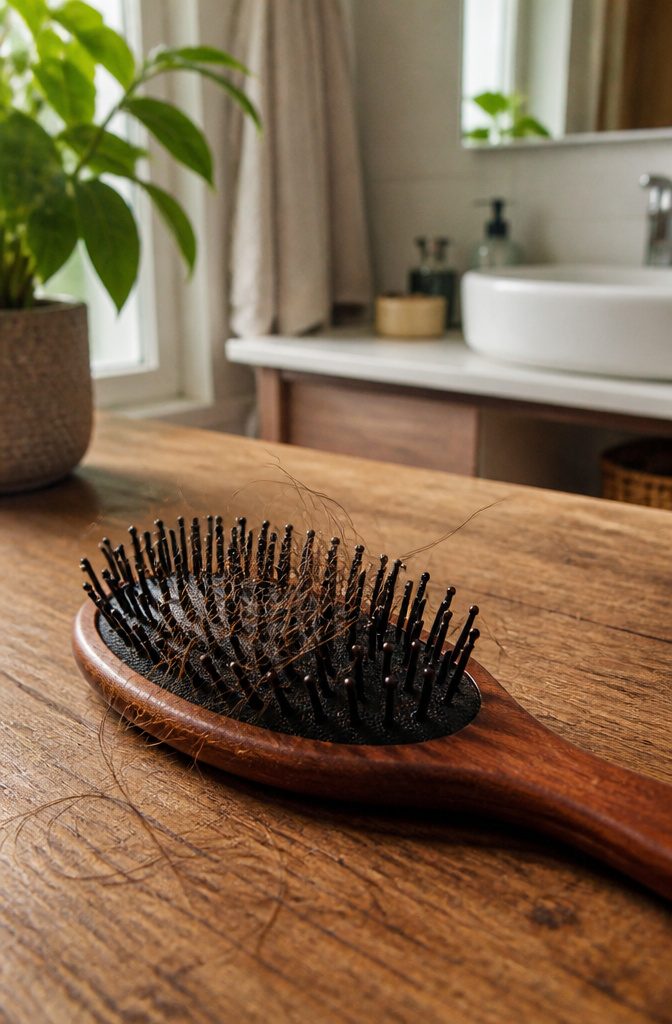
Anagen is the only time your hair is actually getting longer. Cells at the root divide, push the strand up, and keep at it for 2 to 8 years depending on genetics, age, and where on your body the follicle sits.
About 85 to 90 percent of the hair on your scalp is in this phase right now, which is why you have a full head of hair instead of patchy coverage.
The length of your anagen phase sets the maximum length your hair can reach. Growth happens at roughly 0.3 to 0.5 mm per day, which works out to about 1 cm or half an inch per month.
Thicker hair tends to grow faster within that range. If your anagen phase runs three years, you are looking at around 18 inches before the follicle moves on.
Seven years gets you closer to 42 inches, which is why some people can grow hair past their waist and others plateau at shoulder length.
Eyebrow and eyelash anagen is far shorter, just two to three months, which is why those hairs stay short no matter how long you wait.
Catagen: Transition

Growth stops abruptly during catagen. The follicle detaches from its blood supply and shrinks to about one-sixth its original length, cutting the strand off from nutrients and from the cells that produce new hair.
The hair itself stays anchored in place for now, pushed upward by the collapsing follicle, but it no longer lengthens or thickens.
Catagen lasts two to three weeks on the scalp, making it the shortest phase in the cycle.
Only about one to three percent of scalp hair sits in this transitional stage at any given moment, so you will not see or feel anything different while a follicle shifts through it.
Facial and body hair may spend as little as two days in catagen before moving into rest.
Telogen: Rest

Growth pauses in telogen while the hair stays in the follicle. The phase lasts 2–4 months for most scalp hair, though some sources extend it to a year depending on the individual and the follicle.
About 9–15% of the hair on your scalp sits in this phase at any given time, resting without lengthening or falling out right away.
New hair forms beneath the old hair during telogen, preparing the follicle to start the cycle again. The old strand remains attached but no longer grows.
Body hair has a shorter telogen phase, sometimes only a few weeks, while scalp hair can rest much longer. That spread explains why leg hair never reaches the length scalp hair does, even though both follow the same four-stage cycle.
Exogen: Shedding When Counted Separately

Old hair sheds from the follicle at the same time new growth begins underneath, a process that lasts 2 to 5 months.
Some sources call this the exogen phase and list it as the fourth stage of the cycle. Others treat it as part of telogen rather than a separate phase, since the two overlap.
Either way, the mechanism is the same.
The hair detaches from the scalp and falls out, often helped along by washing, brushing, or friction against a pillowcase. Losing 50 to 100 hairs per day during this phase is normal.
Those strands in the shower drain or caught in your hairbrush are not hair loss. Each one is replaced by a new hair growing from the same follicle, so total hair count stays stable.
How Many Hairs You Shed Daily and What Normal Looks Like
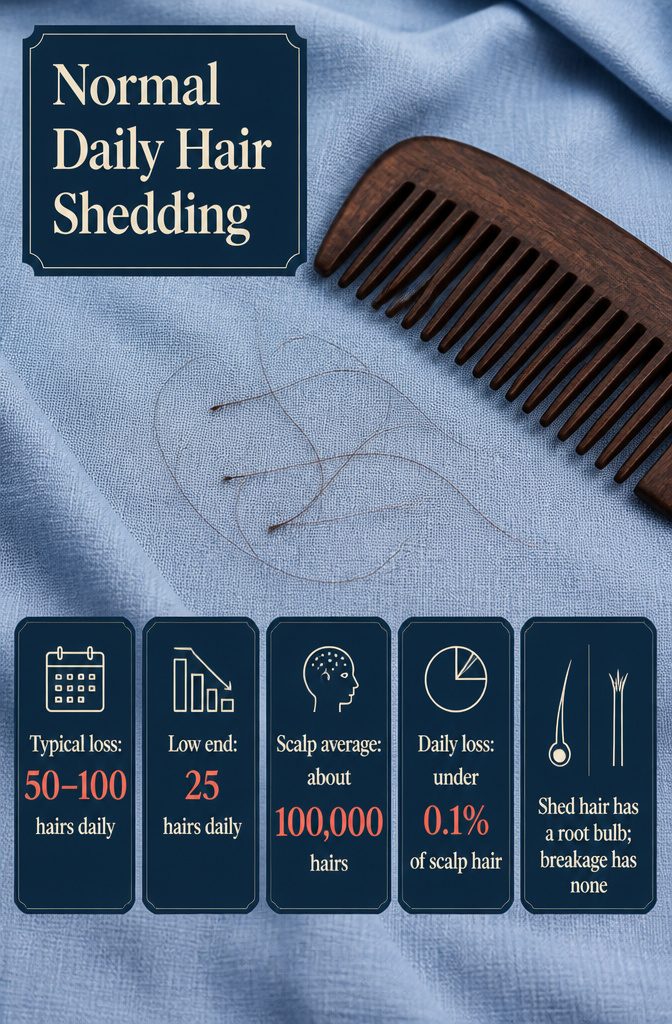
Most people lose 50 to 100 hairs a day, though the range can start as low as 25.
That sounds like a lot until you remember the average scalp carries about 100,000 hairs, so daily shedding accounts for less than a tenth of one percent of what you have.
The loss is constant but spread across the whole head, which is why normal shedding never leaves a visible gap.
You can tell a shed hair from a broken one by checking the end.
A shed hair comes out with a small bulb at the root, the part that was anchored in the follicle. Broken hairs show a blunt or frayed tip somewhere along the shaft, no bulb at all.
If you are pulling out handfuls and most have that bulb, the cycle is moving normally. If most tips are ragged, the problem is mechanical breakage, not shedding.
What Disrupts the Cycle and Increases Shedding
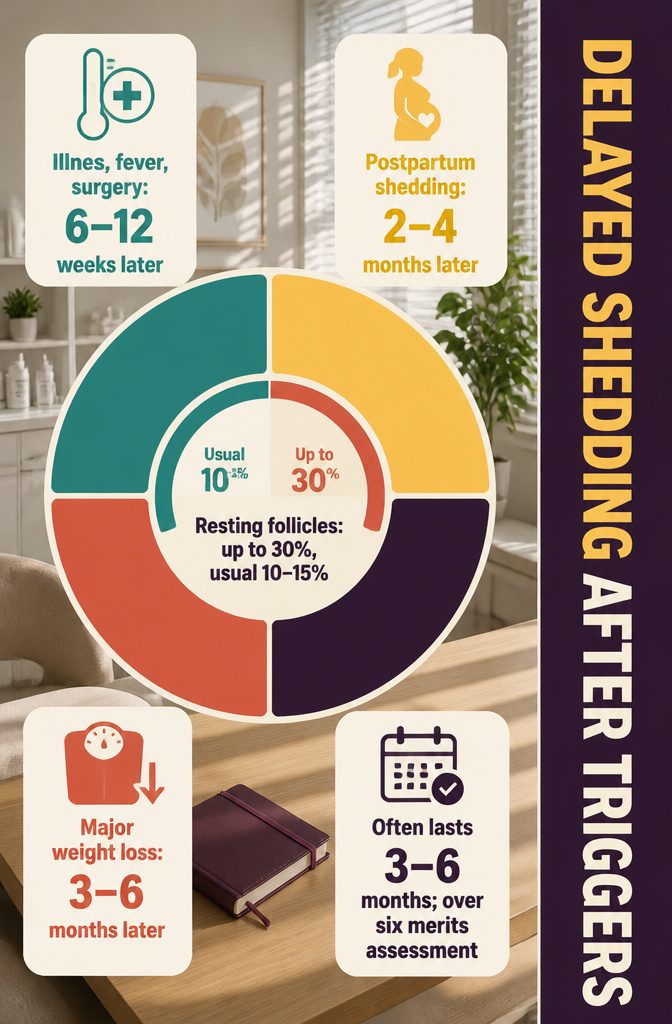
Stress, illness, hormones and nutrition can all push more follicles into the resting phase at once, which is what causes a visible uptick in shedding weeks or months after the event itself.
The timing matters: illness, fever or surgery tends to show up as increased shedding 6–12 weeks later, postpartum shedding typically appears 2–4 months after delivery, and major weight loss can trigger noticeable hair fall 3–6 months down the line.
This delayed pattern is called telogen effluvium, and it commonly lasts 3–6 months from when you first notice the change.
In telogen effluvium, up to 30% of follicles may enter the resting phase together instead of the usual 10–15%, which is why the volume of shed hair suddenly jumps.
The condition is temporary and resolves once the underlying trigger passes, though shedding that continues beyond six months is worth having assessed.
When Shedding Merits Professional Assessment
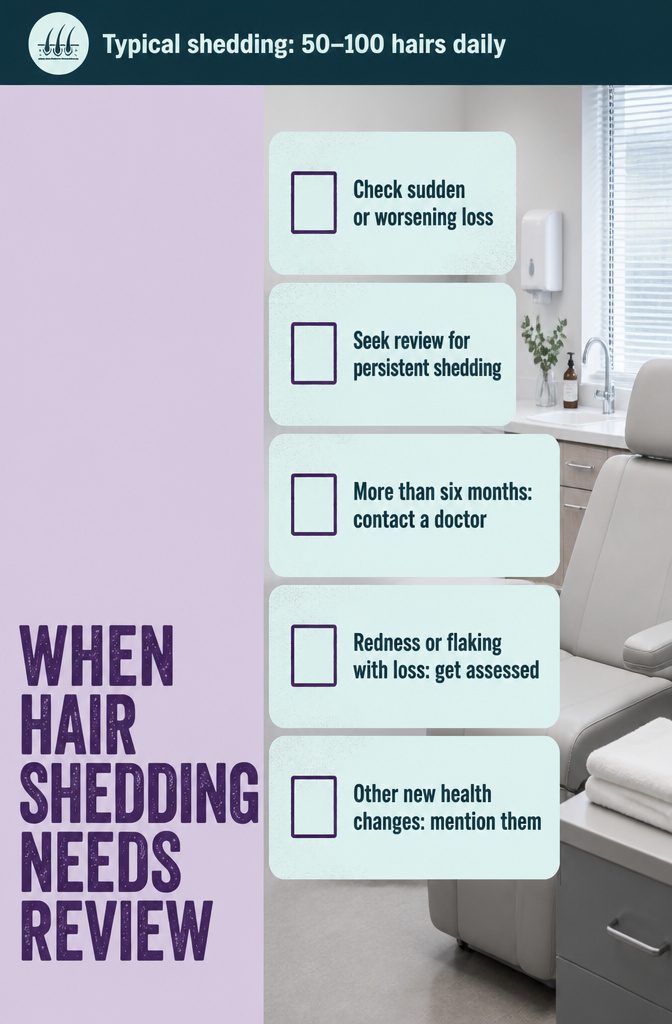
Ordinary shedding sits between 50 and 100 hairs a day, and that holds even when you notice clumps in the shower or on the brush. But sudden, persistent, worsening or patchy shedding merits professional assessment.
If the pattern has continued for more than six months, if you see scalp symptoms like redness or flaking alongside the loss, or if other health changes arrived at the same time, I would contact a doctor or dermatologist.
The fundamental cause determines the treatment plan, and early evaluation often means more options.
Telogen effluvium does not necessarily cause permanent hair loss.
The course depends on the underlying trigger and whether another form of hair loss is present alongside it. Individual evaluation matters here, because the outcome varies too much to give a universal answer.
How Cycle Length Changes by Body Area
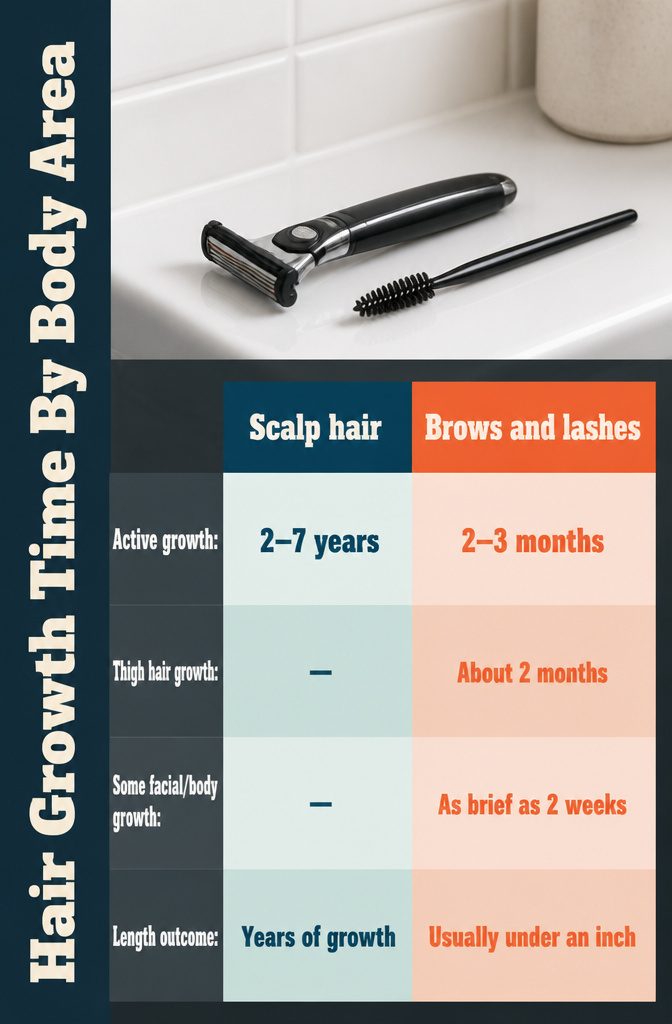
Scalp hair keeps growing for years because its anagen phase runs anywhere from two to seven years.
Eyebrow and eyelash follicles spend only two to three months in active growth, then shift into catagen and telogen. That shorter window means brows and lashes reach a set length and stop, usually well under an inch.
Thigh hair anagen lasts around two months. Facial and body hair can have anagen phases as brief as two weeks in some areas, which is why a shaved leg stays smooth longer than a shaved face grows back in.
The length any hair reaches depends entirely on how long its follicle holds it in anagen before releasing it into the resting phases.
Why Anagen Timing Matters for Hair Removal
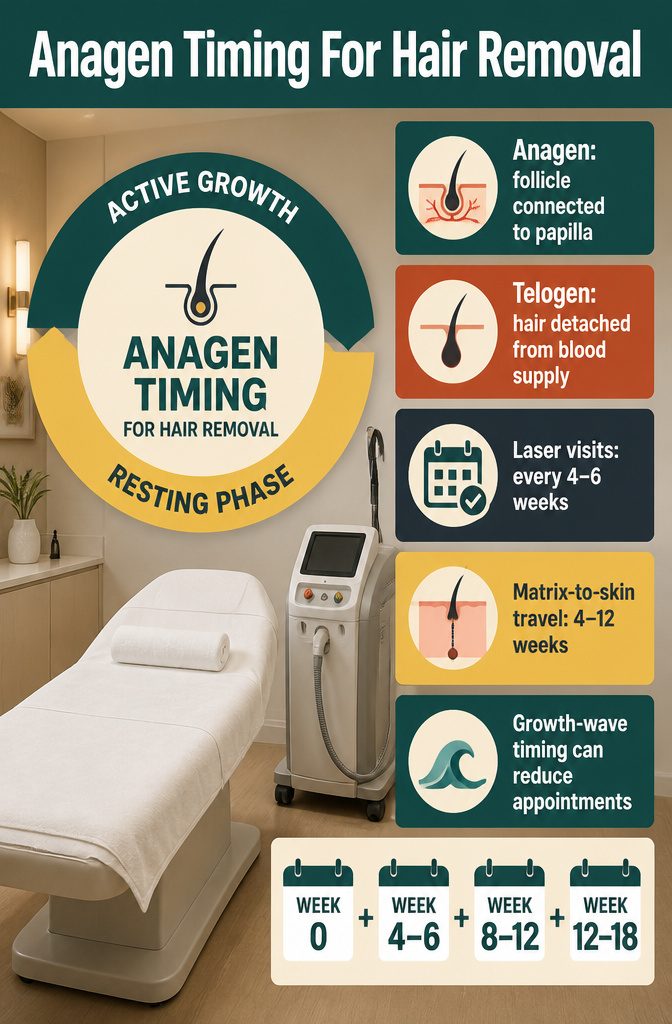
Electrolysis and laser hair removal work best when the hair is in anagen, because the follicle is actively connected to the papilla and the root is anchored in place.
During telogen, the hair has already detached from its blood supply and sits loose in the follicle, so the treatment can’t reach the source.
Laser clinics schedule appointments four to six weeks apart for this reason. That window lets new follicles enter anagen while the ones treated in the previous session finish their cycle.
Hair takes anywhere from four to twelve weeks to travel from the matrix at the base of the follicle up through the skin, depending on the body area.
Timing the sessions to catch each wave of growth means fewer total appointments and better long-term results.
What Happens to Transplanted Hair
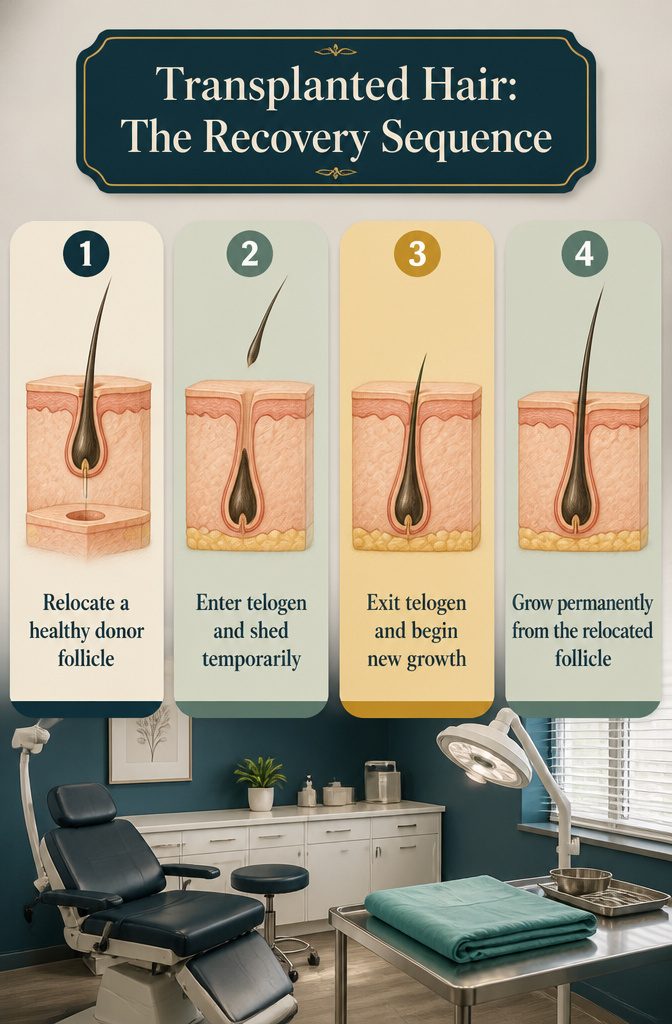
Transplanted hair goes through the same cycle as any other follicle, which means most transplanted hairs shed within the first few weeks after the procedure.
The follicles enter telogen shortly after being moved, whether the technique was FUE or FUT. That temporary loss is expected, not a sign the graft failed.
New growth from those transplanted follicles typically begins within a few months, once they exit telogen and cycle back into anagen. The hair that grows is permanent, anchored by a healthy follicle that was relocated from a stable donor area.
A transplant addresses pattern hair loss where follicles have miniaturized or stopped cycling properly.
It does not fix temporary shedding caused by a resolving trigger like stress, a nutritional gap, or a hormonal shift. If shedding stems from something temporary, the follicles usually recover on their own once the underlying cause resolves.
How Many Cycles Each Follicle Undergoes
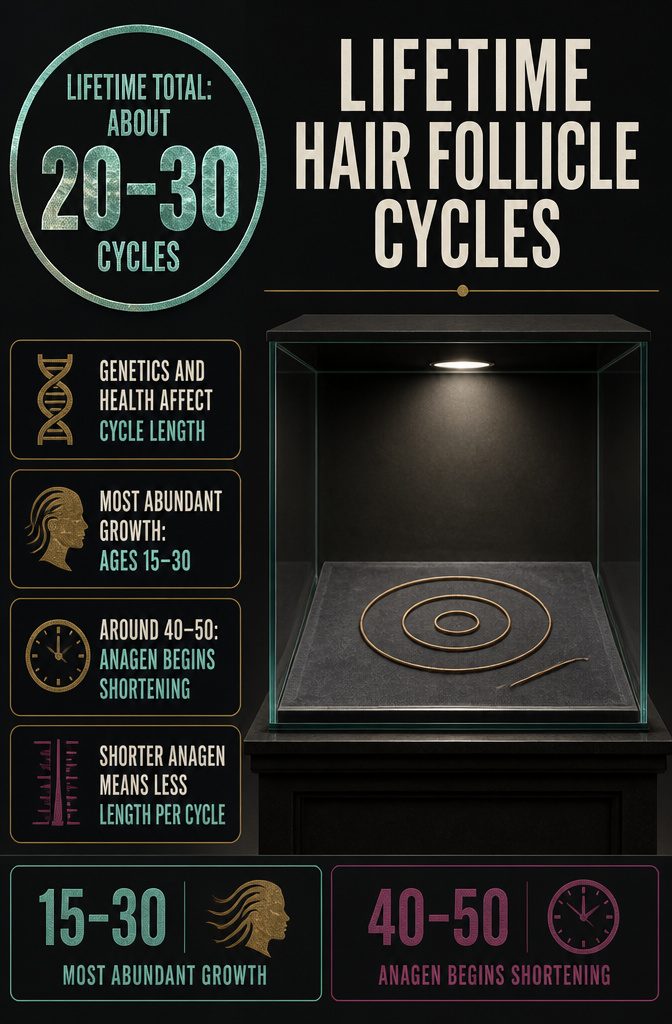
Each follicle goes through about 20–30 complete cycles over the course of your life.
The range sits wide because genetics and overall health change how long each cycle runs, but the limit means you get a fixed window of hair growth no matter how well you care for it.
The most abundant growth happens between ages 15 and 30, when anagen runs longest and the most follicles stay active at once.
Around 40 to 50, anagen starts to shorten, which is when genetically predisposed thinning shows up. The cycles themselves keep turning, but shorter anagen phases mean each round produces less length before the follicle shuts down and rests.
Frequently Asked Questions
What are the 4 stages of hair growth?
The four stages are anagen (active growth), catagen (transition), telogen (rest), and exogen (shedding).
Some sources treat exogen as part of telogen rather than listing it separately, which is why you will see the cycle described as either three phases or four.
How many hairs a day is normal to lose?
Losing 50 to 100 hairs per day is normal. That amount accounts for less than a tenth of one percent of the roughly 100,000 hairs on your scalp, so the loss stays constant without leaving visible gaps.
What percentage of hair is in the growth phase?
About 85 to 90 percent of the hair on your scalp is in anagen right now. That high percentage is why you have full coverage instead of patchy hair.
Why does transplanted hair shed after the procedure?
Most transplanted hairs shed within the first few weeks because the follicles enter telogen shortly after being moved. New growth from those same follicles typically begins within a few months once they cycle back into anagen.
What factors can influence the duration of each phase of the hair growth cycle?
Genetics, age, hormones, stress, nutrition, and overall health all affect how long each phase runs. Seasonal changes can also play a role, with hair often growing faster in summer than in winter.
Are there any vitamins or supplements that can support healthy hair growth and the hair growth cycle?
Supplements with amino acids, protein, biotin, zinc, and other nutrients may support follicle function when a healthcare professional confirms a genuine deficiency. The best approach depends on individual needs rather than a universal formula.
How to distinguish between normal and excessive shedding?
Shedding 50 to 100 hairs daily is normal. Sudden, persistent, worsening, or patchy shedding, along with widening parts or visible thinning, suggests a disruption worth having assessed.
How long is the hair growth cycle?
The full cycle varies by follicle. Anagen lasts 2 to 8 years, catagen runs 2 to 3 weeks, and telogen lasts 2 to 4 months, with shedding overlapping the final resting phase.
Is hair shedding during the telogen phase normal?
Some shedding is expected as part of the normal cycle. A sudden increase or a pattern that continues for months is more worth having checked by a professional.
Can stress affect the hair growth cycle?
Significant physical or emotional stress can push more follicles into the resting phase at once, which often shows up as increased shedding 6 to 12 weeks after the event. This pattern is called telogen effluvium and typically resolves once the trigger passes.
Does telogen effluvium cause permanent hair loss?
Not necessarily. The outcome depends on the underlying trigger and whether another form of hair loss is present alongside it, so individual evaluation matters.
How long does telogen effluvium last?
Telogen effluvium commonly lasts 3 to 6 months from when you first notice the increase in shedding. Shedding that continues beyond 6 months is worth having assessed.
How can I tell whether my hair is shedding or breaking?
Shed hairs have a small bulb at the root, the part that was anchored in the follicle. Broken hairs show a blunt or frayed tip somewhere along the shaft with no bulb at all.
When should I see a professional about hair shedding?
Sudden, persistent, worsening, or patchy shedding merits professional assessment.
If the pattern has continued for more than 6 months, if you see scalp symptoms like redness or flaking, or if other health changes arrived at the same time, contact a doctor or dermatologist.
How many hair growth cycles does each hair follicle undergo in a lifetime?
Each follicle goes through about 20 to 30 complete cycles over the course of your life. The range varies because genetics and overall health change how long each cycle runs.
How long is 7 years of hair growth?
Hair grows roughly 0.3 to 0.5 mm per day, which works out to about 1 cm or half an inch per month. Seven years of uninterrupted anagen gets you close to 42 inches, which is why some people can grow hair past their waist.
How to tell if hair is in anagen phase?
You cannot tell by looking at a single hair on your head, since the phase happens at the follicle level beneath the scalp.
About 85 to 90 percent of your scalp hair is in anagen at any given time, actively lengthening while anchored to its blood supply.





