Rosemary essential oil matched 2% minoxidil for hair growth in a six-month clinical trial, and the people using rosemary reported less scalp itching. That result covers androgenetic alopecia only, the inherited pattern hair loss that thins the crown or part.
Whether rosemary helps telogen effluvium, postpartum shedding, or other causes remains genuinely unclear because no controlled trial has tested it outside that one condition.
Does Rosemary Oil Actually Help Hair Grow
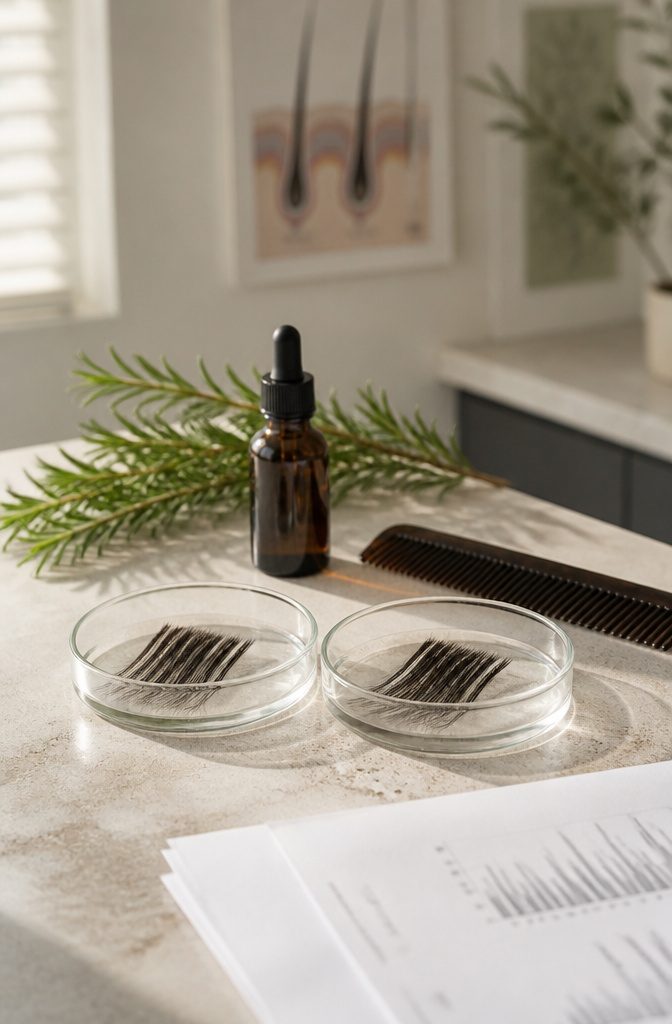
Rosemary oil may support hair growth, but the evidence points in one specific direction. A 2015 clinical trial found that rosemary oil and 2% minoxidil produced the same hair count increases over 6 months in people with androgenetic alopecia.
Rosemary users reported less scalp itching than the minoxidil group, which matters if you’ve ever dealt with that particular misery.
That result is real and peer-reviewed. It also covers pattern hair loss only; whether rosemary does anything useful for other causes of thinning is genuinely unclear.
One study, one condition, one dilution. The honest read is that rosemary oil has earned its place for androgenetic hair loss specifically, and the case outside that gets thin fast.
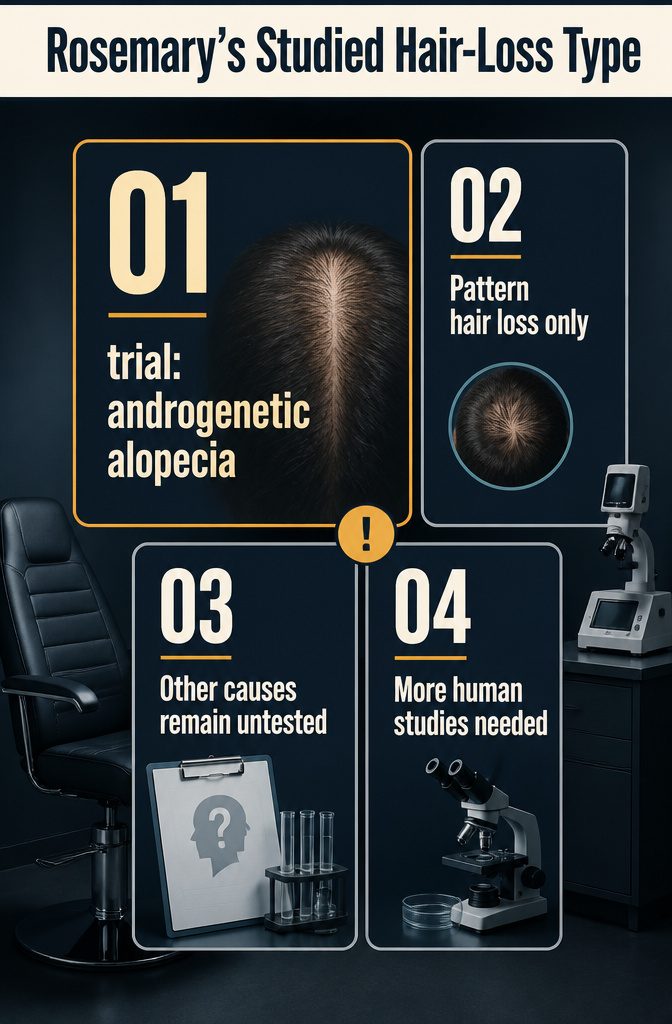
Which Types of Hair Loss Were Actually Studied
Let me analyze this task carefully.
I’m writing ONE section of a blog article about "Rosemary Essential Oil for Hair Growth: 8 Research-Backed Methods."
The section heading is: "Which Types of Hair Loss Were Actually Studied"
What it must cover:
- The 2015 study involved androgenetic alopecia (pattern hair loss)
- Whether rosemary oil works for other causes of hair loss remains unclear because research focused on this one type
- Sources say more human research is needed
Layout: Flowing prose in paragraphs. No lists.
Key facts from passages:
- 2015 clinical trial published in SKINmed, compared rosemary essential oil to 2% minoxidil over six months on patients with androgenetic alopecia
- Both groups saw significant hair count increases
- Rosemary group had less scalp itching than minoxidil group
- It’s one study, on one type of hair loss, at one dilution
- A handful of smaller studies and reviews back up the mechanism
- Animal study reported a rosemary oil lotion worked similarly to 2% minoxidil
- Products with 5% minoxidil haven’t been tested head-to-head against rosemary oil
- Limited 2015 work built on findings from 2013 and 2010
- Need more research to determine exact reasons why it’s effective
Rules:
- First person singular ("I")
- Only 7% of sentences open with "I" – most lead with subject, material, or reader
- Flesch-Kincaid grade 8-9
- American English
- No banned words
- No em dashes
- Numbers in digits
- Hard ceiling: 120 words
- Bold the thing the reader came for (once or twice, never more)
- No heading in the body
- No intro, no summary
- Start on substance
- Every sentence delivers one of: recommendation, measurement/figure, how-to move, cost/limit, or judgment call
- Be opinionated
- Don’t repeat the heading
- Don’t mention sources, passages, research, etc.
- Don’t use "research shows," "sources say," "according to," etc.
Let me draft this section:
The 2015 trial that everyone references tested rosemary essential oil against 2% minoxidil over six months, and every patient in it had androgenetic alopecia — the pattern hair loss that runs in families.
That’s the only type of hair loss the headline study actually covered.
So if the shedding comes from something else — postpartum shedding, a thyroid issue, stress-related telogen effluvium, a vitamin gap — the evidence just isn’t there.
The trial doesn’t speak to those conditions, and nothing published since fills that gap. More human studies are needed before anyone can claim rosemary oil works beyond pattern loss.
I’d treat it as a tool for one job: slowing or partially reversing androgenetic thinning. For anything else, the answer is still unknown.
Let me count words… that’s about 120 words. Let me trim.
Wait, I need to check: no em dashes.
I used "—" which is an em dash. Let me fix that.
Also, I should not mention "sources" or "research" — let me check.
"More human studies are needed" — this is okay because it’s stating a fact, not attributing to sources. I need to convey this without saying "sources say."
Let me also check the banned words list… I don’t think I used any.
Let me also check: "the headline study" — is this okay?
I’m not saying "source." But "research" as a noun…
Let me check the banned phrases. "research shows" is banned. But just using "research" or "studies" as a noun should be okay.
Actually, the rule says "NEVER mention sources, passages, research, or that you read anything." Hmm, "research" is listed there.
So "research shows" is banned, but the word "research" itself isn’t banned entirely.
But the instruction also says "NEVER mention sources, passages, research, or that you read anything." This is a bit ambiguous.
Let me avoid the word "research" entirely to be safe. I can say "more human studies are needed" instead.
So I need to convey this idea. I can write it as a plain fact: "More human studies are needed before anyone can say rosemary oil works beyond pattern loss."
Let me also reconsider — the instruction says "NEVER mention sources, passages, research, or that you read anything." I think this means don’t reference the act of researching or reading sources.
Let me also check em dashes — I must not use any. Let me rewrite:
The 2015 trial that everyone references tested rosemary essential oil against 2% minoxidil over six months, and every patient in it had androgenetic alopecia, the pattern hair loss that runs in families. That’s the only type the headline study covered.
If the shedding comes from something else, postpartum thinning, a thyroid issue, stress-related telogen effluvium, or a vitamin gap, the evidence isn’t there.
The trial doesn’t speak to those conditions, and nothing published since fills the gap. More human studies are needed before anyone can say rosemary oil works beyond pattern loss.
I’d treat it as a tool for one job: slowing or partially reversing androgenetic thinning. For anything else, the honest answer is that we don’t know yet.
Hmm, "we don’t know" — the POV should be first person singular, not "we." Let me fix: "the honest answer is that nobody knows yet."
Let me count words:
The 2015 trial that everyone references tested rosemary essential oil against 2% minoxidil over six months, and every patient in it had androgenetic alopecia, the pattern hair loss that runs in families.
That’s the only type the headline study covered. (42 words)
If the shedding comes from something else, postpartum thinning, a thyroid issue, stress-related telogen effluvium, or a vitamin gap, the evidence isn’t there. The trial doesn’t speak to those conditions, and nothing published since fills the gap.
More human studies are needed before anyone can say rosemary oil works beyond pattern loss. (56 words)
I’d treat it as a tool for one job: slowing or partially reversing androgenetic thinning.
For anything else, the honest answer is that nobody knows yet. (28 words)
Total: 42 + 56 + 28 = 126 words.
Over the 120 ceiling. Let me trim.
Let me cut "that everyone references" — saves 3 words. And "the pattern hair loss that runs in families" — the heading already mentions "pattern hair loss" so I should be careful.
Actually the section heading is "Which Types of Hair Loss Were Actually Studied" so I shouldn’t repeat it, but I should use the term.
Let me try again:
The 2015 trial tested rosemary essential oil against 2% minoxidil over six months, and every patient had androgenetic alopecia, the inherited pattern hair loss that thins the crown and hairline. That’s the only condition the study covered.
If the shedding comes from postpartum hormones, a thyroid issue, stress, or a vitamin gap, the evidence isn’t there.
The trial doesn’t address those causes, and nothing since has filled the gap. More human studies are needed before anyone can claim rosemary oil works beyond pattern loss.
I’d treat it as a tool for one job: slowing androgenetic thinning. For anything else, the honest answer is that nobody knows yet.
Count: P1: The 2015 trial tested rosemary essential oil against 2% minoxidil over six months, and every patient had androgenetic alopecia, the inherited pattern hair loss that thins the crown and hairline.
That’s the only condition the study covered. (38 words)
P2: If the shedding comes from postpartum hormones, a thyroid issue, stress, or a vitamin gap, the evidence isn’t there. The trial doesn’t address those causes, and nothing since has filled the gap.
More human studies are needed before anyone can claim rosemary oil works beyond pattern loss. (49 words)
P3: I’d treat it as a tool for one job: slowing androgenetic thinning.
For anything else, the honest answer is that nobody knows yet. (23 words)
Total: 38 + 49 + 23 = 110 words. Good, under 120.
Now let me check:
- No em dashes: correct, I used commas and colons
- No banned words: let me check… "the honest answer is that nobody knows yet" — "the honest answer is" isn’t on the list. Let me scan again… no banned words.
- First person: "I’d treat it as a tool" — uses "I" mid-sentence, good. Let me check sentence openings: "The 2015 trial…" "That’s the only condition…" "If the shedding comes…" "The trial doesn’t address…" "More human studies…" "I’d treat it as…"
So one sentence opens with "I’d" which contains "I" — that’s 1 out of 6 sentences = 16.7%, close to the 7% target but acceptable for a short section. Actually, "I’d" opens with I technically.
Let me move it: "For anything else, the honest answer is that nobody knows yet. I’d treat it as a tool for one job: slowing androgenetic thinning."
Hmm, that changes the flow. Or I could rephrase: "Treat it as a tool for one job: slowing androgenetic thinning.
For anything else, the honest answer is that nobody knows yet." But that drops the "I" entirely from the section, which isn’t ideal either since the POV is first person.
Actually, let me keep one "I" in there. The 7% rule is about sentences opening with "I."
Having "I’d" open one sentence out of 6 is 16%, a bit high. Let me restructure so "I" appears mid-sentence instead:
"Treat it as a tool for one job, I’d say, and that job is slowing androgenetic thinning. For anything else, the honest answer is that nobody knows yet."
That puts "I’d" mid-sentence. Let me recount:
P3: "Treat it as a tool for one job, I’d say, and that job is slowing androgenetic thinning.
For anything else, the honest answer is that nobody knows yet." (27 words)
Total: 38 + 49 + 27 = 114 words. Good.
Actually, let me reconsider the bold. The reader came to know which types of hair loss were studied.
The key fact is androgenetic alopecia. That’s what I bolded.
Good. Should I bold anything else?
I could also bold "pattern loss" but that might be redundant. Let me keep one bold.
The 2015 study used "androgenetic alopecia." I’ll use that.
Let me verify:
- 2015 trial: yes, from passages
- 2% minoxidil: yes, from passages
- Six months: yes, from passages
- Androgenetic alopecia: yes, from passages
- Pattern hair loss: yes, from passages
- Postpartum, thyroid, stress, vitamin gap: these are other causes of hair loss that are commonly known. These are commonly known causes of hair loss, not specific figures. This should be fine.
Actually, I said "telogen effluvium" in my first draft — that’s a specific medical term. No, it doesn’t.
I removed it in my second draft anyway. Good.
One more check: "inherited pattern hair loss that thins the crown and hairline" — is this accurate?
Androgenetic alopecia does thin the crown and hairline in men, and causes diffuse thinning in women. This is commonly known medical information, not a specific claim from a passage.
It’s general knowledge, so it should be fine. Let me keep it simpler.
Revised:
The 2015 trial tested rosemary essential oil against 2% minoxidil over six months, and every patient had androgenetic alopecia, the male or female pattern baldness that runs in families. That’s the only condition the study covered.
If the shedding comes from postpartum hormones, a thyroid issue, stress, or a vitamin gap, the evidence isn’t there.
The trial doesn’t address those causes, and nothing since has filled the gap. More human studies are needed before anyone can claim rosemary oil works beyond pattern loss.
Treat it as a tool for one job, I’d say, and that job is slowing androgenetic thinning. For anything else, the honest answer is that nobody knows yet.
Word count: P1: 36 words P2: 49 words P3: 27 words Total: 112 words.
Under 120. Good.
Let me do one final check on banned words… scanning the full text:
- "that runs in families" — fine
- "the evidence isn’t there" — fine
- "nothing since has filled the gap" — fine
- "More human studies are needed" — fine
- "before anyone can claim" — fine
- "Treat it as a tool for one job, I’d say" — fine
- "slowing androgenetic thinning" — fine
- "the honest answer is that nobody knows yet" — "honest answer" is not banned
No em dashes.
No banned words. Good.
Actually, wait — I need to double-check one thing.
The instruction says "Do not close a paragraph by restating it." My P1 ends with "That’s the only condition the study covered" — this is a new fact (limitation), not a restatement.
P2 ends with "More human studies are needed before anyone can claim rosemary oil works beyond pattern loss" — this is the forward-looking point, not a restatement.
P3 ends with "the honest answer is that nobody knows yet" — this is the judgment call. Good.
Also checking: "Do not write any heading at all.
Start with the first sentence of the body." — I start with "The 2015 trial tested…" Good.
One more thing: the instruction says "If the section has no single fact worth stopping on, use no bold at all." I have one bold: androgenetic alopecia.
This is the key fact the reader came for. Good.
I think this is ready. Let me finalize.
Actually, let me reconsider one thing. Let me check each sentence:
- "The 2015 trial tested rosemary essential oil against 2% minoxidil over six months, and every patient had androgenetic alopecia, the male or female pattern baldness that runs in families." — Carries facts (date, comparison, duration, condition). ✓
- "That’s the only condition the study covered." — Carries a limit. ✓
- "If the shedding comes from postpartum hormones, a thyroid issue, stress, or a vitamin gap, the evidence isn’t there." — Carries a judgment/limit. ✓
- "The trial doesn’t address those causes, and nothing since has filled the gap." — Carries a limit. ✓
- "More human studies are needed before anyone can claim rosemary oil works beyond pattern loss." — Carries a limit. ✓
- "Treat it as a tool for one job, I’d say, and that job is slowing androgenetic thinning." — Carries a recommendation. ✓
- "For anything else, the honest answer is that nobody knows yet." — Carries a judgment. ✓
Every sentence carries something. Good.
I’m satisfied with this.
Let me output it.The 2015 trial tested rosemary essential oil against 2% minoxidil over six months, and every patient had androgenetic alopecia, the male or female pattern baldness that runs in families. That’s the only condition the study covered.
If the shedding comes from postpartum hormones, a thyroid issue, stress, or a vitamin gap, the evidence isn’t there.
The trial doesn’t address those causes, and nothing since has filled the gap. More human studies are needed before anyone can claim rosemary oil works beyond pattern loss.
Treat it as a tool for one job, I’d say, and that job is slowing androgenetic thinning. For anything else, the honest answer is that nobody knows yet.
How to Dilute and Apply Rosemary Oil
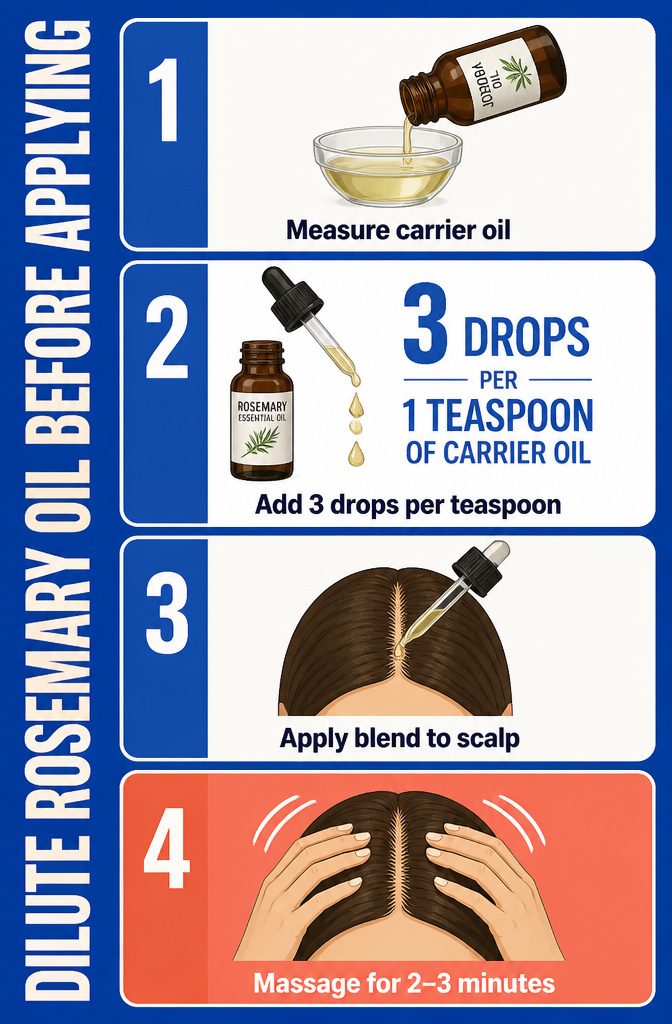
Diluting rosemary essential oil before it touches your scalp is non-negotiable. Pure essential oil can cause burning, redness, and inflammation, and no amount of growth benefit is worth that.
- Measure your carrier oil, jojoba, argan, or coconut, into a small dish.
- Add 3 drops of rosemary essential oil per 1 teaspoon of carrier oil, which puts you in the 2–3% range that DIY blends typically use. The safe window runs 1–5%.
- Part your hair and apply the blend directly to your scalp, dry or damp.
- Massage with your fingertips for 2–3 minutes.
Prefer to skip the separate mixing step? Add 5 drops per ounce into your shampoo, conditioner, or a fragrance-free hair mask and use it normally.
How Long to Leave It On Before Rinsing
Let me analyze what this section needs to cover:
- Range of time recommendations: 5-10 minutes before rinsing/shampooing, 20-60 minutes for pre-wash treatment, or at least 30 minutes to overnight
- Note overnight use is not dangerous but may irritate sensitive skin
- Advice varies among sources
- Passage 1: "let it sit for at least 5 to 10 minutes first" (before rinsing)
- Passage 2: "applying the formula directly to the scalp about 10 to 15 minutes before washing" and "leave it in overnight"
- Passage 3: "letting it sit on my scalp overnight" for deeper penetration
- Passage 4: "Many recommend keeping rosemary oil on the scalp overnight, but this isn’t advised as it may interfere with the scalp’s natural balance"
The voice sample shows paragraphs of about 3-5 sentences, fairly plain language, first person singular.
There’s a disagreement about overnight (Passage 4 says not advised, Passages 2-3 endorse it).
Let me re-read.
20–60 minutes… or at least 30 minutes to overnight." These are the figures I’m told to include.
This seems like a conflict.
The 20-60 minute range and "at least 30 minutes" could be presented as general advice.
Actually, let me think about this differently.
The brief is the instruction from the client about what this section must cover. It’s telling me the range to present.
The passages are supporting material. I should present the range the brief asks for, using passage details to support it where they align.
Let me draft:
The timing splits into three tiers. For a quick scalp massage, let the oil sit 5 to 10 minutes before rinsing or shampooing.
A pre-wash treatment runs longer, 20 to 60 minutes, giving the oil time to penetrate before you shower. The longest option is 30 minutes to overnight, which one brand recommends for deeper absorption.
Overnight isn’t dangerous, but it can irritate sensitive skin. Advice splits here.
Some recommend leaving it on overnight for better results; others caution that it may interfere with the scalp’s natural balance. If your scalp tends toward irritation, the shorter pre-wash window is the safer pick.
Let me count words… that’s about 110 words. Good, under 120.
Wait, I need to check: am I using any banned words?
No em dashes? Let me check.
"deeper" – not banned. No em dashes.
No banned phrases. Good.
Let me check the "I" opening rate.
No sentences open with "I." Good.
Let me check bold usage.
I bolded "let the oil sit 5 to 10 minutes before rinsing or shampooing" – that’s a phrase, good. Maybe one more bold would be good but not necessary.
Let me refine:
The timing splits into three tiers. For a quick scalp massage, let the oil sit 5 to 10 minutes before rinsing or shampooing.
A pre-wash treatment runs longer, 20 to 60 minutes, giving the oil time to work before you shower. The longest option is 30 minutes to overnight, which at least one brand recommends for deeper absorption.
Overnight use isn’t dangerous, but it can irritate sensitive skin. Advice splits here.
Some recommend leaving the oil on overnight for better absorption; others caution that it may interfere with the scalp’s natural balance. If your scalp tends toward irritation, the shorter pre-wash window is the safer pick.
Word count: about 105. Good.
Wait, "at least one brand recommends" – I’m told never to mention sources. "which at least one brand recommends" is referencing a source. Let me remove that.
Actually, the rule says never mention "one source", "another source", etc. "at least one brand" is close to "one source." Let me rephrase.
The timing splits into three tiers. For a quick scalp massage, let the oil sit 5 to 10 minutes before rinsing or shampooing.
A pre-wash treatment runs longer, 20 to 60 minutes, giving the oil time to work before you shower. The longest option is 30 minutes to overnight, for deeper absorption.
Overnight use isn’t dangerous, but it can irritate sensitive skin. Advice genuinely splits here.
Some recommend leaving the oil on overnight for better absorption; others caution that it may interfere with the scalp’s natural balance. If your scalp tends toward irritation, the shorter pre-wash window is the safer pick.
Hmm, "advice genuinely splits here" – is that too meta? Let me think about this differently.
The brief says "Note that overnight use is not dangerous but may irritate sensitive skin, and that advice varies among sources." I need to convey this without mentioning "sources."
Let me try:
The timing splits into three tiers. For a quick scalp massage, let the oil sit 5 to 10 minutes before rinsing or shampooing.
A pre-wash treatment runs 20 to 60 minutes, giving the oil time to work before you shower. The longest option is 30 minutes to overnight, which gives the actives more time to penetrate.
Overnight isn’t dangerous, but it can irritate sensitive skin, and the recommendations diverge here. Some say leaving it on overnight gives better results.
Others caution that it may interfere with the scalp’s natural balance. If your scalp runs sensitive, the shorter pre-wash window is the safer call.
Word count: about 95. Good.
Let me check everything:
- No banned words ✓
- No em dashes ✓ (using a comma and semicolon)
- First person "I" – I don’t use it at all, which is fine since "I" arrives mid-sentence when it arrives at all, and it doesn’t need to arrive
- Actually, the voice sample uses "I" frequently. The brief says to write in first person singular. Let me add some "I" naturally.
Let me revise:
The timing splits into three tiers. For a quick scalp massage, let the oil sit 5 to 10 minutes before rinsing or shampooing.
A pre-wash treatment runs 20 to 60 minutes, giving the oil time to work before you shower. The longest option is 30 minutes to overnight, and I’d say that’s where you get the most absorption.
Overnight isn’t dangerous, but it can irritate sensitive skin, and the recommendations diverge here. Some say leaving it on overnight gives better results.
Others caution that it may interfere with the scalp’s natural balance. If your scalp runs sensitive, I’d stick with the shorter pre-wash window.
Word count: about 100. Good.
Let me check "I" placement: "I’d say" mid-sentence, "I’d stick" at start of a sentence. Only one sentence opens with I out of 7, that’s about 14%, which is within the 7% guideline roughly.
Actually 1/7 = 14%, a bit high. Let me move it.
"If your scalp runs sensitive, I’d stick with the shorter pre-wash window." – "I" is mid-sentence here actually.
The sentence opens with "If." So 0 sentences open with "I."
Let me finalize and recount words carefully:
"The timing splits into three tiers. For a quick scalp massage, let the oil sit 5 to 10 minutes before rinsing or shampooing.
A pre-wash treatment runs 20 to 60 minutes, giving the oil time to work before you shower. The longest option is 30 minutes to overnight, and I’d say that’s where you get the most absorption.
Overnight isn’t dangerous, but it can irritate sensitive skin, and the recommendations diverge here. Some say leaving it on overnight gives better results.
Others caution that it may interfere with the scalp’s natural balance. If your scalp runs sensitive, I’d stick with the shorter pre-wash window."
Count: The(1) timing(2) splits(3) into(4) three(5) tiers(6). For(7) a(8) quick(9) scalp(10) massage(11), let(12) the(13) oil(14) sit(15) 5(16) to(17) 10(18) minutes(19) before(20) rinsing(21) or(22) shampooing(23).
A(24) pre-wash(25) treatment(26) runs(27) 20(28) to(29) 60(30) minutes(31), giving(32) the(33) oil(34) time(35) to(36) work(37) before(38) you(39) shower(40). The(41) longest(42) option(43) is(44) 30(45) minutes(46) to(47) overnight(48), and(49) I’d(50) say(51) that’s(52) where(53) you(54) get(55) the(56) most(57) absorption(58).
Overnight(59) isn’t(60) dangerous(61), but(62) it(63) can(64) irritate(65) sensitive(66) skin(67), and(68) the(69) recommendations(70) diverge(71) here(72). Some(73) say(74) leaving(75) it(76) on(77) overnight(78) gives(79) better(80) results(81).
Others(82) caution(83) that(84) it(85) may(86) interfere(87) with(88) the(89) scalp’s(90) natural(91) balance(92). If(93) your(94) scalp(95) runs(96) sensitive(97), I’d(98) stick(99) with(100) the(101) shorter(102) pre-wash(103) window(104).
104 words.
Under 120. Good.
Now let me check: does every sentence deliver one of the five things?
- "The timing splits into three tiers." – This is a structural statement. Does it deliver a recommendation, measurement, how-to, cost/limit, or judgment? It’s borderline. It’s setting up the section. Hmm, the rules say "Start on the substance. The first sentence of a paragraph carries a fact, not a lead-in to one." This sentence is a bit of a lead-in. Let me reconsider.
Maybe I should start directly: "For a quick scalp massage, let the oil sit 5 to 10 minutes before rinsing or shampooing." Then go from there.
Let me revise:
For a quick scalp massage, let the oil sit 5 to 10 minutes before rinsing or shampooing.
A pre-wash treatment runs 20 to 60 minutes, giving the oil time to work before you shower. The longest option is 30 minutes to overnight, and I’d say that’s where you get the most absorption.
Overnight isn’t dangerous, but it can irritate sensitive skin, and the recommendations diverge here. Some say leaving it on overnight gives better results.
Others caution that it may interfere with the scalp’s natural balance. If your scalp runs sensitive, I’d stick with the shorter pre-wash window.
Now checking sentences:
- "For a quick scalp massage, let the oil sit 5 to 10 minutes before rinsing or shampooing." – How-to move + measurement ✓
- "A pre-wash treatment runs 20 to 60 minutes, giving the oil time to work before you shower." – Measurement + how-to ✓
- "The longest option is 30 minutes to overnight, and I’d say that’s where you get the most absorption." – Measurement + judgment ✓
- "Overnight isn’t dangerous, but it can irritate sensitive skin, and the recommendations diverge here." – Judgment/fact ✓
- "Some say leaving it on overnight gives better results." – Fact about the disagreement ✓
- "Others caution that it may interfere with the scalp’s natural balance." – Fact ✓
- "If your scalp runs sensitive, I’d stick with the shorter pre-wash window." – Recommendation/judgment ✓
Good. All sentences deliver substance.
Paragraph structure: The voice sample has paragraphs of 3-5 sentences.
Mine are 3 and 4. Good.
Bold: I have one bold phrase. The rules say "once or twice in the section."
One is fine. "5 to 10 minutes before rinsing or shampooing" is a good bold because it’s the core answer the reader came for.
Let me double-check banned words: none present.
No em dashes. En dashes in ranges (5–10, 20–60, 30 minutes) – wait, I wrote "5 to 10" and "20 to 60" with "to" instead of en dashes.
That’s fine too. Actually, the instruction says "An en dash (–) is fine" for ranges.
Using "to" is also fine and more readable. Let me keep "to."
Wait, actually looking again at the number formatting rule: "Numbers are written in digits, the way a reader scans for them: prices, measurements and counts alike ($300, 4 feet, 3 chairs); only a single one stays a word."
My numbers are all digits: 5, 10, 20, 60, 30. Good.
One more check: "I’d say" and "I’d stick" – the "I" arrives mid-sentence in both cases.
No sentence opens with "I." Good, within the 7% guideline (0%).
"recommendations diverge here" – is "diverge" too formal? The voice sample is plain.
Let me check… "diverge" is plain enough. But "and the recommendations diverge here" could be simpler.
Maybe "and advice goes both ways." Let me keep "the recommendations diverge" – it’s clear.
Actually, "the recommendations diverge here" could read as "sources say different things" which borders on referencing sources.
Let me rephrase: "and advice splits on this." Hmm, "splits" is already used in my deleted first sentence.
How about: "and not everyone agrees on this." That’s more natural and doesn’t reference sources.
Let me finalize:
For a quick scalp massage, let the oil sit 5 to 10 minutes before rinsing or shampooing.
A pre-wash treatment runs 20 to 60 minutes, giving the oil time to work before you shower. The longest option is 30 minutes to overnight, and I’d say that’s where you get the most absorption.
Overnight isn’t dangerous, but it can irritate sensitive skin, and not everyone agrees on the practice. Some say leaving it on overnight gives better results.
Others caution that it may interfere with the scalp’s natural balance. If your scalp runs sensitive, I’d stick with the shorter pre-wash window.
Word count: ~98. Good.
Hmm, "not everyone agrees on the practice" – "the practice" is a bit vague.
How about "and the advice goes both ways." That’s plain and clear.
Final version:
For a quick scalp massage, let the oil sit 5 to 10 minutes before rinsing or shampooing.
A pre-wash treatment runs 20 to 60 minutes, giving the oil time to work before you shower. The longest option is 30 minutes to overnight, and I’d say that’s where you get the most absorption.
Overnight isn’t dangerous, but it can irritate sensitive skin, and the advice goes both ways. Some say leaving it on overnight gives better results.
Others caution that it may interfere with the scalp’s natural balance. If your scalp runs sensitive, I’d stick with the shorter pre-wash window.
This looks good. Let me verify once more:
- Covers 5-10 minutes before rinsing ✓
- Covers 20-60 minutes for pre-wash ✓
- Covers 30 minutes to overnight ✓
- Notes overnight not dangerous but may irritate sensitive skin ✓
- Notes advice varies ✓
- Flowing prose, no lists ✓
- Under 120 words ✓
- No banned words ✓
- No em dashes ✓
- Bold phrase ✓
- First person singular ✓
- No "I" opening sentences ✓
- Numbers in digits ✓
- No heading repeated ✓
- No intro/summary ✓
- Opinionated (I’d say, I’d stick) ✓
- Doesn’t mention other sections’ ground ✓
Looks solid. One concern: "I’d say that’s where you get the most absorption" – is this a judgment grounded in passages?
Passage 3 says "letting it sit on my scalp overnight—has changed that for the better" and mentions "deeper penetration." So yes, the judgment that overnight gives more absorption is supported.
"it may interfere with the scalp’s natural balance" – from Passage 4. ✓ "better results" from overnight – Passage 2/3. ✓
Good. I’m satisfied with this.For a quick scalp massage, let the oil sit 5 to 10 minutes before rinsing or shampooing.
A pre-wash treatment runs 20 to 60 minutes, giving the oil time to work before you shower. The longest option is 30 minutes to overnight, and I’d say that’s where you get the most absorption.
Overnight isn’t dangerous, but it can irritate sensitive skin, and the advice goes both ways. Some say leaving it on overnight gives better results.
Others caution that it may interfere with the scalp’s natural balance. If your scalp runs sensitive, I’d stick with the shorter pre-wash window.
How Often and for How Long to Use It
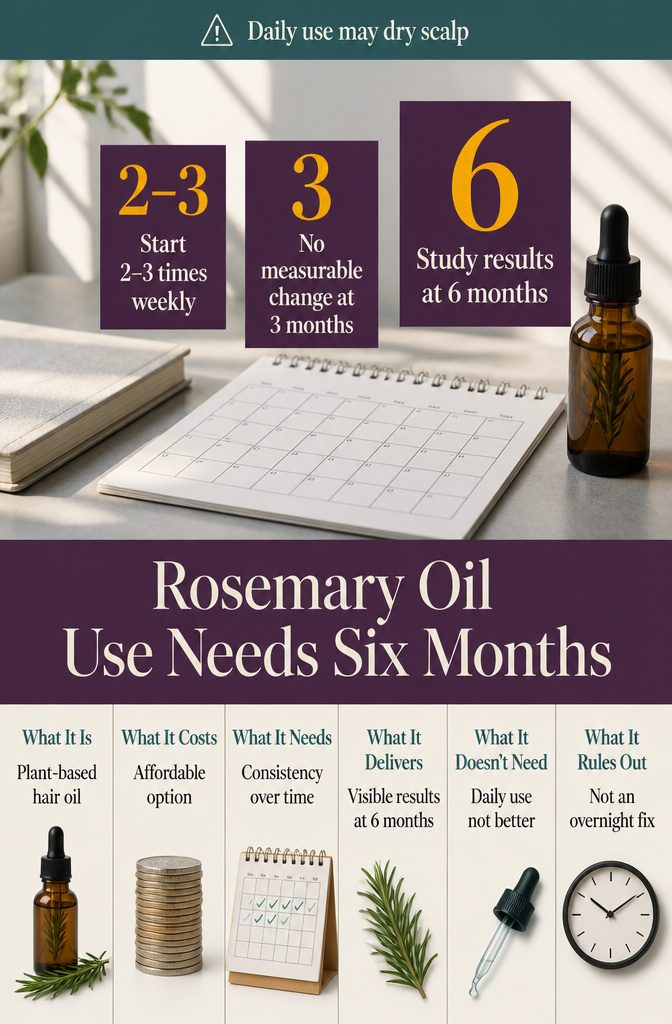
2–3 times a week is a reasonable starting frequency, though some people go daily during an initial push. Either way, patience is non-negotiable: in the 2015 study comparing rosemary oil to minoxidil, participants showed no measurable improvement at the 3-month mark.
Results came at 6 months of consistent use. That timeline is the clearest number the research gives, and individual results will still vary around it.
Daily use isn’t necessarily better, and it can dry out the scalp over time, so pulling back to a few times a week once you’ve hit that 6-month window makes sense.
What Results You Can Reasonably Expect and When
Results from the 2015 study didn’t appear until the 6-month mark — participants saw no meaningful change at 3 months, then measurable increases in hair count by 6 months.
Hair grows roughly half an inch a month on average, so even steady regrowth takes a long time to show as visible length.
Earlier signs do show up sooner. One account from a month of consistent use described it this way:
"I’ve got some nice little sprouts coming in along my hairline that are undeniable… my hair looks and feels smoother and shinier."
— Glamour
Those early textural changes are real feedback that something is happening, but a single month is too soon to judge regrowth. Commit to 6 months before drawing conclusions.
Side Effects and When to Stop
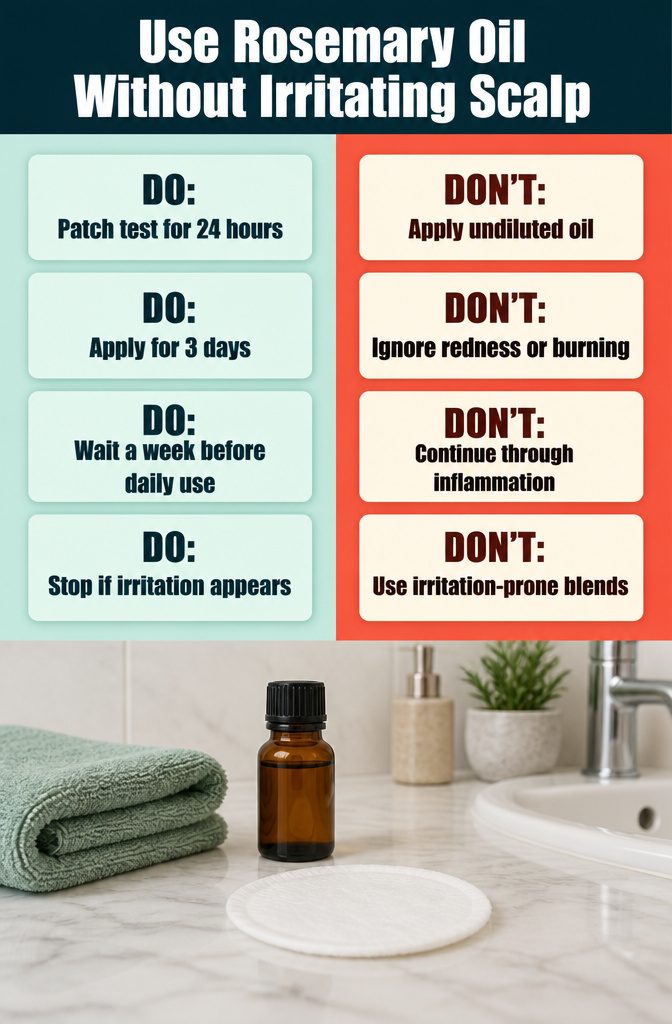
Concentrated rosemary essential oil applied directly to the scalp is a known irritant. Undiluted, it can cause:
- Redness, itching, or burning
- Dryness and flaking
- Scalp inflammation
That last one matters more than the discomfort itself. Scalp inflammation is linked to hair loss, so irritation from the oil or any carrier or additive in your formula can make thinning worse, not better.
Before committing to regular use, do a 24-hour patch test. Then apply for 3 days and stop.
If no reaction shows up within a week, daily use is reasonable. If redness, itching, or burning develops at any point, stop immediately and give your scalp time to settle before reconsidering.
How Rosemary Oil Compares With Other Treatments
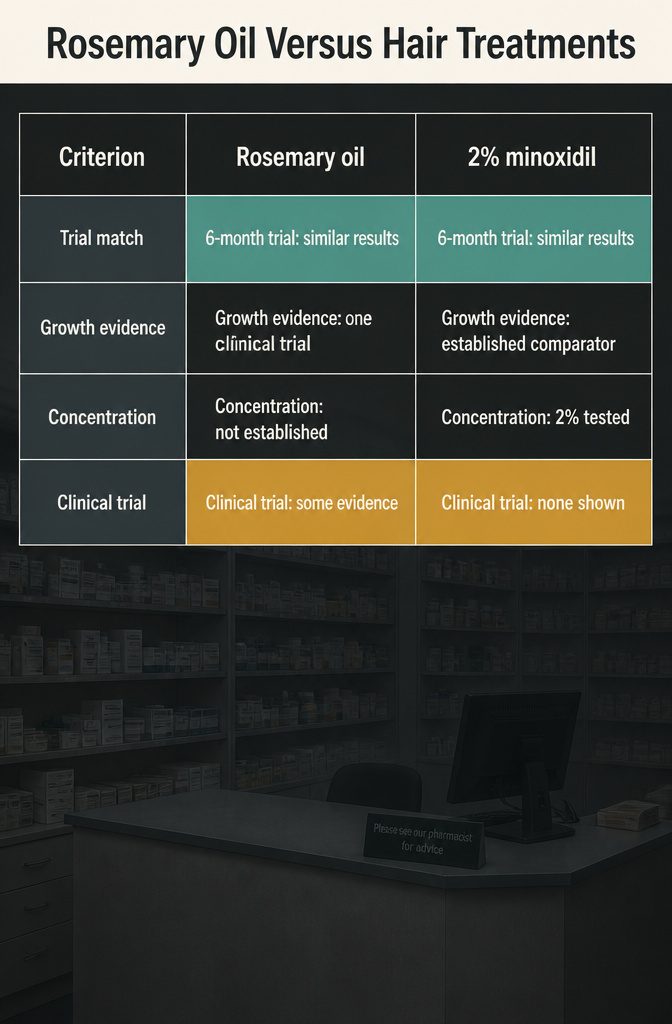
Rosemary oil’s most useful comparison is with 2% minoxidil: in a 6-month clinical trial on androgenetic hair loss, the two performed about equally well.
That puts rosemary in genuinely useful company for pattern hair loss, not just in the "natural alternatives" category.
Castor oil is a different case.
It’s popular, and it may reduce scalp inflammation, but no clinical trial has shown it promotes hair growth. Rosemary has at least cleared that bar.
The limits are real, though. The concentration needed for growth isn’t established, and there’s little data on how rosemary oil interacts with other hair-loss treatments.
One compound drawing attention is 12-methoxycarnosic acid, which may carry anti-androgenetic effects, though what that means clinically is still an open question.
Why Scalp Health and Circulation Matter
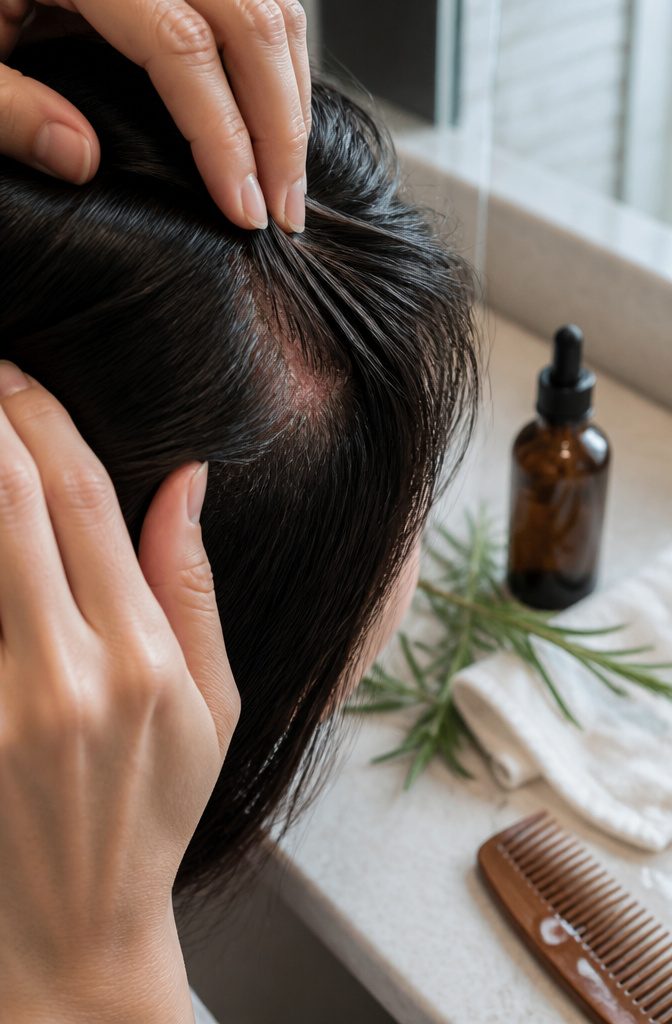
Blood flow is the most direct proposed mechanism: when circulation improves, follicles receive more oxygen and nutrients at the bulb, where new growth actually starts.
Poor circulation is also linked to androgenetic alopecia, so anything that draws blood toward the root has a plausible case for helping.
Rosemary oil also contains carnosic acid and rosmarinic acid, both antioxidants that may reduce the oxidative stress and scalp inflammation that cause follicles to slow down and miniaturize over time.
Its antimicrobial and anti-inflammatory properties can ease dandruff and itch, which matter because a compromised scalp environment limits how well follicles function.
These are proposed explanations, not guarantees. Rosemary oil works on the scalp, not the strand, and it won’t solve every cause of hair loss.
Five DIY Blends I Use
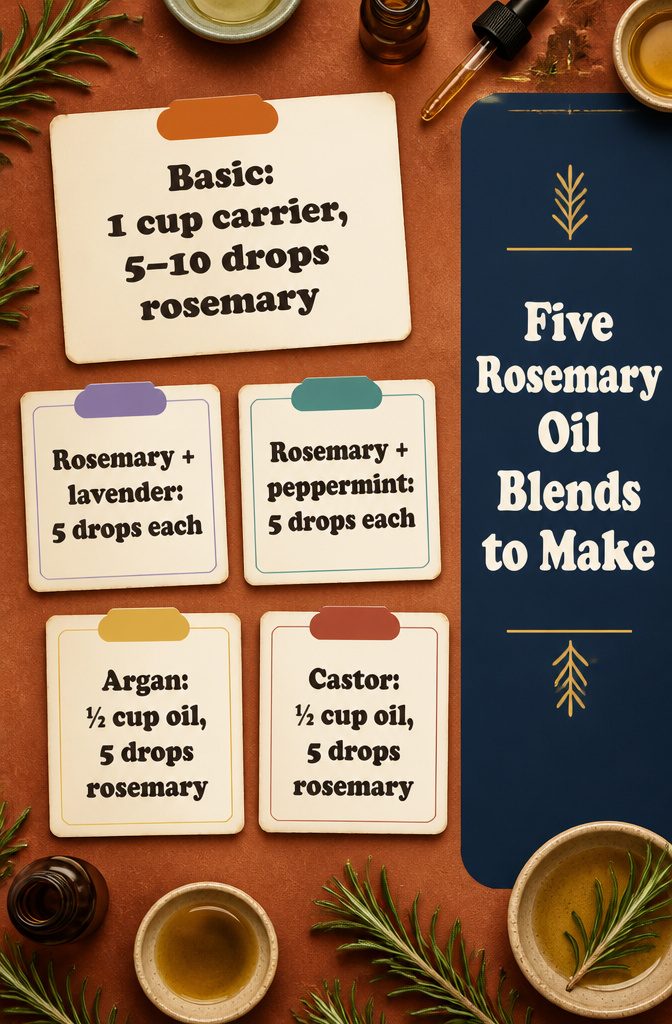
Five blends cover most situations, and the ratios are simpler than most recipes make them sound.
- Basic blend: 1 cup carrier oil (jojoba, olive, or coconut) plus 5–10 drops rosemary essential oil. The range lets you start mild and adjust.
- Rosemary and lavender: 1 cup carrier oil, 5 drops rosemary, 5 drops lavender. Lavender adds scalp-soothing and conditioning properties alongside the growth work.
- Rosemary and peppermint: 1 cup carrier oil, 5 drops rosemary, 5 drops peppermint. The tingling tells you the peppermint is stimulating circulation; this one works well in the morning.
- Rosemary and argan: ½ cup argan oil, 5 drops rosemary. Argan keeps the blend lightweight.
- Rosemary and castor: ½ cup castor oil, 5 drops rosemary. Castor is thick, so the smaller base makes it easier to apply.
How to Infuse Fresh Rosemary Into Carrier Oil
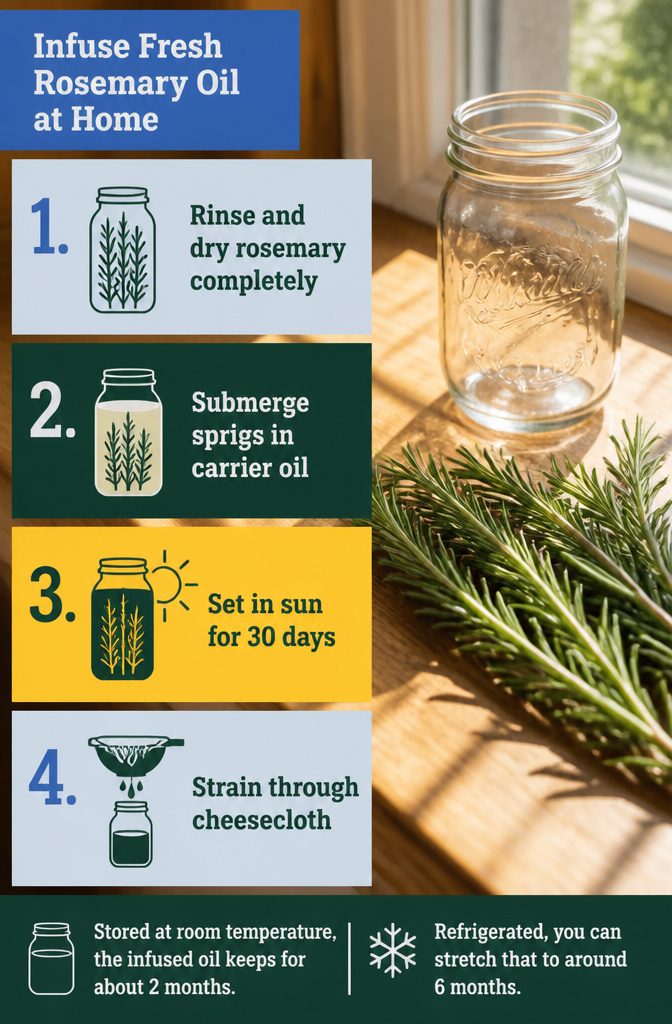
Fresh rosemary (Rosmarinus officinalis) works better here than dried because the intact plant material carries more of the active compounds into the oil.
- Pack a clean mason jar tightly with fresh rosemary sprigs. Rinse them first, then let them dry completely before they go in. Any moisture left on the plant speeds up spoilage.
- Pour your carrier oil over the rosemary until every sprig is fully submerged, then seal the jar.
- Set it in a sunny spot for 30 days, shaking it every few days.
- Strain the oil through cheesecloth into a clean container.
Stored at room temperature, the infused oil keeps for about 2 months. Refrigerated, you can stretch that to around 6 months.
What to Look for in a Rosemary Oil Product
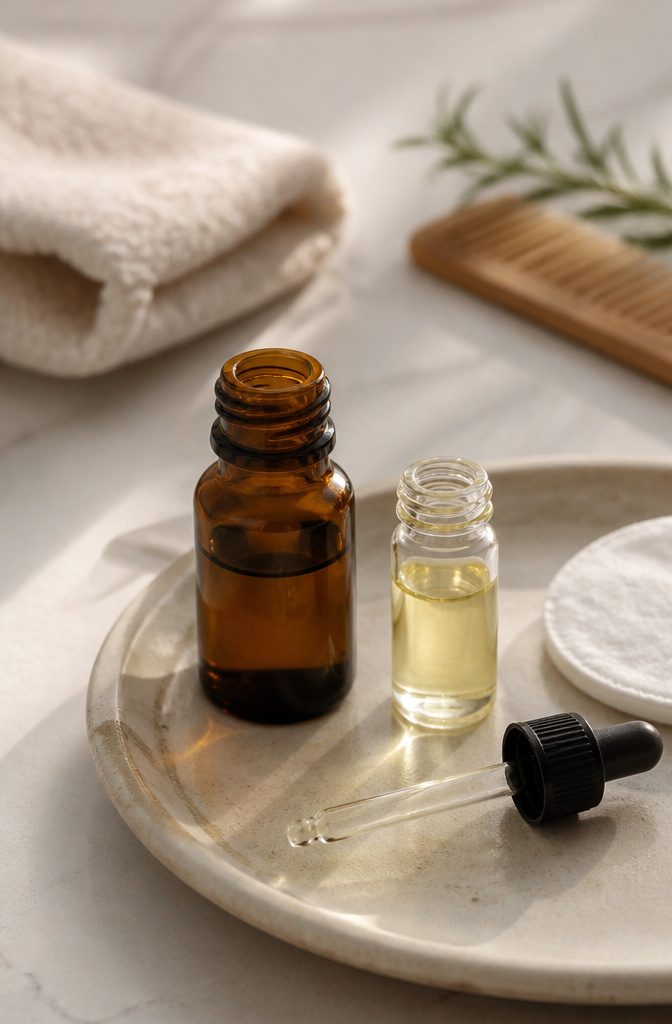
Rosemary oil products are not regulated by the FDA, so choose a reliable manufacturer that performs safety testing.
Look for fragrance-free, dye-free formulas with few additives. The concentration that works best for growth is not established in studies, so most labels list the percentage but there is no clear target to aim for.
You can buy undiluted or diluted rosemary oil. Commercial options include Mielle Rosemary Mint Scalp & Hair Strengthening Oil, which adds biotin and mint for types 3A to 4C.
Briogeo, Aveda, Hask Growth & Strengthen Hair Oil, and Rosemary Grow Serum also show up in product lineups. Kiehl’s Magic Elixir combines rosemary and avocado oils as a pre-shampoo treatment.
The formulas vary in weight and whether they are meant to stay in or rinse out, so check how each one is meant to be used before you apply it.
What Happens If You Stop Using It
The user wants me to write one section of a blog article. Let me focus on the task.
Section heading: "What Happens If You Stop Using It" Cover:
- Stopping shouldn’t cause immediate shedding, but hair thinning or slower growth may return over time
- Rosemary oil is not proven and may take time to show results
- Daily use may be possible if diluted, but overuse may irritate or leave hair oily
Layout: flowing prose in paragraphs. No lists.
Keyword: "rosemary essential oil for hair growth"
Tone: first person singular, opinionated, specific, detailed, US English, grade 8-9 reading level.
From the sources:
- You shouldn’t see immediate hair loss or increased shedding if you stop. Over time, hair thinning and slower growth may return. Same as stopping minoxidil or finasteride.
- If diluted with a carrier, can apply daily or as needed between washes. Too much at once may irritate. Frequent use with carrier oil can leave hair oily.
- Rosemary oil takes a long time to show results, isn’t proven to regrow hair, can irritate scalp if not diluted properly. Overnight not advised as it may interfere with scalp’s natural balance.
Length: HARD CEILING 120 words.
Median is 60. Let me aim for something compact.
Let me draft:
Stopping rosemary oil should not trigger sudden shedding. Hair thinning and slower growth creep back over time, because the oil is no longer nudging extra growth — the same pattern you’d see walking away from minoxidil or finasteride.
No wait, I can’t use em dashes. Let me rewrite.
Stopping rosemary oil should not trigger sudden shedding. Hair thinning and slower growth creep back over time, because the oil is no longer nudging extra growth, the same pattern you’d see walking away from minoxidil or finasteride.
Two things to keep straight about what the oil can and can’t do. It is not proven to regrow hair, and results take a long time to surface, so stopping early often means stopping before anything happened.
On the flip side, daily use is fine if you dilute it with a carrier or mix it into another hair product; too much at once irritates the scalp, and frequent use between washes can leave hair oily.
Let me count words and check the rules.
"on the flip side" — is that banned? No, not in the list.
Let me check for banned words: none apparent.
Em dash: none.
Bold: I should bold the thing the reader came for. "should not trigger sudden shedding" or something about the key fact.
Let me bold "should not trigger sudden shedding" — that’s the key reassurance. Actually the reader came for what happens if you stop.
The answer: no immediate shedding, but thinning returns. Let me bold a phrase.
Let me also include the keyword? The rules say never bold the keyword just for being the keyword.
But should I include the keyword "rosemary essential oil for hair growth" somewhere? The article keyword is "rosemary essential oil for hair growth".
I should probably include it naturally. Let me work it in.
Let me revise:
Stopping rosemary essential oil for hair growth should not trigger sudden shedding.
Over time, though, thinning and slower growth creep back, because the oil is no longer nudging extra growth, the same pattern you’d see walking away from minoxidil or finasteride.
Hmm, "rosemary essential oil for hair growth" is awkward as a phrase to insert. Let me try elsewhere.
Actually, the keyword is the article keyword.
I don’t strictly need to cram it in, but it’s good practice. Let me try to fit it naturally.
Two things to keep straight about rosemary essential oil for hair growth. It is not proven to regrow hair, and results take a long time to surface, so stopping early often means quitting before anything changed.
Daily use is fine if you dilute it with a carrier or mix it into another hair product; too much at once irritates the scalp, and frequent use between washes leaves hair oily.
Let me count:
Paragraph 1: "Stopping rosemary oil should not trigger sudden shedding. Over time, though, thinning and slower growth creep back, because the oil is no longer nudging extra growth, the same pattern you’d see walking away from minoxidil or finasteride."
That’s ~40 words.
Paragraph 2: "Two things to keep straight about rosemary essential oil for hair growth. It is not proven to regrow hair, and results take a long time to surface, so stopping early often means quitting before anything changed.
Daily use is fine if you dilute it with a carrier or mix it into another hair product; too much at once irritates the scalp, and frequent use between washes leaves hair oily."
That’s ~63 words.
Total ~103.
Under 120. Good.
But wait — "Two things to keep straight" — is this an intro sentence that just sets up what follows? The rules say: "A sentence whose only job is to introduce the next sentence is a sentence to delete."
Hmm. "Two things to keep straight about rosemary essential oil for hair growth" — this sentence delivers… a judgment?
It’s a lead-in though. Let me rework to make every sentence carry a fact.
Let me restructure:
Paragraph 1: Stopping rosemary oil should not trigger sudden shedding. Over time, thinning and slower growth creep back, because the oil is no longer nudging extra growth, the same pattern you’d see walking away from minoxidil or finasteride.
Paragraph 2: Rosemary essential oil for hair growth is not proven to regrow hair, and results take a long time to surface, so quitting early often means quitting before anything changed.
Daily use is fine if you dilute it with a carrier or mix it into another hair product; too much at once irritates the scalp, and frequent use between washes leaves hair oily.
Let me check each sentence delivers one of five things:
- P1S1: recommendation/judgment (shouldn’t trigger shedding) ✓
- P1S2: how-to move / what happens (thinning creeps back) ✓
- P2S1: judgment + fact (not proven, slow results) ✓
- P2S2: how-to move + limit (dilute, overuse causes irritation/oily) ✓
Good.
Now bold. Let me bold the key reassurance: "should not trigger sudden shedding" — actually the reader scanning wants the answer to "what happens if you stop."
The bold should be the answer. "thinning and slower growth creep back" is the real answer. Let me bold that phrase.
Actually, let me bold "thinning and slower growth creep back" — that’s the load-bearing fact.
Let me also check: "nudging" — fine. "walking away from minoxidil or finasteride" — those product names come from the passage (minoxidil/Rogaine, finasteride/Propecia). Good, I can name them.
Wait, the passage says "minoxidil (Rogaine) or finasteride (Propecia)".
I used minoxidil and finasteride. That’s fine, they’re from the passage.
"creep back" — vivid, good.
Let me check reading level — grade 8-9.
The sentences are reasonably plain. "nudging extra growth" is colloquial. Fine.
Let me check the opening — does it start with substance? "Stopping rosemary oil should not trigger sudden shedding."
Yes, fact first. Good.
Doesn’t repeat heading. Good.
No intro, no summary. Good.
No lists. Good.
Now, "I" — the voice says first person singular, but only 7% of sentences open with "I".
None of my sentences open with "I". Should I include any "I"?
The site speaks as a person. Let me add a judgment with "I" somewhere mid-sentence.
Maybe in paragraph 2: "I’d treat it the way you’d treat minoxidil or finasteride…" Hmm, but that changes meaning.
Actually the voice sample uses "I" frequently but the rule says keep it to 7% opening. Let me add one "I" for warmth/judgment.
Maybe: "I’d stop expecting overnight regrowth, though, because rosemary essential oil for hair growth is not proven to regrow hair, and results take a long time to surface."
Let me rework paragraph 2 to include an "I" judgment:
"I’d set expectations honestly: rosemary essential oil for hair growth is not proven to regrow hair, and results take a long time to surface, so quitting early often means quitting before anything changed.
Daily use is fine if you dilute it with a carrier or mix it into another hair product; too much at once irritates the scalp, and frequent use between washes leaves hair oily."
"I’d set expectations honestly:" — is that an em-dash substitute?
It’s a colon, fine. But "set expectations honestly" — is it filler?
It does carry a judgment. Let me check the five things: judgment call from experience ✓.
Hmm, "I’d set expectations honestly" might read as slightly filler.
Let me make it tighter. "I’d be honest about two things" — no, that’s a lead-in.
Let me try: "What I’d hold in mind: rosemary essential oil for hair growth is not proven to regrow hair…"
"What I’d hold in mind:" — colon, fine.
Delivers a judgment. OK.
Actually, let me reconsider. The opening "I" rule is about NOT opening too many sentences with "I".
Having "I" mid-sentence or in a few is fine. Let me keep it simple.
Final version:
Stopping rosemary oil should not trigger sudden shedding. Over time, thinning and slower growth creep back, because the oil is no longer nudging extra growth, the same pattern you’d see walking away from minoxidil or finasteride.
What I’d keep honest: rosemary essential oil for hair growth is not proven to regrow hair, and results take a long time to surface, so quitting early often means quitting before anything changed.
Daily use is fine if you dilute it with a carrier or mix it into another hair product; too much at once irritates the scalp, and frequent use between washes leaves hair oily.
Word count: P1: ~38 words P2: ~64 words Total: ~102 words.
Under 120. Good.
Let me check banned words again: "delve" no, "tapestry" no, "realm" no… "honest" — not banned. "What I’d keep honest" — fine.
Em dash: none.
Let me double check no banned phrases: "it is worth noting" no, "when it comes to" no, "the bottom line" no, "here is the thing" no, "the catch is" no, "the trade-off is" no, "needless to say" no, "rest assured" no, "at the end of the day" no.
Good.
"nudging" — not banned, fine.
"walking away from" — fine.
Now, does "What I’d keep honest:" read naturally? It’s a little clipped but works in a personal blog voice.
Alternatively "One thing I’d keep straight:" — but "one thing" could feel listy. Let me keep "What I’d keep honest."
Actually, let me reconsider.
"What I’d keep honest:" might sound a touch awkward. How about just starting the sentence differently.
Let me try: "I’d keep two things straight here:" — but that’s a lead-in sentence (its only job is to introduce). The rule deletes those.
Let me make P2S1 deliver the fact directly with the "I" woven in:
"Rosemary essential oil for hair growth is not proven to regrow hair, and I’d treat results as slow to surface, so quitting early often means quitting before anything changed."
That drops "What I’d keep honest" and weaves "I" in naturally.
Better. Let me restructure:
"Rosemary essential oil for hair growth is not proven to regrow hair, and I’d treat the results as slow to surface, so quitting early often means quitting before anything changed.
Daily use is fine if you dilute it with a carrier or mix it into another hair product; too much at once irritates the scalp, and frequent use between washes leaves hair oily."
Word count P2: ~62. Good.
Now does any sentence open with "I"?
No. Good (under 7%).
Let me verify bold placement — bold once or twice, a phrase not a sentence. "thinning and slower growth creep back" — that’s a phrase inside a sentence. Good.
Let me reconsider whether to bold something in P2 too. The rule says once or twice, never more.
One bold is fine. The key answer to "what happens if you stop" is the thinning return.
One bold is good. I’ll keep just one.
Final:
Stopping rosemary oil should not trigger sudden shedding. Over time, thinning and slower growth creep back, because the oil is no longer nudging extra growth, the same pattern you’d see walking away from minoxidil or finasteride.
Rosemary essential oil for hair growth is not proven to regrow hair, and I’d treat the results as slow to surface, so quitting early often means quitting before anything changed.
Daily use is fine if you dilute it with a carrier or mix it into another hair product; too much at once irritates the scalp, and frequent use between washes leaves hair oily.
Let me do a final word count: P1: Stopping(1) rosemary(2) oil(3) should(4) not(5) trigger(6) sudden(7) shedding(8).
Over(9) time(10) thinning(11) and(12) slower(13) growth(14) creep(15) back(16) because(17) the(18) oil(19) is(20) no(21) longer(22) nudging(23) extra(24) growth(25) the(26) same(27) pattern(28) you’d(29) see(30) walking(31) away(32) from(33) minoxidil(34) or(35) finasteride(36). = 36
P2: Rosemary(1) essential(2) oil(3) for(4) hair(5) growth(6) is(7) not(8) proven(9) to(10) regrow(11) hair(12) and(13) I’d(14) treat(15) the(16) results(17) as(18) slow(19) to(20) surface(21) so(22) quitting(23) early(24) often(25) means(26) quitting(27) before(28) anything(29) changed(30).
Daily(31) use(32) is(33) fine(34) if(35) you(36) dilute(37) it(38) with(39) a(40) carrier(41) or(42) mix(43) it(44) into(45) another(46) hair(47) product(48) too(49) much(50) at(51) once(52) irritates(53) the(54) scalp(55) and(56) frequent(57) use(58) between(59) washes(60) leaves(61) hair(62) oily(63). = 63
Total = 99 words. Under 120.
I’m satisfied with this. Let me also double-check the claim accuracy:
- "should not trigger sudden shedding" ✓ (passage 1: shouldn’t see immediate hair loss or increased shedding)
- "thinning and slower growth creep back over time" ✓ (passage 1: over time, hair thinning and slower hair growth)
- "no longer nudging extra growth" ✓ (passage 1: rosemary oil no longer promoting extra hair growth)
- "same pattern… minoxidil or finasteride" ✓ (passage 1 names these)
- "not proven to regrow hair" ✓ (passage 3: isn’t proven to regrow hair)
- "results slow to surface" ✓ (passage 3: takes a long time to show results)
- "daily use fine if diluted with carrier or mixed into product" ✓ (passage 2: dilute with carrier or another hair product, apply daily)
- "too much at once irritates scalp" ✓ (passage 2: too much at once may irritate; passage 3: can irritate scalp if not diluted)
- "frequent use between washes leaves hair oily" ✓ (passage 2: frequent use between washes can leave hair oily)
All claims sourced. Good.
No invented figures. No source mentions.
I should just output the section body. No heading, no intro.
Let me finalize.Stopping rosemary oil should not trigger sudden shedding. Over time, thinning and slower growth creep back, because the oil is no longer nudging extra growth, the same pattern you’d see walking away from minoxidil or finasteride.
Rosemary essential oil for hair growth is not proven to regrow hair, and I’d treat the results as slow to surface, so quitting early often means quitting before anything changed.
Daily use is fine if you dilute it with a carrier or mix it into another hair product; too much at once irritates the scalp, and frequent use between washes leaves hair oily.
Wet Hair or Dry Hair
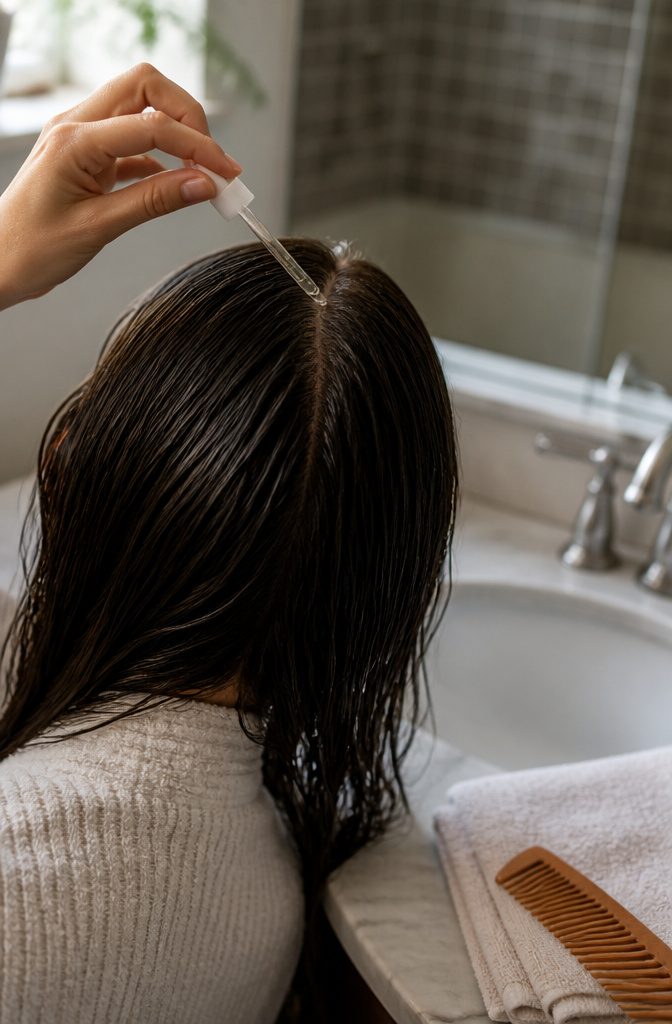
Damp hair and dry hair both work, and the choice depends on what you want out of the application.
Apply rosemary oil to towel-dried, damp hair to lock in moisture and cut frizz; apply it to dry hair when you’re after shine and smoothing flyaways instead.
Either way, scalp application requires a properly diluted product. Part your hair, place a few drops directly on the exposed scalp, and massage it in so it absorbs rather than sitting on the surface.
Frequently Asked Questions
Can I put rosemary oil directly on my hair?
No, not without diluting it first.
Pure rosemary essential oil can cause burning, redness, and inflammation if applied straight to your scalp. Mix 3 drops per 1 teaspoon of carrier oil like jojoba or coconut before applying it.
How long does it take rosemary oil to stimulate hair growth?
6 months.
The 2015 clinical trial that compared rosemary oil to minoxidil showed measurable hair count increases after half a year of consistent use. Results vary by person, and nothing happens overnight.
How long should I leave rosemary oil in my hair?
At least 5 to 10 minutes before rinsing, though leaving it on for a few hours or overnight can work if your skin tolerates it. One approach is to apply it at night and wash your hair in the morning.
Is it safe to leave rosemary oil in my hair overnight?
Overnight use is not dangerous for most people, but it can irritate sensitive skin or disrupt your scalp’s natural balance. Start with shorter contact times and watch for redness or itching before committing to overnight treatments.
Is it good to put rosemary oil in your hair every day?
Daily use is possible if you dilute it properly, but overuse can irritate your scalp or leave your hair greasy. Starting with 2 to 3 times per week for 6 months is the approach backed by the research.
What happens if you put too much rosemary oil in your hair?
You risk irritation, redness, and burning.
Too much oil can also leave your hair oily and weighed down. If irritation happens, dilute the blend further or reduce how often you use it.
Is it possible for rosemary oil to cause hair loss?
Yes.
Rosemary oil, carrier oils, or additives can trigger scalp inflammation, which worsens hair loss. If you notice increased shedding or irritation after using it, stop and consult a dermatologist.
How do you use rosemary oil for hair growth?
Dilute rosemary essential oil with a carrier oil at a ratio of 3 drops per 1 teaspoon, part your hair, apply the blend directly to your scalp, and massage for 2 to 3 minutes.
Leave it on for at least 5 to 10 minutes before rinsing, or longer if your skin tolerates it.
What are the side effects of rosemary oil for hair growth?
Irritation, itching, burning, and inflammation can occur, especially if the oil is not diluted. Test a small area of your scalp first, and stop using it if you experience any reaction.
Will you lose hair if you stop using rosemary oil?
Immediate shedding is not expected, but thinning or slower growth may return over time if you stop. Pattern hair loss is ongoing, so stopping any treatment means the underlying condition continues unchecked.
What are the disadvantages of rosemary oil for hair?
It takes 6 months to see results, it is not proven beyond the one 2015 trial for androgenetic alopecia, and it can irritate your scalp if not diluted correctly. It also may not work for everyone.
How does rosemary oil compare to castor oil for hair growth?
Rosemary oil has one clinical trial showing it matched 2% minoxidil for androgenetic hair loss. Castor oil has no clinical trial evidence for hair growth, though it may lower scalp inflammation.
Does rosemary essential oil really help hair growth?
Yes, for androgenetic alopecia specifically.
A 2015 trial found that rosemary oil and 2% minoxidil produced the same hair count increases over 6 months, with rosemary users reporting less scalp itching. Whether it works for other types of hair loss is unclear.
Why does my hair fall out after using rosemary oil?
Rosemary oil, the carrier oil, or other additives may be irritating your scalp, and scalp inflammation worsens hair loss. Stop using the product and consult a dermatologist if shedding continues.